My Blog List

Monday, 15 November 2021

A grand day out


It seems ages since I last went for a wander up the coast, something I used to do very regularly at this time of year before the pandemic.
  I started at Boulmer and walked north from the village along the beach as the tide was coming in.  The weather was sunny and calm with a flat calm sea.  It is a great place to see waders and here are some of those I came across.

First bar-tailed godwits.  These have been in the news in the past week after one was tracked flying 8108 miles non-stop from Alaska to Australia in 239 hours (almost 10 days) at an average speed of 34mph.  The bird was heading for New Zealand but had to divert over 1000 miles to Australia after encountering headwinds, which makes me wonder how it knew Australia was there.  The godwits I saw are winter visitors from Siberia.


I saw and heard lots of redshanks who know just how deep they can go without getting their feathers wet.


These two spent several minutes fighting but it was difficult to see what it was all about as there was plenty of space for both of them.


Other waders were ringed plovers,

knots,

sanderlings,

dunlins (not a great photo but in for completeness),

turnstones,

and purple sandpipers.


The curlews stayed on the shore as long as possible but were eventually driven into nearby fields by the rising tide.


This is an oystercatcher with a knot and a godwit.

Ducks on the sea were eiders,

wigeons,

and mallards.

One very surprising sighting (to me at least) was little grebe fishing in the sea.  Other birds on the shore or close by included grey herons, carrion crows, rock pipits, pied wagtails, wrens, robins, linnets and house sparrows, some of which I may go back to photograph another time.  Oh, and plenty of seagulls!

Wednesday, 10 November 2021

Interlopers in the moth trap

Not everything that arrives in the moth trap is a moth.  These are a few of the other insects I have found over the last few months.

My favourites were the ichneumons which I saw on several occasions.  These are solitary wasps which are parasitoids of other insect larvae, often moth larvae.  There are 2500 UK species and they are notoriously difficult to identify.  The Natural History Museum's Beginner's guide to identifying British ichneumonids helpfully shows the ten commonest nocturnal orange-bodied species but I am not sure which these are.  They are all from different nights.


Wasps were common in late summer and were of more than one species - at least both common wasp (Vespula vulgaris) and German wasp (Vespula germanica).  They were generally very lethargic in the early morning and I was stung only once, when I picked up an egg box without knowing there was a wasp on the other side..


Crane flies were also fairly common visitors but often escaped before being photographed.

The only butterfly was a peacock.

The only bee was a honey bee.  I can't locate the photo but you know what a honey bee looks like.

There was one shield bug.  I think it may be a birch shield bug, Elasmostethus interstinctus.

Other insects known to visit moth traps include caddis flies, lacewings, hornets, beetles and dragonflies but I didn't see any of these.  The most surprising moth-trapping by-catch I have heard of was a puffin!  

Friday, 5 November 2021

Gizzard stones

Another surprise.  I found an old pellet on the roof, trapped in a hydrangea branch that had grown over the tiles.  I assumed it had been regurgitated by a tawny owl sitting on a branch of the oak tree above.  The pellet was hard and about 40mm by 10mm.


I could see a claw and what looked like a small stone and a piece of insect wing case but not much else.

A tawny owl pellet is mostly made of fur and will break apart easily to reveal the bones inside - usually the bones and skulls of three or four small mammals.  This one was tough so I soaked it in water.  It was still difficult to tease apart because it was made of decomposed feathers rather than fur.  And the largest bones it contained were the legs and feet of a bird.

So now I think the pellet is not from a tawny owl at all.  The bones were all broken - an owl swallows its prey whole. There were quite a few other bone fragments but no skull or other parts that I could recognise.  My best guess is that the pellet is from a sparrowhawk.  I am a bit puzzled by what look like a few strands of grass, best seen in the top photos.  They were much less obvious in the grey mush once the pellet had been teased apart in water.  I can understand how a bit of grass might be swallowed during eating but I would have expected it to be digested easily. Here are the pellet contents, minus the feathers.  You can see the claws, two lines of bone fragments, skin strips, stones and a few small bits of insect wing case as well.

The several small torn fragments of skin look like bird skin.

The most intriguing finding was these four small stones, about 5-10mm in diameter.

Birds can't chew and they mash up their food in a muscular stomach, the gizzard.  Many birds swallow small stones to help this process, stones known as gizzard stones or gastroliths.

Plant-eating dinosaurs used gastroliths as well.  Their stones were much larger and stayed inside for years, becoming smooth and rounded like pebbles on a beach.  I found this photo of Jurassic gastroliths on Wikipedia.

Sunday, 31 October 2021

Pop goes the weasel


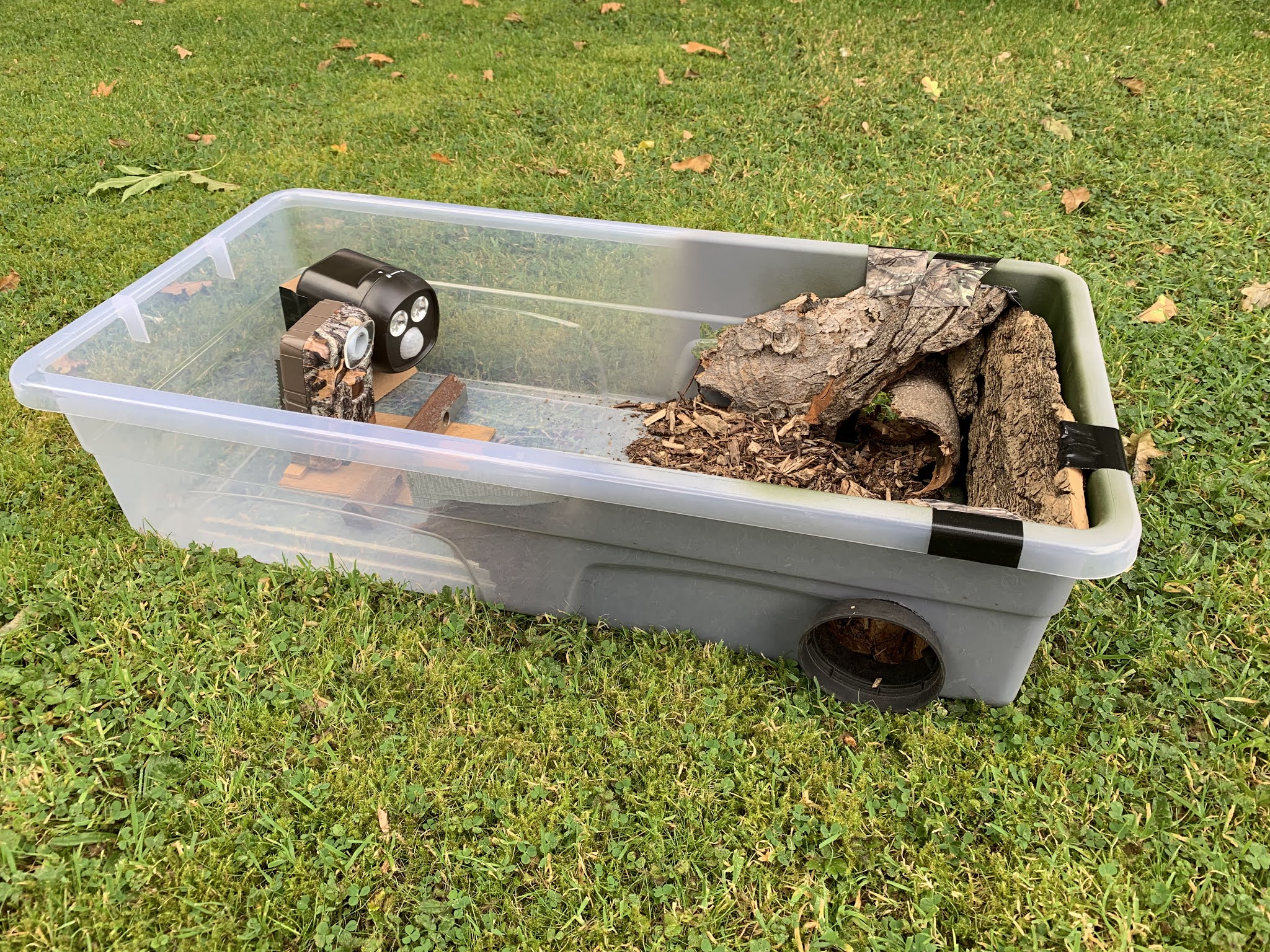
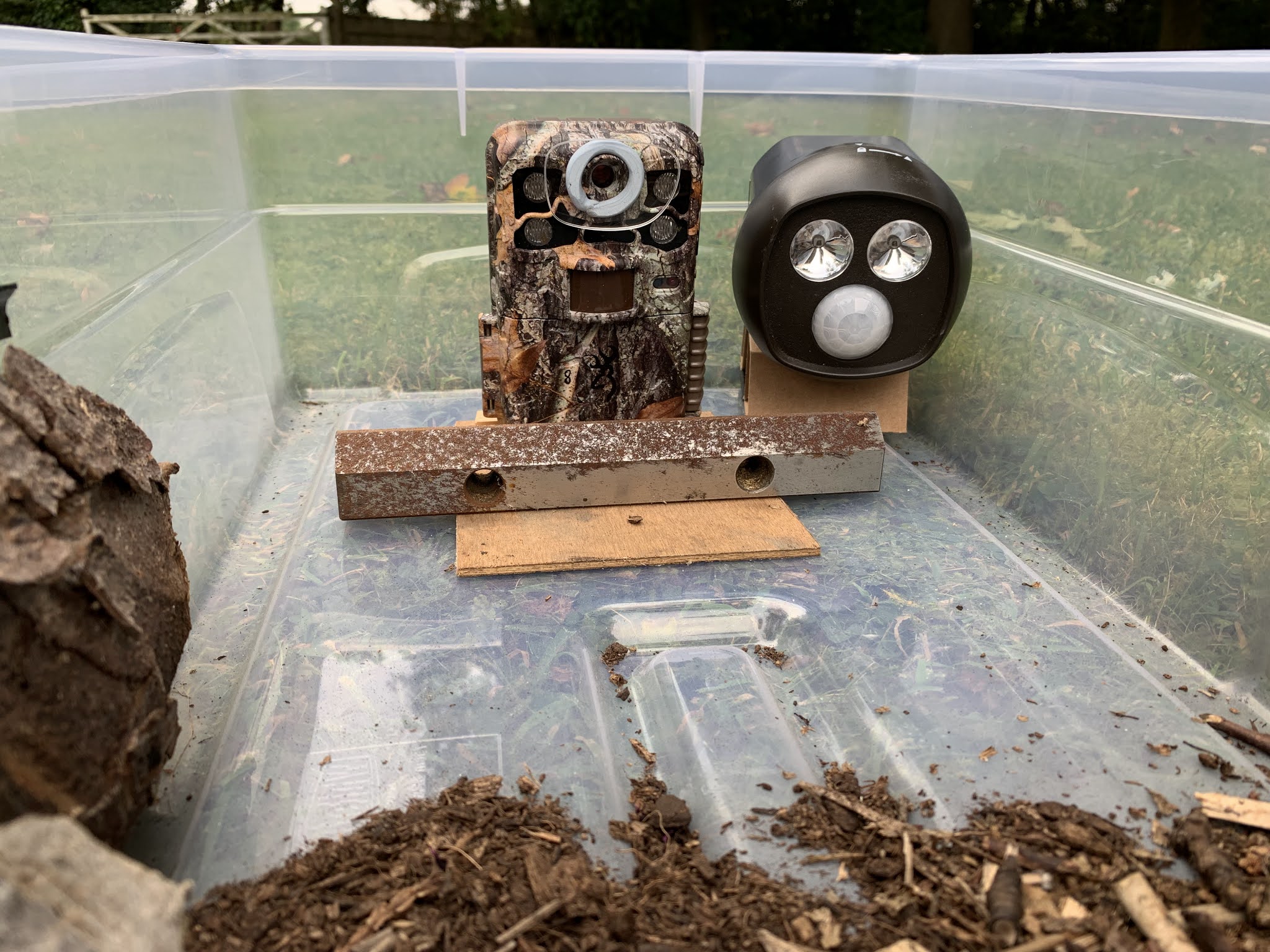
Ever since the weasel turned up in the garden in the summer I have been trying to get another picture.  Inspired by the Mostela*, a trail camera box used for monitoring stoat and weasel populations, I built one similar from a translucent plastic storage box (£7 from Dunelm).  There are two holes at one end and a trail camera at the other.  The Mostela was designed by Jeroen Mos, an ecologist and small mustelid researcher in The Netherlands, and is an enclosed box with a cutaway plastic pipe connecting the two entrance holes.  Wanting better pictures in a more natural setting, I made mine to admit natural light and built a small "stage set" of bark and loose bark chippings at one end.  The trail camera has a +2 dioptre lens to cope with the close focus.  It can record in colour in daylight but reverts to infrared when the light is poor or at night and it is then augmented by a motion-activated battery-powered infrared security light (a Brlnno APL200).  This is a view of the box with the lid removed.


Here are the camera and the infrared light.

This is the "stage set".

Here is the box in the garden with two Victorian land drain pipes as access tunnels.

Like other small mustelids, weasels are very inquisitive animals and will investigate any small hole which might contain prey.  For the first few days I baited the camera box with sunflower seeds so that it would smell of voles and mice but recently it has been left as it is (although mice and voles still visit every day).  I had the camera box set in my garden and the local nature reserve for four weeks before a weasel eventually made a brief appearance this week.  In fact it was very brief so I have added a 25% slow motion replay to the video.


Several other animals are much more regular visitors.  They include wood mice, always at night and so in black and white.  Wood mice visit every night and spend a lot of time in the box.  There is no food for them but perhaps it is warm and dry and feels safe.


Bank voles more often appear in daylight.  It is a pity the weasel didn't stay this long.


Common shrews also mostly turn up in daylight.  This clip also has a 25% speed replay.


Pygmy shrews appear both in daytime and after dark.


And a couple of very unexpected visitors.  Both birds were in the box for over two minutes and got rather agitated when they couldn't find the way out.


I plan to leave my weasel box set in the hope of more recordings and, perhaps, one day even a visit from a stoat.

* Mos J, Hofmeester TG.  The Mostela: an adjusted camera trapping device as a promising non-invasive tool to study and monitor small mustelids.  Mamm Res. 65, 843-853 (2020). https://doi.org/10.1007/s13364-020-00513-y

Tuesday, 26 October 2021

Even more moths

Since my last post on moths in the garden I have been setting the trap every week or two and each time I find moths I haven't seen before - apart from the latest time when the only thing in the trap was a crane fly.  The species count is now over 100 although there are also several mid-sized greyish-brown jobs I am not sure about.  The rest of them have been spectacular so here are few of the recent beauties I can identify fairly confidently.

Blood-vein,

Canary-shouldered Thorn,

and Centre-barred Sallow.

I joined the North East Garden Moth Scheme meeting in Gosforth Nature Reserve one evening and saw these three - Herald,

Devon Carpet, apparently a first record for the county,

and Small Phoenix.

Back in my garden - Pebble Hook-tip,

Silver Y,

Mother of Pearl (a micro-moth, but rather a large one),

Copper Underwing,

Dusky Thorn,

Shuffle-shaped Dart,

Angle Shades,

Rosy Rustic,

and Red-green Carpet.

The last is the second largest moth I have seen - a Red Underwing.


That's it until next year.  I look forward to next spring to see what will turn up then.