My Blog List

Showing posts with label Common shrew. Show all posts

Thursday, 15 October 2026

Garden visitors


Wow this was a surprise.  I have been here 37 years and this is the first time I have "seen" a badger in the garden.  I didn't see it of course but it showed up on the camera by the "weasel wall" in the garden.  It recorded only three videos but was here for at least an hour so I expect it had a good look around.  In the video it was eating something but we can't see what.


I still haven't worked out how it got in and out.  There is a 600mm (2 foot) rabbit fence all the way round and I can't see a hole in or under the fence so the badger must have climbed over.  
I am hoping it will return and I'm working on a squirrel-proof peanut feeder to try to tempt it back.

The next morning the camera saw three pheasants, a cock and two hens.  Nine years ago I had a pheasant who regularly came to the door to be fed but there has been only one sighting since, until now.


The next photo is from July but hasn't featured here before.  The fox has obviously spotted the camera.

The camera in the camera box by the gate sees wood mice, bank voles, common shrews and pygmy shrews all the time but last week there was a very curious tri-coloured common shrew which I presume is just a colour variant.


And just earlier this week, a tawny owl showed twice on the weasel wall camera.  The second time it caught a mouse - it's a pity that the mouse didn't trigger the camera before the owl struck but it's still good to see.


There have been very few weasel or stoat sightings in recent weeks so it is good to see something other than American grey squirrels on the cameras.  All these are things I would have missed if it wasn't for the trail cameras.  It's amazing what goes on in the garden when my back is turned.

Sunday, 28 December 2025

End of year favourites - Shrews

My trail cameras have captured all four species of British mainland shrews this year.  And my shrew of the year is the Greater White-toothed Shrew.


Until very recently we had only three species, Common Shrew, Pygmy Shrew and Water Shrew. Then four years ago the Greater White-toothed Shrew was found not far from here in County Durham.  It was previously known in mainland Europe and some of the Channel Islands but how it arrived here is a mystery.  I set up a camera in Elemore Park and soon had footage of this rare colonist.  You can read the full story here.


The largest of our native shrews is the Water Shrew.  As its name suggests, it is mostly found near water and there is a healthy population in Gosforth Nature Reserve, only a mile from here. There needs to be too as the local herons have taken a liking to them.  One of my cameras recorded a heron (or herons) catching and eating nine shrews in six days in one camera position.


All three native species are found in my garden and turn up in my weasel camera box.  Common Shrews and Pygmy Shrews are both regulars and the Water Shrew which was so active here last autumn made a guest appearance at the beginning of this year, with all three shrew species turning up on the same night.


One camera has been back in County Durham since the beginning of this month so I hope to have more shrew videos soon.

Monday, 4 August 2025

The Greater White-toothed Shrew


Well here is something new.  A new mammal, not only to my trail cameras but to the UK.  This is the Greater White-toothed Shrew (Crocidura russula), first discovered in this country only four years ago.  It came to notice when a photo of a shrew brought in by a cat in Sunderland was posted on Facebook (as you do) and was noticed by local mammalogist and ecologist Ian Bond. It looked different from any of our native shrews and was subsequently confirmed to be a new British species.  How it got here is not established but looking back at earlier photos of dead shrews(!) it has probably been present at least since 2015.

You can't see the white teeth unless you have a live-trapped or dead individual but the Greater White-toothed Shrew can be identified by being medium-sized for a shrew, having grey fur, large protruding ears, white hairs on its tail and a distinctive nose profile described as looking like a Womble or a Clanger (if you are young enough to remember those).  The zoomed-in screen grabs from video freeze-frames aren't the best quality but this is the nose shape and large ears,

and here you can make out the white tail hairs.

All these are clearer on the video.  These few clips are all I have so far and because we are looking at shrews they are fairly brief.


The camera box was placed in a scruffy area close to a hedgerow in Elemore Park, only a mile or so from Easington Lane where the original Greater White-toothed Shrew was first recorded. Although it is within Sunderland metropolitan borough it is closer to Durham.  A few interesting observations about the recordings: all were in daylight and 
Greater White-toothed Shrews are known to be mainly diurnal in habit; there were a few Common Shrew recordings but no Pygmy Shrews, a few Field Voles but no Bank Voles; and no Wood Mice, which is a surprise.  I had enough videos of Common and 
Greater White-toothed Shrews to make this short slow-motion comparison video.


The 
Greater White-toothed Shrew is a resident of much of Western Europe and some of the Channel Islands.  It was discovered in Ireland in 2007 and is causing concern there because as it spread it has completely displaced the native Pygmy Shrew.  The small mammal ecology of Ireland is different from ours as there is only one native shrew, one mouse (Wood Mouse) and one vole (Bank Vole, accidentally introduced in the 1920s).  The 
Greater White-toothed Shrew lives at much higher densities than the Pygmy Shrew and probably out-competes it by eating all the food.  Since its discovery here a monitoring programme has been put in place by the Mammal Society, mainly involving barn owl pellet dissection, to monitor the spread of the Greater White-toothed Shrew and its effect, if any, on the Pygmy Shrew - the small mammal ecology of Great Britain is different from Ireland as we have a wider range of small mammals and predators. In Ireland this is classed as an invasive species but although there is now evidence that the Greater White-toothed Shrew is spreading across County Durham the effect on Pygmy Shrews is unknown so here it is a non-native species. 
  Genetic analysis suggests the Sunderland shrew came from France and not from Ireland.

Our three native shrew species, Common Shrew (Sorex araneus), Pygmy Shrew (Sorex minutus) and Water Shrew (Neomys fodiens), all have red-tipped teeth whose enamel is strengthened with iron.  As a reminder, here is what they look like.  The Common Shrew is chunky in build, has only a medium length tail and is tricoloured on the sides, dark, medium and light.  The Pygmy Shrew is very small and slim with a long furry tail.  The Water Shrew is large and is black and white.


I am grateful to Anthony Hindmarch, the 
Elemore Park manager, for the opportunity to site my camera - we were primarily looking for weasels and voles so at least we found a field vole.  I hope to see more Greater White-toothed Shrew videos when I next check the camera and I'll post an update here.

Sunday, 12 January 2025

ShrewCam

It seems that shrews are like London buses - you wait ages for one and then three come along all at once.  WeaselCam is mainly seeing wood mice at the moment but a few nights ago there were three shrews.  First a pygmy shrew, which has been appearing from time to time, then a common shrew, which hasn't been common recently, and last a water shrew, the first I have seen since September.


This has happened twice before.  In
2020 I set a camera hoping to find a water vole up near Wark Forest and found three shrew species in one night.  And a few weeks ago I saw three within an hour near Riding Mill.  I don't know if these episodes have just been coincidence or whether the shrews could be following each other around or interacting in some way.  Either way it seems odd.  I posted the video on the Mammal Society Facebook page asking the same question but didn't get a reply, just lots of "likes".  If you have any thoughts please leave a comment.

Monday, 30 December 2024

End of year favourites - Shrews

WeaselCam has been on tour a few times this year but has failed to record a weasel away from here.  It has, however, been good at recording other small mammals.  While in Williwood, the home of Denise & Phil, the box was visited by three species of shrew within an hour, providing an opportunity to compare their shape, body size and tail length.  From the top they are common shrew, pygmy shrew and water shrew.

Here's the video.

And here are the three individual species - common shrew,

pygmy shrew,

and water shrew.

Monday, 21 October 2024

SardineCam 2

Two of my cameras have been on tour again, this time to Denise and Phil near Riding Mill in South Northumberland.  As before, one camera was set up with a sardine scent lure and the other was in a camera box.  SardineCam was set in woodland edge for the first week and within woodland the second week.  It recorded 1061 videos in all, most of which were of wood mice.  As last time, the mice were fascinated by the sardine smell.  A domestic cat also came by to sniff but the highlight was a roe doe.


Passers-by taking no interest in the sardines were fox, American grey squirrel, robin, blackbird, song thrush and wood pigeon.

The camera box was set at woodland edge in the first week and recorded 546 videos, almost all of wood mice.  In the second week I put it in a rough grass field, still not far from woodland. This time there were only 163 videos and almost all were of shrews - common shrew, pygmy shrew and, most excitingly of all, a water shrew.  There is a small garden pond nearby but the nearest large pond is 160m away across a railway line.  Here are the three shrews in frame grabs from the video to compare their size, body shape and tail length, common shrew above, pygmy shrew middle and water shrew below.

And here is the video.


It was fascinating to find another water shrew away from water, so soon after the one in my garden.  Here is a montage of more water shrew action, all high speed.


If anything the common shrew is even more frantic.  It was interesting to see it collecting the sunflower seeds I had put in.  Shrews are insectivores but water shrews and common shrews both take sunflower seeds in my garden.


The smallest of the three, the pygmy shrew, seems a bit less hyperactive.


We did get a glimpse of a vole but it was very shy and didn't venture past the entrance pipe.  I can't tell what it is with any confidence but from its size I suspect it is a field vole rather than a bank vole.

So no mustelids, which we were hoping for, and no wood mice in the field, but it was great to see all the shrews.  And it is fascinating that moving the camera 50m from woodland to grass completely changes the clientele.  I am not sure it will be worth persevering with the sardine lure but the camera box seems by far the best way to see small mammals.

Friday, 4 October 2024

SardineCam

A couple of my trail cameras have been on tour - to my friends Gill and Martyn in deepest darkest Hexhamshire.  I took a new camera box for one camera and set up the second with a sardine lure as a new experiment.  Sardines are used by researchers to increase detection of carnivores so I wondered if it would work here.  Hexhamshire is home to polecats (Mustela putorius), one if the UK's most elusive mammals, so one aim was to see if we could catch one on camera.  The more realistic aim was to see what we would find.

The cameras were set for three weeks and at the end of that time both SD cards were full.  The sardine camera had 398 videos and the box camera 498 so I had plenty to look through.  The sardine camera was set up at the edge of woodland with the camera and the sardine can fixed to opposite ends of a piece of wood.  The can was secured with a cable tie.

SardineCam recorded 11 species but only four of those were interested in the sardine lure - the others were just passing by.  The four were badger, wood mouse, magpie and domestic cat.  The badger visited only once but tried hard to get into the can.  The camera gave a great close up of its teeth and claws (with a spider in the top left of the lens).


The magpie visited twice and the first time it managed to peck a few fragments of fish, even though the can was only slightly open (the can is now very visible after badger removed all my camouflage).


The wood mouse visited many times, obviously attracted by the smell but not trying to get at the can.  The cat just sniffed a few times and walked on.

Most of the 398 videos were of American grey squirrels.  Other passers by were blackbird, robin, wood pigeon, pheasant, roe deer, and red fox.

My new camera box was set up at the base of a stone wall.

It had large entrance pipes hoping to entice in slightly larger animals but in the end the only visitors were wood mice, bank voles, common shrews and pygmy shrews.  Here is a brief summary of 498 videos (most of which featured a wood mouse!).


It was very interesting to try out the cameras in a new environment.  The card in the  camera box was full in only nine days so another time I would need a bigger card.  I was hoping we might see a stoat or a weasel and I still have polecat on my wish list.

Friday, 28 October 2022

SmallMammalCam

This is National Mammal Week so it is a good time to show a few mammal pictures.  When I wrote about the small mammal camera box a few weeks ago it was about 5m inside the small copse in my garden.  The camera was seeing bank voles, wood mice and shrews every day/night.  After that I moved it about 10m, so it was now 5m into the meadow.  The clientele changed immediately and the wood mice stopped coming.  The bank voles and shrews still turned up regularly but the new arrival was a field vole.  The noise on the video is rain on the roof of the box.


The next video shows the difference between a bank vole and a field vole.  The latter is larger, greyer, has a shorter tail and has flatter, furrier ears.


Bank voles usually visit the box one at a time.  If there is more than one it can lead to a bit of conflict.


The other regular visitor was a common shrew.  It is hyperactive compared with the voles - the video is at normal speed.


I then moved the box back to the edge of the meadow and the copse and the wood mice immediately reappeared.  Being mainly nocturnal they show up in infrared recordings.

I was surprised that the mice don't want to venture even 5m into the meadow, and that the field voles won't go 5m into the wood.  The bank voles and shrews are happy wherever the box is.

The main reason for having the small mammal camera box is to try to film a weasel but so far no joy.  I have seen the weasel this week near the gate so I have moved the box over there and fitted larger entrance pipes in the hope that might entice it in.  We'll see.

Friday, 7 October 2022

Cohabitation

I noticed a hole in the ground at the edge of my meadow and set a trail camera to see what was in it.  I reckoned whoever was down there could be tempted into view with a few sunflower hearts.  The result was a surprise as there were three different species sharing the hole, presumably with separate living accommodation underground.

I guessed there would be a vole as the hole was connected to tunnelled runs through the grass. Most often the camera shows a bank vole, usually dashing out and back in but sometimes disappearing down the run.


Bank voles move fast, hoping that there isn't a kestrel or a weasel watching.  This was on a different camera with a bit of a green colour cast.


Next to show was a common shrew.  Despite being insectivores, shrews are also keen on sunflower hearts.


And then a field vole.  Not so easy to tell at first because it usually shows up at night, but it is larger than a bank vole with a shorter tail and larger flatter ears.


Here are the three of them at night, plus a less welcome visitor.


The camera usually records the animals one at a time but one day there were several confrontations between a vole (probably the field vole) and a shrew.  Several times the vole blocked the entrance and once it chased the shrew - I have added a couple of slow motion replays because the action is so fast.  The last clip shows the shrew eventually gets in when the vole (probably a bank vole this time) turns its back.


I think this type of cohabitation is not unusual.  A few years ago I put a camera on the entrance to a pile of stone in the copse and recorded bank vole, common shrew, wood mouse and water shrew all using the same entrance.

Monday, 5 September 2022

SmallMammalCam

This blog has been taken over by insects in the last few weeks so it is high time we had some trail camera images.  My small mammal trail camera box, modelled on a Mostela, has been set in the garden for over a month, hoping to catch a glimpse of a weasel or a stoat.  So far there has been no sign but smaller animals are daily visitors.  I put in a few sunflower hearts from time to time so the box will smell of mice and voles which may, in turn, tempt a curious weasel.

The most frequent visitors, especially in daytime, are bank voles.  They vary in size as some are not full grown.  The video shows a full size vole stuffing its cheeks with seeds before taking them off to eat in peace or to hide for later.


Wood mice are mainly nocturnal and so far have only shown up at night, so in black and white on the video via infrared.  They usually turn up long after the voles have taken all the food.


Common shrews are insectivores but they are surprisingly keen on sunflower hearts, something I have seen before.


Smallest of all are pygmy shrews.  Weighing only 5g or so they are slimmer than common shrews with a proportionately longer tail and with two-tone colouring rather than the three-tone of common shrews.


The last video puts them all together to compare their sizes.

Thursday, 16 June 2022

News from WaterShrewCam

The water shrew appears on the trail camera every day, often just a glimpse as it dashes to and fro.


This short clip shows how frenetic its life is.

The recent lack of rain means there is no water flow so there is a film on the water and the shrew ends up looking a bit scruffy.  It has no difficulty in finding things to eat right at the water's edge. At the end of the next video the shrew has caught a spider and seems to be biting it without eating it - perhaps to disable it with a venomous bite to save it for later.

The last video shows a visit from a cousin -  a common shrew (Sorex araneus).  It has a good look round but, unlike the recent wood mouse, it does not appear to steal from the larder, perhaps because there was nothing left.  The video gives the opportunity to compare the two shrews.  The common shrew is smaller and slimmer with pointier nose and a proportionately shorter tail.  In infrared light it just looks paler but in daylight it would have tri-colour brown/cream colouration compared with the water shrew's black and white.  Notice a water scorpion (Nepa cinerea) in the water as the shrew passes.  It was lucky this was a common shrew and not the water shrew.


Sunday, 31 October 2021

Pop goes the weasel


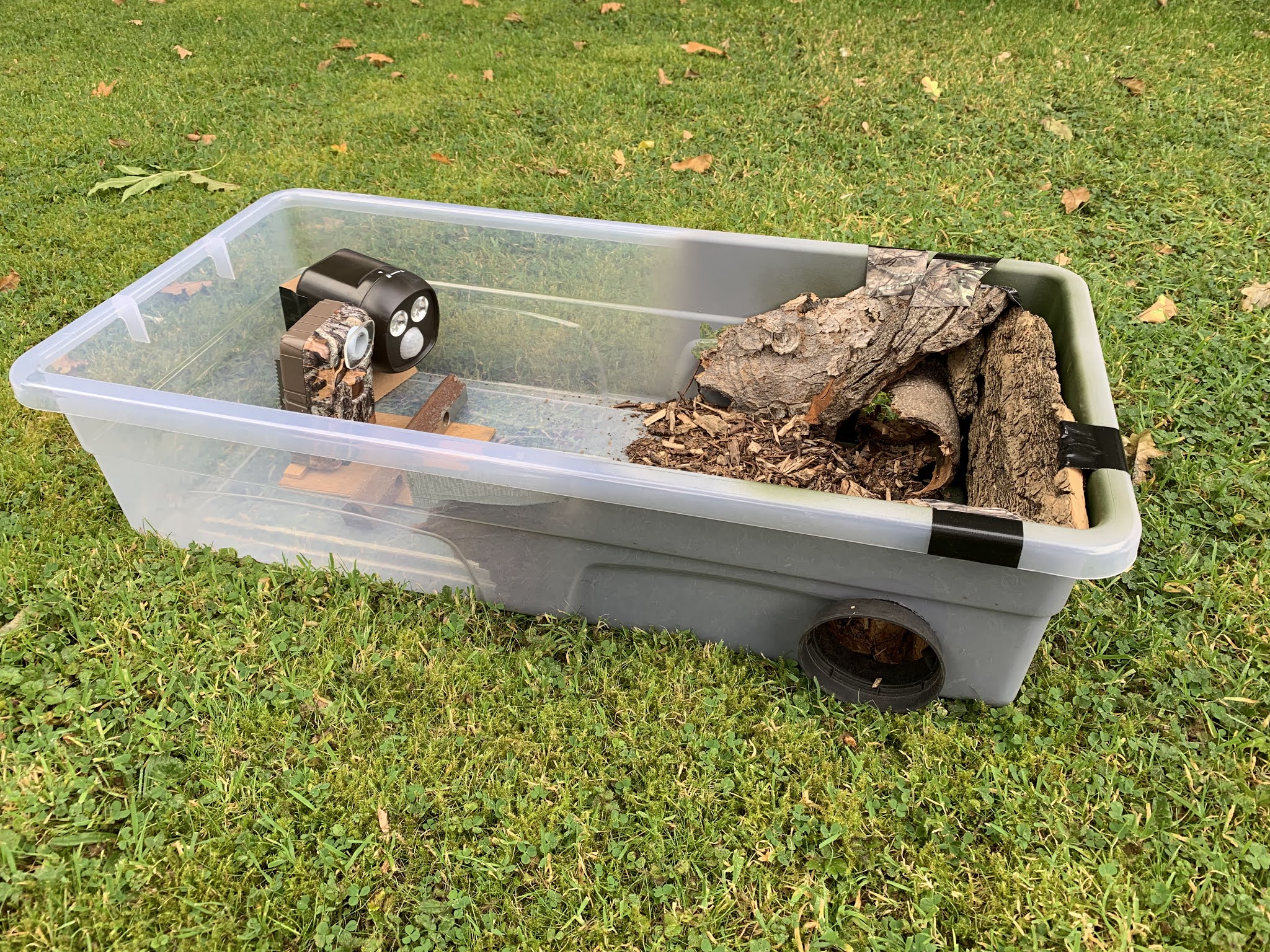
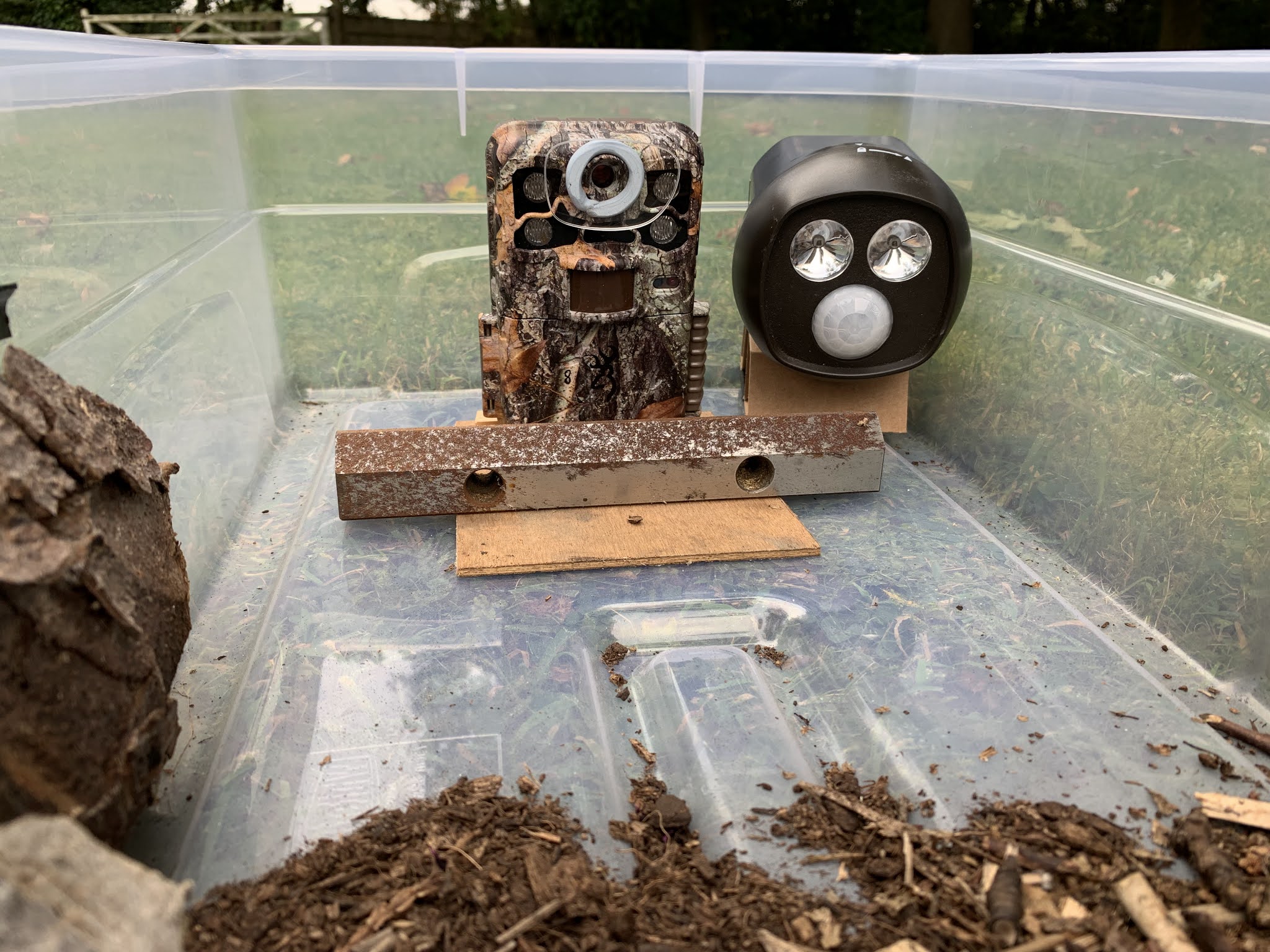
Ever since the weasel turned up in the garden in the summer I have been trying to get another picture.  Inspired by the Mostela*, a trail camera box used for monitoring stoat and weasel populations, I built one similar from a translucent plastic storage box (£7 from Dunelm).  There are two holes at one end and a trail camera at the other.  The Mostela was designed by Jeroen Mos, an ecologist and small mustelid researcher in The Netherlands, and is an enclosed box with a cutaway plastic pipe connecting the two entrance holes.  Wanting better pictures in a more natural setting, I made mine to admit natural light and built a small "stage set" of bark and loose bark chippings at one end.  The trail camera has a +2 dioptre lens to cope with the close focus.  It can record in colour in daylight but reverts to infrared when the light is poor or at night and it is then augmented by a motion-activated battery-powered infrared security light (a Brlnno APL200).  This is a view of the box with the lid removed.


Here are the camera and the infrared light.

This is the "stage set".

Here is the box in the garden with two Victorian land drain pipes as access tunnels.

Like other small mustelids, weasels are very inquisitive animals and will investigate any small hole which might contain prey.  For the first few days I baited the camera box with sunflower seeds so that it would smell of voles and mice but recently it has been left as it is (although mice and voles still visit every day).  I had the camera box set in my garden and the local nature reserve for four weeks before a weasel eventually made a brief appearance this week.  In fact it was very brief so I have added a 25% slow motion replay to the video.


Several other animals are much more regular visitors.  They include wood mice, always at night and so in black and white.  Wood mice visit every night and spend a lot of time in the box.  There is no food for them but perhaps it is warm and dry and feels safe.


Bank voles more often appear in daylight.  It is a pity the weasel didn't stay this long.


Common shrews also mostly turn up in daylight.  This clip also has a 25% speed replay.


Pygmy shrews appear both in daytime and after dark.


And a couple of very unexpected visitors.  Both birds were in the box for over two minutes and got rather agitated when they couldn't find the way out.


I plan to leave my weasel box set in the hope of more recordings and, perhaps, one day even a visit from a stoat.

* Mos J, Hofmeester TG.  The Mostela: an adjusted camera trapping device as a promising non-invasive tool to study and monitor small mustelids.  Mamm Res. 65, 843-853 (2020). https://doi.org/10.1007/s13364-020-00513-y

Monday, 19 April 2021

ShrewCam

The small mammal trail camera has been regularly recording shrews, along with the dozens of mice and voles, both in my garden and at the local nature reserve.  When I looked closely I realised that there were recordings of pygmy shrews as well as common shrews from both sites.

Compared with a common shrew (Sorex araneus), a pygmy shrew (Sorex minutus) is noticeably smaller; has a significantly longer and hairier tail; has two-tone colouring, lacking the paler flanks of the common shrew; and has a rather domed head and a thin pointed snout.  Some of these features are quite hard to pick out on a video, or even on frame grabs, because shrews move at such high speed.  The body weight of a pygmy shrew is 2.5-7.5g and of a common shrew 6-12g.  In the video I have added a bank vole (14-40g) and a wood mouse (13-27g) for comparison.

One advantage of the small mammal camera box is that the animals are all more or less at the same distance from the camera, making a size comparison easier.

In a still frame from the video, this is a pygmy shrew, showing the long tail in the first image.


This a rather blurred high-speed common shrew but you can see the size difference.


On the same scale this is a bank vole.

And a wood mouse.