I live in hope of another visit from a weasel to the trail camera box but for the moment it is nearly all wood mice. The bank voles seem to have given up after realising there was no free food on offer but wood mice call in every night just to check. This visitor made a welcome change. Perhaps I should have called this post TrogTrogCam.
My Blog List
Showing posts with label Wren. Show all posts
Saturday, 18 December 2021
Sunday, 31 October 2021
Pop goes the weasel
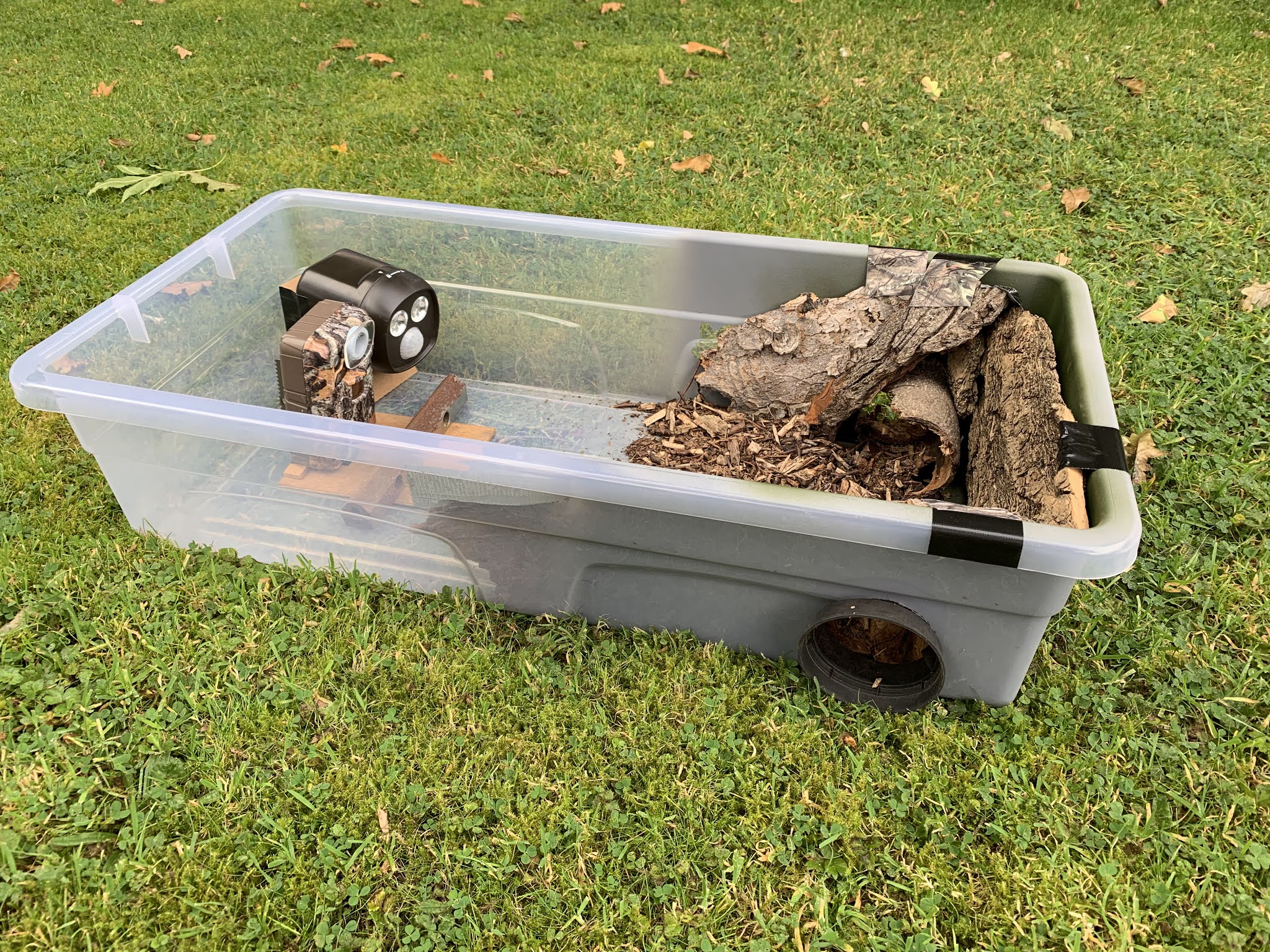
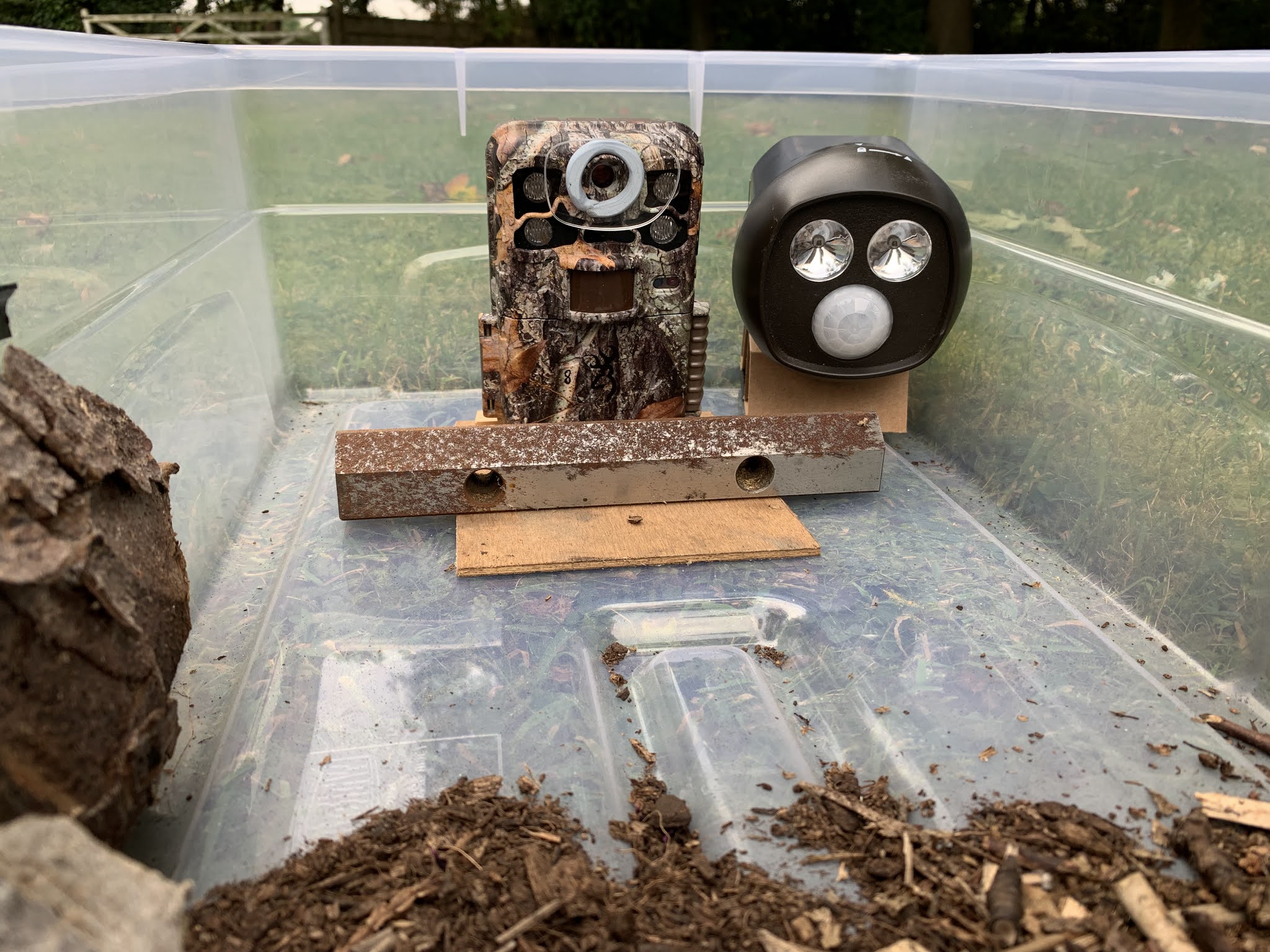
Ever since the weasel turned up in the garden in the summer I have been trying to get another picture. Inspired by the Mostela*, a trail camera box used for monitoring stoat and weasel populations, I built one similar from a translucent plastic storage box (£7 from Dunelm). There are two holes at one end and a trail camera at the other. The Mostela was designed by Jeroen Mos, an ecologist and small mustelid researcher in The Netherlands, and is an enclosed box with a cutaway plastic pipe connecting the two entrance holes. Wanting better pictures in a more natural setting, I made mine to admit natural light and built a small "stage set" of bark and loose bark chippings at one end. The trail camera has a +2 dioptre lens to cope with the close focus. It can record in colour in daylight but reverts to infrared when the light is poor or at night and it is then augmented by a motion-activated battery-powered infrared security light (a Brlnno APL200). This is a view of the box with the lid removed.
Here is the box in the garden with two Victorian land drain pipes as access tunnels.
Like other small mustelids, weasels are very inquisitive animals and will investigate any small hole which might contain prey. For the first few days I baited the camera box with sunflower seeds so that it would smell of voles and mice but recently it has been left as it is (although mice and voles still visit every day). I had the camera box set in my garden and the local nature reserve for four weeks before a weasel eventually made a brief appearance this week. In fact it was very brief so I have added a 25% slow motion replay to the video.
Several other animals are much more regular visitors. They include wood mice, always at night and so in black and white. Wood mice visit every night and spend a lot of time in the box. There is no food for them but perhaps it is warm and dry and feels safe.
And a couple of very unexpected visitors. Both birds were in the box for over two minutes and got rather agitated when they couldn't find the way out.
I plan to leave my weasel box set in the hope of more recordings and, perhaps, one day even a visit from a stoat.
* Mos J, Hofmeester TG. The Mostela: an adjusted camera trapping device as a promising non-invasive tool to study and monitor small mustelids. Mamm Res. 65, 843-853 (2020). https://doi.org/10.1007/s13364-020-00513-y
Wednesday, 15 July 2020
Young wrens
There has been another batch of fledgling wrens in the garden. It is a different brood from a couple of weeks ago so they must be having a good season. More than other young birds, wrens always look a bit grumpy.
Friday, 13 April 2018
Winter feeding comes to an end
I have been feeding the birds in my garden all year round for years, probably the main reason why there are so many birds in the garden. In the feeding station at Gosforth Park Nature Reserve, just over mile from here as the sparrowhawk flies, feeding starts in October and ends at Easter. Here are a few of the birds there just before feeding stopped for the summer.
The woodpecker's breast feathers are rather discoloured. Most woodpeckers now look very smart as they approach the breeding season so I think this one has been spending time on a tree which has stained her feathers.
Monday, 23 January 2017
Roosting wrens
This is a short video I made seven years ago, long before I started this blog. In a very cold winter this gang of wrens (I think herd is the correct group name) was roosting in a nest box in the porch. The colder it got, the more there were, with a peak of 16 in one box. On this night there were probably 10 or so. At the end of the video they are disturbed by me going out to work the next morning and they all bale out of the box like paratroopers. I think I'll have to do more video recording and editing.
Monday, 26 December 2016
Bird of the week - Wren
Despite its small size, gram for gram the wren is our loudest bird.
The wren's binomial name is Troglodytes troglodytes. One drawback of the name of this blog is that I regularly have to explain the joke. (Although a troglodyte is a cave dweller the word comes from Greek words trogle, a hole, and dyein, to creep.) In French the wren is a little king, roitelet, also troglodyte mignon, mignon meaning cute(!). In German it is a hedge king, Zaunkönig, and king crops up in its name in several other languages.
There are several myths and folk tales about the wren, particularly how it became known as the king of the birds. A challenge was set amongst the birds to see who would be king and the owl decided that the prize would go to the bird that could fly highest. All the birds took off and flew upwards, dropping out one by one. Eventually only the eagle was left. Just as it could fly no higher the wren took off from a hiding place on the eagle's back and claimed the prize, which was duplicitous or resourceful depending how you look at it.
Today, St Stephen's Day or Boxing Day, is also Wren Day or Hunt the Wren Day. St Stephen, the first christian martyr, was said to have been betrayed by the song of the wren, one of the few birds to sing in winter. Originally a druidic or Norse festival, it is still celebrated in parts of Ireland and elsewhere. In times past the young men of the town would try to catch a wren in the countryside and parade it through the town tied to a decorated holly bush. I suspect these days it is mainly an excuse for the Wren Boys to dress up in a straw costume, march around town and drink Guinness. You can read more about hunting the wren here.
By National Library of Ireland on The Commons - December 26Uploaded by oaktree_b, Public Domain, https://commons.wikimedia.org/w/index.php?curid=17816307
The wren is the most numerous and widespread bird in the British Isles. Numbers fall after a hard winter but soon rebound and there are reckoned to be around 9 or 10 million breeding pairs.
Wrens are found in almost every habitat apart from high mountains.
They are also found throughout Europe, as shown by this EBCC map.
New research from the BTO also shows that northern wrens are tougher and better adapted to cold weather than the softies in the south. Read more here.
Thomas Bewick wrote of the wren,
This is his engraving from A History of British Birds (1797).
Thursday, 9 July 2015
NEWPOTY 2015
For the first time I submitted photos to the North East Wildlife Photography Competition and three were shortlisted. I am delighted to say that one of them won a prize. This photo was runner-up in the Wildlife Portraits category. It was taken in Denise & Phil's garden at Williwood so many thanks to them. The prize is a place on a wildlife photography workshop which I hope will provide more photos for the blog. More news in due course.
Wednesday, 17 December 2014
Saturday, 4 October 2014
Saturday, 9 August 2014
Subscribe to:
Posts (Atom)