My Blog List

Showing posts with label Tree sparrow. Show all posts

Friday, 17 April 2026

Charting the decline of sparrows and starlings


There have been many changes in the wildlife in my garden over the years, perhaps the most dramatic being the recent disappearance of tree sparrows and starlings.  I have been submitting data to the BTO Garden Birdwatch since it started in 1995 and data from my garden are available online from 2003.  I was keen on graphs when I was at work, often using them to investigate changes over time.  So here's a graph.  It shows the number of weeks per year that I recorded a starling or a tree sparrow in 2003-2025.

Starlings were regular residents in the garden from when I moved here 37 years ago.  They nested in tree holes each year, disappearing after the chicks fledged and returning six months later. There were no nests in 2024 or 2025 and I haven't seen a starling here this year.

Tree sparrow was a very rare bird here until 2012.  Although I counted the nests in nest boxes they also nested in tree holes so I don't think the nest box numbers are all that useful but there were nine in 2016, only one in 2023 and none in 2024 or 2025.  You'll see from the graph they were here all the time for a few years and records fell precipitously since 2019.  I have only seen one once this year.

Both starlings and tree sparrows are in decline nationally and both are red-listed on the UK Birds of Conservation Concern although the national picture isn't quite as dramatic as the changes here.  The UK breeding population of starlings fell by 57% from 1995 to 2023.  During the same period the tree sparrow breeding population increased by 39% but that was after a catastrophic decline from the 1970s - numbers now are still only 5% of what they were.  I found couple of graphs on the BTO website that sort of mirror my experience but use different data on a different timescale.  This is their starling graph.

And their tree sparrows.

There have been two other major developments in the garden in recent years which may be related to these changes.  The first was the arrival of ring-necked parakeets that have been here every day since late 2022.  They are tree hole nesters and could potentially compete with starlings for nest holes but they don't nest in the garden and wouldn't fit through a nest box hole. Here's another version of my graph.

The second change, which is probably more relevant, has been a change in the status of American grey squirrels.  The first grey squirrel was seen here in 2005 and the last native red squirrel in 2016.  For 18 years I was part of a team exercising grey squirrel control locally in the hope that the red squirrels could be preserved.  However, the grey tide was unstoppable and I eventually gave up in early 2023 after everyone else had already done so.  Grey squirrels have been here every day since.  They also nest in tree holes and the nearest to the house is in what used to be a starling nest.  I suspect the starlings and sparrows may have seen the resident squirrels and decided otherwise go elsewhere.  On this version of the graph the grey box shows when grey squirrels were resident (and not persecuted).

The grey squirrels have a lot to answer for but there isn't much I can do about them.  After last week's post I haven't seen the stoat again and I think it may also have been put off by the squirrels.  Of course both the parakeets and the squirrels, or neither, might be involved.  It would be nice to think I might see starlings and tree sparrows nesting here one day.  Here's hoping.

Monday, 1 March 2021

Double strike

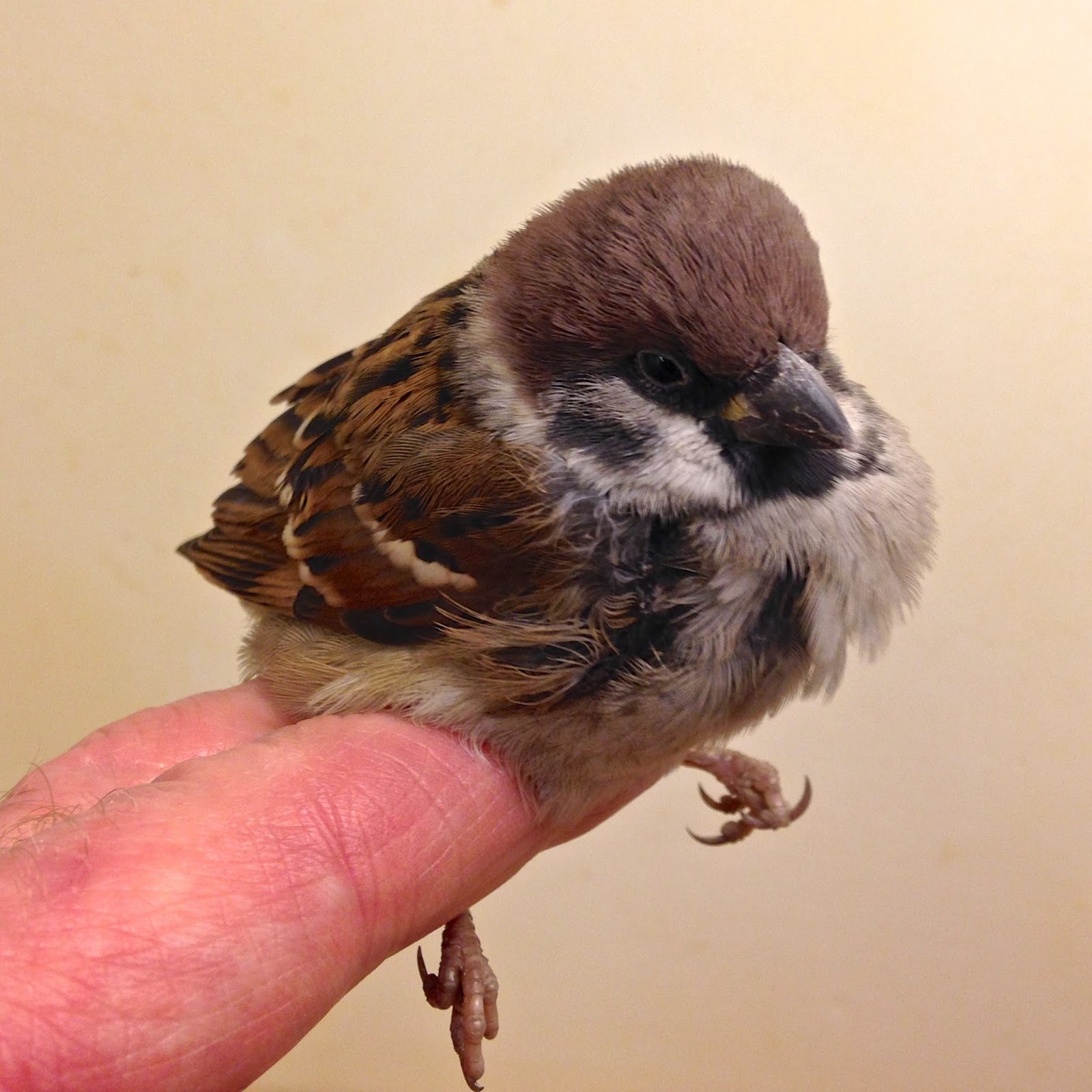
I heard a fearful bang on the kitchen window early this morning.  When I went out to see what had hit it I found two very stunned tree sparrows lying on the ground.  I picked them up to keep them warm (and to take their photo) and in less than ten minutes they were fit to fly.

Despite there being lots of birds in the garden and lots of windows in the house I don't get many bird strikes and fortunately they are rarely fatal.  Often the trigger is a sparrowhawk attack, in which case the attacker knows to pick off the stunned prey before it can fly away.  This is the first double strike I can remember.

Wednesday, 19 June 2019

Black-faced sparrows

The garden is now full of young birds.  I am pleased to say there are lots of tree sparrows - I was worried they might be discouraged by the sparrowhawk who was here in the winter but I think he moved on just in time.  I have noticed at least three and possibly more young tree sparrows with black faces and collars.  My guess is that this is a partial form of melanism and that they came from the same brood.  If they stick around it will be interesting to see how they change as they mature.


These are even darker with the black extending onto the breast.


As a comparison, this is what the others look like.


The BTO Abnormal Plumage Survey has almost 3000 records of which only 112 relate to melanistic birds and 40% of those are blue tits or great tits, with 18 other species represented.

Monday, 8 April 2019

A welcome return

Last week I heard a familiar sound that has so far been absent from the garden this year - the cheep of a tree sparrow. Not before time these two were busy checking out the available accommodation.


It looks as though they may have some competition.


As I suspected might happen, the sparrowhawk has been here less often in the past couple of weeks and I haven't seen him since last Tuesday.  The kitchen garden feeder is busy again and finches and woodpeckers are now brave enough to use it.  Here is the latest sparrowhawk photo.

I didn't realise until I looked up the data on the BTO Garden BirdWatch site that sparrowhawks generally leave gardens at this time of year and sightings drop by up to 50%.  So maybe I won't see him again for a while.  If that is the case I hope he comes back in full adult plumage next winter.

Tuesday, 28 November 2017

Fire Rescue Service

I had a most unexpected visitor yesterday evening.  I heard a strange noise coming from the sitting room and when I went to investigate it was coming from the wood-burning stove, which fortunately wasn't lit.  And this is what I saw.

The tree sparrow must have fallen down the chimney and ended up in the stove.  It was flapping around in the ashes but I managed to catch it as I didn't want an ash-covered sparrow flying around the house.


Of course it had then to have its photo taken.


It was cold and dark outside and I wasn't sure how long the sparrow had been in the stove.  It looked pretty groggy to start with and I wondered if it was starved and/or dehydrated.  In the daytime I would just have released but I put it in a transparent box with food and water.  I left it in peace but I can't tell whether it took any food or water.  I reasoned that it would be safer in the box overnight and it seemed none the worse for its adventure as I released it this morning. Perhaps we should call it Passer cineraria, the ashy sparrow.

Friday, 16 June 2017

Nestbox update

I have been posting regular updates on the tree sparrows' progress on the "Nestbox camera 2017 page", accessible via the tab above.  The female laid six eggs starting around 20/21 May and all six hatched around 05 June.  It has been very difficult to get a good view into the box because of nest material in front of the camera, despite my moving the camera several times before laying started.  Things have improved in the past couple of days as the chicks are bigger and are coming up to the entrance hole to be fed.

Today for the first time I have taken photos of the outside of the box.  The parents are very wary, which is interesting as another pair in a box in the kitchen garden don't seem at all bothered when I am working in there.  I took these photos by hiding in the car with camo net over the window.  This one shows how the chicks look now.  The bolt just above the entrance plate holds the camera and the other holes show where I was adjusting the camera position to try to improve the view.

The chicks' diet is varied but is mostly insects.  The tasting menu starts with ladybird larvae.

Then sunflower seeds from the feeder.

The next course is a damselfly.

Followed by more ladybirds.

It is interesting how early the sparrows started to feed at the entrance - probably helped by the tunnel of nest material that helps the chicks climb up to the hole.  In previous years the blue tits have only done this in the last day or so before fledging.  This is the view inside today.

And finally a video clip from yesterday to show the mayhem.


Regular updates will continue on the "Nestbox camera 2017 page" and I'll post an update here on the main blog when the chicks fledge if I mange to get any photos.  I think there are seven other boxes in the garden with tree sparrow nests, as well as other nests in dead trees in the wood.  Some of the other boxes are already on the second brood.  I'm hoping we'll get a second brood in this box as well.

Monday, 22 May 2017

Eggcellent news

At last.  Today for the first time I can see eggs (two of them) in the camera box.  I have been writing occasional updates on the Nestbox camera 2017 page (tab above) since the tree sparrows moved in on 12th March but there has been very little to write about recently.  The nest was finished weeks ago and although the birds have continued to visit there was no sign of laying.   The structure of the nest is very different from the blue tits which have occupied the box in previous years.  There is a tunnel from the entrance hole to the back of the floor which has meant I have had to reposition the camera several times and the view still gets obscured by bits of nest material.  The birds' activity has increased in the past couple of days but even last night the female didn't sleep in (the blue tits have always slept in for at least one night before laying).  Then this morning she was in the box for a long time and this afternoon I can see this. Whether both were laid today or one was yesterday and I couldn't see it I'm not sure.  I expect the latter is more likely.

There are tree sparrows in several other boxes and in holes in trees in my patch of woodland and some of those have already fledged their first brood.  This was a youngster I photographed this morning that is already old enough to feed itself.

The BTO website says the tree sparrow clutch size is 5-6 eggs and the median first clutch laying date is 17 May so perhaps this pair is not so late.  I expect there will be a few more eggs this week.  Incubation is 12-13 days and fledging is 15-18 days after that so we're looking at the second half of June.  There may well be a second brood to follow.  Lets hope so and that we still have some sort of view into the nest.  Regular updates will be on the "Nestbox camera 2017" page (accessed via the tab above).  I'll also post any major developments, such as hatching, fledging, etc on this main blog.

Saturday, 22 April 2017

More bad news


I got home the other day to find that a sparrowhawk had killed and eaten a woodpecker right outside the back door. The remains were pretty mangled (I've spared you the gory bits) so I couldn't even tell whether the victim was male or female.  I also don't know whether it was one of the pair trying to set up home in the garden.  There are several woodpeckers that visit the feeders every day and I can't tell which is which.

The other thing I've seen is that the second hole excavated by "my" woodpecker is now occupied  by a starling.  It is pretty hard to tell which bird is in which hole at the moment as things have mostly gone quiet, with the ownership battles having been settled, but it seems as though here isn't now a resident woodpecker here.

The first woodpecker hole was taken over by a pair of starlings but they also seem to have moved on.  It is now the property of a tree sparrow but I think he has left it too late.  I feel really sorry for him as he sits outside the hole calling for a mate all day.  He has ended up in possession of prime real estate but all the females are already spoken for.

At one stage he did entice a female in for a quick look around.


For whatever reason things didn't work out for them and he was back to calling all day.  He's still at it.

It is not all doom and gloom.  A blackcap and a chiffchaff have started singing in the garden in the past week and I have had several interesting visitors to the feeders.


Sunday, 12 March 2017

Nestbox update

I have been away for the weekend and returned to find that building has started in the camera nest box.

In the past few weeks both blue tits and tree sparrows have been showing interest in the box.  A pair of blue tits has been coming in many times each morning.


The tree sparrows have mostly sat on the roof chirping loudly but one has occasionally dashed in and out, almost too quick for the camera.

The box was put up in 2009 and this is the ninth consecutive year in which it has been occupied.  In 2009 a pair of blue tits built a nest but one of them was taken by a sparrowhawk before any eggs were laid.  In 2010 a pair of great tits hatched two eggs but neither chick fledged.  In 2011-2016 the box was occupied by blue tits which raised 11, 11, 2, 8, 4, and 6 chicks, an average of 7 a year.  Early last year I changed the entrance plate to 32mm, hoping to attract tree sparrows, which were in several other boxes, but still the nest was built by blue tits.

Now it looks as though the tree sparrows have adopted what you might call the German Beach Towel Strategy and have moved in and started building.  It is said that possession is nine-tenths of the law so they have probably won the battle.  It will be interesting to watch them, as they make a change from blue tits and are likely to have two or three broods (the blue tits always have just one).  The BTO website says that egg laying starts in mid April and goes on until mid August.  The eggs are white with brown blotches with 5 or 6 in a clutch.  Incubation takes 12-13 days (slightly quicker than the blue tits) and nestlings fledge after 15-18 days (again slightly quicker).  The nest material is noticeably different from that used by blue tits, being grass, leaves and feathers whereas the blue tits mainly bring in moss to begin with.


As I did in the past two years I'll post regular reports on the "Nestbox camera 2017" page (accessible via a separate tab above) with occasional updates here on the main blog.