My Blog List

Showing posts with label Parakeet. Show all posts

Friday, 1 May 2026

Feeding the birds


I expect you have seen the latest recommendations from the BTO on feeding garden birds.  The new guidance is to stop feeding seeds and peanuts from today to the end of October in the hope of reducing transmission of trichomonosis which has caused declines in populations of chaffinches and greenfinches.

The problem is widespread but seems a bit less up here compared with farther south.  This graph from the BTO Garden BirdWatch shows the reporting rate for greenfinches in the North East.

Compare that with the South East.


These are similar data for chaffinches.


I don't remember ever seeing a finch on the peanut feeder so I think I'll continue with peanuts until they are all used up and see what happens.  That will be a relief to the woodpeckers who will be here with their fledglings in June.

I reckon I only see about one sick finch a year here.  One effect of stopping feeding is that all the finches will disappear so recording of both healthy and sick finches will presumably plummet but I expect the BTO experts have thought about that.  I'll be disappointed not to see the birds but I guess it is all for the greater good.


At the moment I still have lots of siskins, redpolls, bullfinches, greenfinches and chaffinches outside the kitchen window.  They are going to be very disappointed.


My prize visitor, a brambling, was only here for a week before setting off home to Scandinavia about three weeks ago.

Assuming most people comply with the advice it's going to be interesting to see what happens, both here and nationally.  I expect I'll be getting complaints from the local clean-up squad as well.

Friday, 17 April 2026

Charting the decline of sparrows and starlings


There have been many changes in the wildlife in my garden over the years, perhaps the most dramatic being the recent disappearance of tree sparrows and starlings.  I have been submitting data to the BTO Garden Birdwatch since it started in 1995 and data from my garden are available online from 2003.  I was keen on graphs when I was at work, often using them to investigate changes over time.  So here's a graph.  It shows the number of weeks per year that I recorded a starling or a tree sparrow in 2003-2025.

Starlings were regular residents in the garden from when I moved here 37 years ago.  They nested in tree holes each year, disappearing after the chicks fledged and returning six months later. There were no nests in 2024 or 2025 and I haven't seen a starling here this year.

Tree sparrow was a very rare bird here until 2012.  Although I counted the nests in nest boxes they also nested in tree holes so I don't think the nest box numbers are all that useful but there were nine in 2016, only one in 2023 and none in 2024 or 2025.  You'll see from the graph they were here all the time for a few years and records fell precipitously since 2019.  I have only seen one once this year.

Both starlings and tree sparrows are in decline nationally and both are red-listed on the UK Birds of Conservation Concern although the national picture isn't quite as dramatic as the changes here.  The UK breeding population of starlings fell by 57% from 1995 to 2023.  During the same period the tree sparrow breeding population increased by 39% but that was after a catastrophic decline from the 1970s - numbers now are still only 5% of what they were.  I found couple of graphs on the BTO website that sort of mirror my experience but use different data on a different timescale.  This is their starling graph.

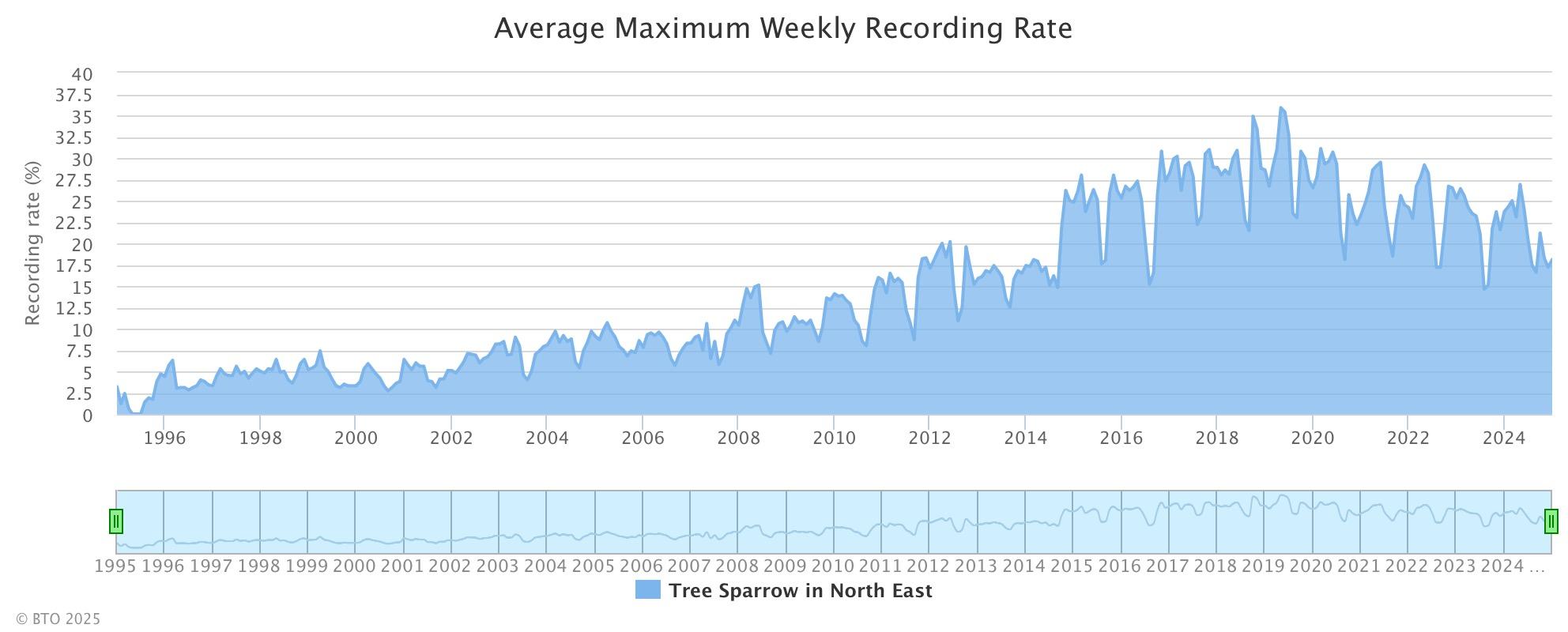
And their tree sparrows.

There have been two other major developments in the garden in recent years which may be related to these changes.  The first was the arrival of ring-necked parakeets that have been here every day since late 2022.  They are tree hole nesters and could potentially compete with starlings for nest holes but they don't nest in the garden and wouldn't fit through a nest box hole. Here's another version of my graph.

The second change, which is probably more relevant, has been a change in the status of American grey squirrels.  The first grey squirrel was seen here in 2005 and the last native red squirrel in 2016.  For 18 years I was part of a team exercising grey squirrel control locally in the hope that the red squirrels could be preserved.  However, the grey tide was unstoppable and I eventually gave up in early 2023 after everyone else had already done so.  Grey squirrels have been here every day since.  They also nest in tree holes and the nearest to the house is in what used to be a starling nest.  I suspect the starlings and sparrows may have seen the resident squirrels and decided otherwise go elsewhere.  On this version of the graph the grey box shows when grey squirrels were resident (and not persecuted).

The grey squirrels have a lot to answer for but there isn't much I can do about them.  After last week's post I haven't seen the stoat again and I think it may also have been put off by the squirrels.  Of course both the parakeets and the squirrels, or neither, might be involved.  It would be nice to think I might see starlings and tree sparrows nesting here one day.  Here's hoping.

Thursday, 30 January 2025

30 years of BTO GardenBirdWatch


The end of 2024 saw the completion of 30 years of data collection and analysis by the British Trust for Ornithology (BTO) Garden BirdWatch (GBW).  It has up to 13,000 people submitting up to half million records each year and once a data set gets that big it starts to produce really interesting and valuable results.  I have been fortunate to be a member and to have been submitting data from my garden from the start in January 1995.  On the GBW website I can look back at my own data but perhaps it is more interesting to examine long-term trends in the North East or the whole country.  Two examples, chosen because of observations in my garden, are Rook and Ring-necked Parakeet which show contrasting fortunes.  When I moved here in 1989 there was a rookery in the small copse in my garden.  The rooks were great fun to have as neighbours but their numbers gradually dwindled from a peak of 44 nests to six nests in 2010.  A few birds turned up for a look round but didn't nest in 2011 and there have been none since.  The GBW data for gardens in the North East show a steady decline but some people are still fortunate to see them.

I can see from my GBW data that the first time I saw a ring-necked parakeet here was in week 12 (March) 2022.  I saw one or two birds until week 17 and then they disappeared.  The next record was in week 46 (November) 2022 and they have been here in numbers ever since, up to 15 at a time.  Here is the graph for gardens in the North East so this is a bird that is obviously here to stay.

Here they are seen through the kitchen window with the iPhone.  Note the three non-native mammals as well.  They are even more regular visitors than the parakeets.

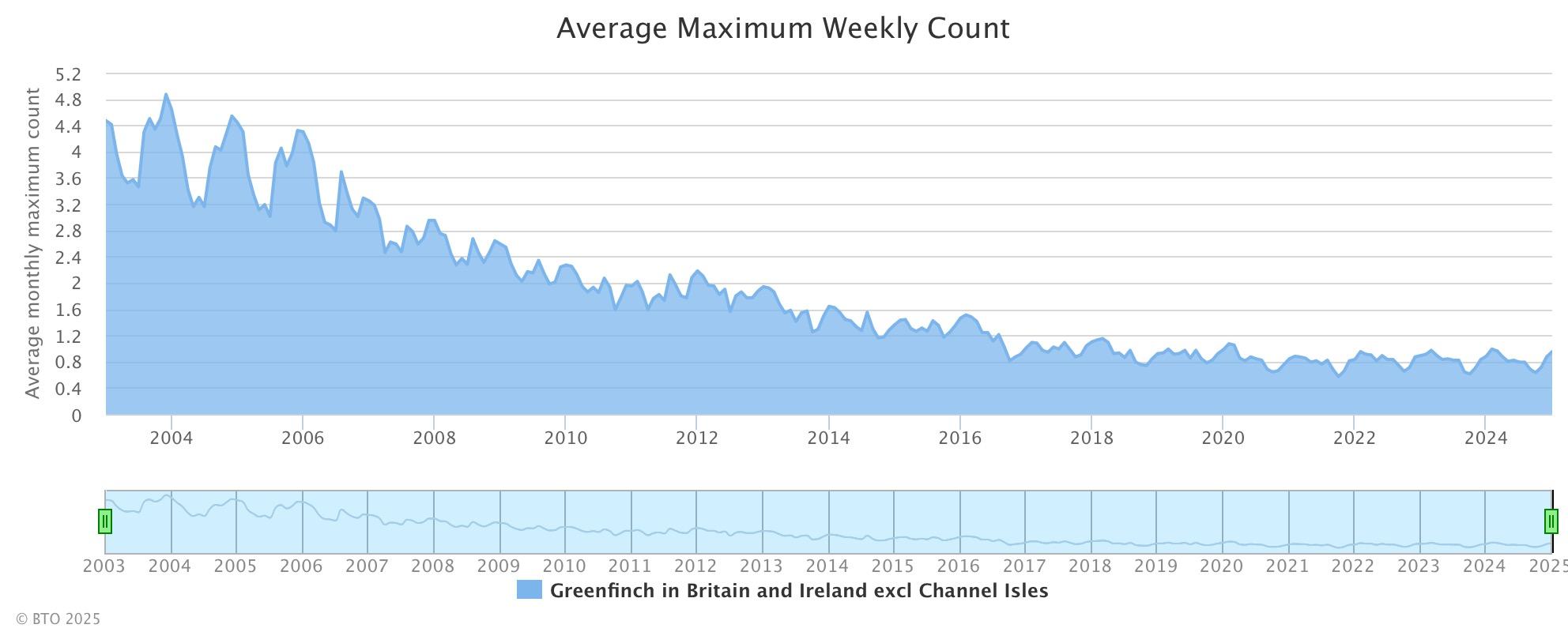
Two finches, both very common here, also show contrasting fortunes.  Greenfinches have long been in decline nationally, probably mainly because of infection with trichomonosis.  In recent weeks here I have been seeing up to nine at a time but this is the national picture, first for presence, then abundance.

.


In contrast, goldfinches, which commonly feed alongside greenfinches, are doing well.  They seem not to be affected by trichomonosis.

The BTO GBW data shows lots of other winners and losers over the past 30 years.  Birds in decline include spotted flycatchers, starlings and collared doves.  Those increasing in numbers include wood pigeons, great spotted woodpeckers and magpies.  One final comparison I have chosen is between our two sparrows.  First house sparrow (a very rare bird in my garden, only two sightings in 30 years),


and tree sparrow (a new arrival here about 13 years ago but scarce for the last two years).


The BTO Garden BirdWatch is one of the largest and most valuable citizen science projects in this country, providing important and fascinating insight into changes and trends in the fortunes of our garden birds.  As someone too lazy to keep lists I find it a great way to check on what has been happening in my own garden as well.

Friday, 13 September 2024

Alexandrine Parakeet


I see a lot of the parakeets.  They visit the feeders outside my kitchen window, several times a day and up to 14 at a time.  This one immediately stood out because of the red feathers on its shoulders, possibly the lesser coverts.  The red feathers are an almost exact colour match for the beak.


This bird stayed for long enough for a few photos but I haven't seen it since.  I assumed it was some sort of variant of Ring-necked or Rose-ringed Parakeet (Psittacula krameri) but an internet search led me to the Alexandrine Parakeet (Psittacula eupatria).  This is larger, has maroon patches on its wings and a yellow/orange tip to the beak, so that's what my bird is.  The lack of a neck ring means it is either a female or a first-year male.  There are only a handful of records on iRecord in the UK and none this far north.  This bird was with the other parakeets and I suppose is likely to be an escapee.

The Alexandrine Parakeet is named after Alexander the Great who imported them from India to many European countries.  They were, and are, prized as captive birds but they escape from time to time and there are feral populations in many Middle Eastern countries.  They hang around with Ring-necked Parakeets, as my bird was doing.

Thursday, 15 August 2024

Through the kitchen window

The parakeets are in the garden every day, visiting many times from early morning to late evening, up to 12 at a time.  They are beautiful and entertaining to watch and just occasionally get themselves organised for a decent photo.


Thursday, 5 January 2023

More parakeets


The parakeets have been regulars in the garden since they reappeared in November. They are not very agile on the feeders but climb around carefully using the beak as an extra foot.


They like peanuts and sunflower seeds and will also go on the new mesh seed feeder.

Generally there are one or two at a time but the most I have seen together is six.  I managed to get five in one photo.


Another time they were in the top of the trees just above the house.  I went out to see what all the noise was about and found they were scolding a sparrowhawk sitting in the next tree.  Here's a short clip of the noise.

Sunday, 20 November 2022

The return of the parakeets


Ring-necked parakeets arrived in my garden for the first time in March but disappeared after a few weeks.  They turned up again a couple of weeks ago and have been here most days since.

They are great fun to have around.  Noisy, exotic and colourful, they really brighten up a drab November day.  They usually arrive as a pair (the male has the black and pink neck ring) and often sit in the trees calling when they are not on the feeders.  They eat both sunflower hearts and peanuts.  Sometimes they fly around above the garden, calling loudly.  I can't tell if it is always the same two birds but I hope they stay around all winter.