The roe deer are wearing their beautiful foxy red lightweight summer coats now. This one was keeping a eye on me between mouthfuls but was happy to keeping munching.
I don't go chasing butterflies but I have been keeping an eye out for these. They are white-letter hairstreaks (Satyrium w-album) and have been seen on a couple of wych elms at the edge of Gosforth Park Nature Reserve for the past three weeks or so. I have looked for them each time I visited but had never seen one until yesterday morning.
White-letter hairstreak caterpillars feed exclusively on elm trees so the population suffered greatly when Dutch elm disease wiped out most of the trees 40 years ago.
The white letter is a 'W' on the underwings and white-letter hairstreaks always rest with their wings closed. I think these are all females - they were walking through the leaves looking for places to lay their eggs and have slightly longer "tails" on the back of the wings.
This is the third mud-loving bird I have posted this week. The increased area of mud in front of the hide at Gosforth Park is popular with birds that we don't often see. Water rails are generally fairly secretive birds but these are happy to come out onto the mud each evening. This is an adult.
There are also several juveniles.
If and when we have some rain they will eventually move back into the reed beds as the water level rises.
A less common visitor to Gosforth Park Nature Reserve than the snipe I posted a couple of days ago, this is a juvenile lapwing. It was fascinating to watch it on the mud. It would walk two or three steps forwards and then vibrate one leg as it stood still on the other. After a few seconds it snapped up a morsel, presumably disturbed by the vibration, and then moved on and repeated the exercise many times. I then wondered if lapwings might be right-legged or left-legged but this one was using either leg with no preference.
A mudlark was someone who scavenged in the mud to look for items of value, especially along the River Thames in 18th and 19th century London.
In normal circumstances in Gosforth Park we don't often see the sort of birds that like poking about in mud. However, the recent prolonged drought has meant that the water level is very low and several more unusual birds have been attracted to explore the mud. A few common snipes have been visiting in recent days and this one seemed either to be unaware of me or unworried by the noise of the camera. I am used to hearing and seeing these birds at a distance but seeing this one close up was a chance to appreciate the beauty of its plumage.
Well this was an amazing find. It is a queen European hornet (Vespa crabro) and was found this afternoon by Paul, the warden at Gosforth Park Nature Reserve, in his garden. I didn't know we had them up here as this is the distribution map on the BWARS* website.
Paul has seen one here before, several years ago, but he didn't get a photo and no-one believed him. This was very definitely real and was huge. I have seen a lot of hornet workers in the Midlands recently (more to follow) and this one was much bigger. You can see from the 5mm grid that she is about 30mm long.
After the photos the queen flew back into the woods so with luck she has already started a nest. I'll keep an eye out each time I visit, hoping to see more. It is only 2km from here as the hornet flies so I may eventually see them in the garden.
* BWARS = Bees, Wasps, and Ants Recording Society.
A rare sighting of a young unicorn in Gosforth Park.
I noticed these bees flying while I was walking around Gosforth Park Nature Reserve. I could see that they were male Andrena mining bees but unusually I didn't have a camera and didn't have time to investigate, so I returned the next day. They were flying only an inch or so off the ground and very slowly, exploring the path and the leaf litter and occasionally stopping to rest.
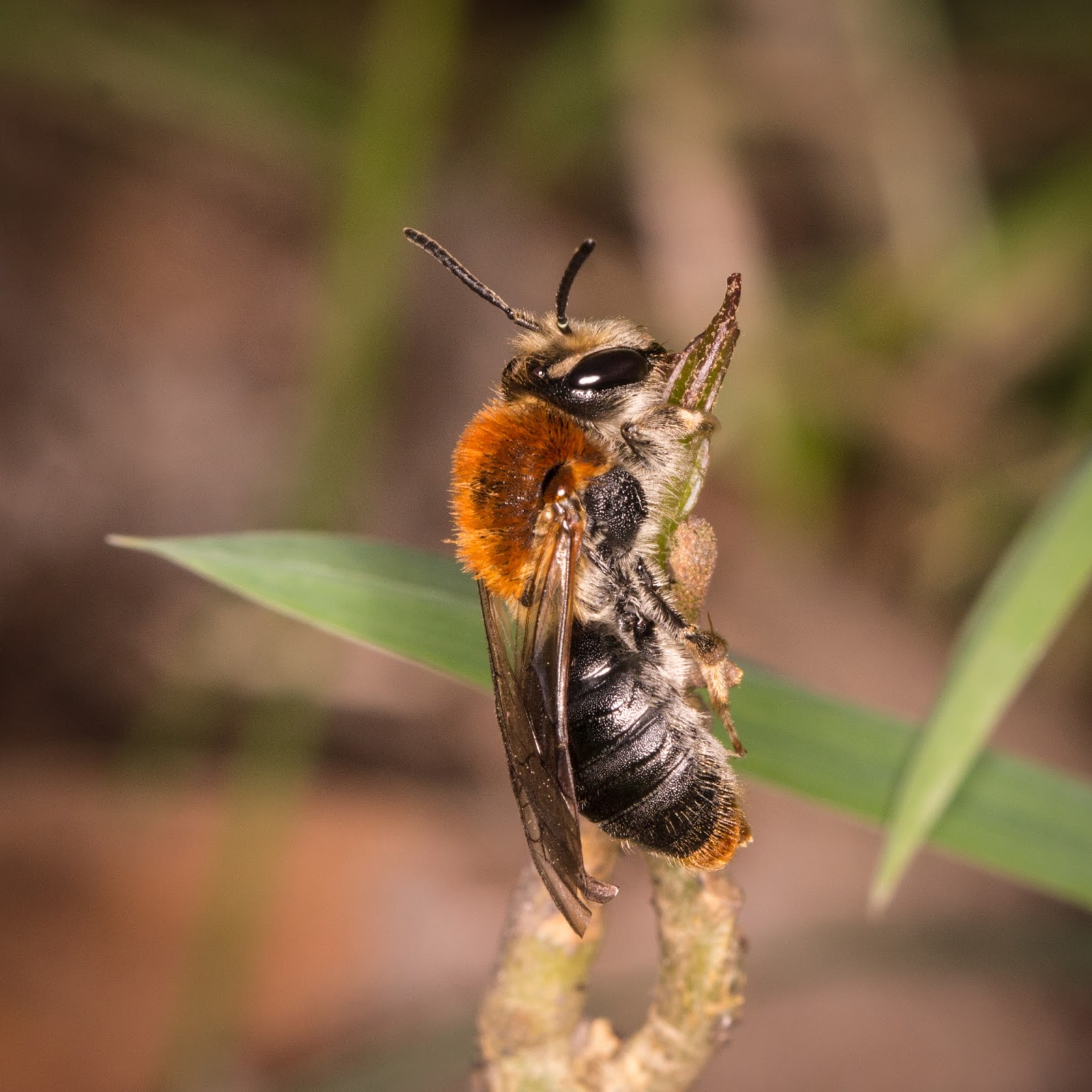
With a few exceptions, male Andrena bees are not easy to identify, for me at least. I was preparing to go home with the photos and look them up in Steven Falk's field guide when I spotted a female bee. She was clinging onto a tree seedling about two or three inches high and was immediately recognisable as an orange-tailed mining bee (Andrena haemorrhoa).
She was very clean and shiny and I guessed she was freshly emerged.
She was grooming and stretching and was repeatedly stretching her right wings. The front wing looks slightly crumpled at the tip and the two wings are separated. You can see the row of hooks on the leading edge of the rear wing that should hold the two together. I don't know if she was just getting it sorted out after emerging from her cocoon or if there was something wrong with it.
After a few minutes she dropped off onto the leaves and just waited.
The presence of this bee made it likely that the males were also Andrena haemorrhoa so I watched for a few minutes. The first one to find her was shrugged off but the second one had more luck, proving he is the same species.
Female mining bees dig holes in the ground for their nests.
These bees are in the edge of a well trodden path Although their nest holes are separate they are close together in an aggregation.
This female was peeping out of the entrance but she wouldn't come out while I was watching.
This male was waiting in the entrance of another hole but he didn't dig it.
A female walked past but she wasn't the owner of the hole either.
Orange-tailed mining bees are common and widespread but before this I have mainly seen them on flowers. Now I know where they live.
PS "A man is known by the company he keeps" is a the moral of Aesop's fable The Ass and His Purchaser.