My Blog List

Showing posts with label Field vole. Show all posts

Thursday, 10 April 2025

News from WeaselCam

It has been a quiet start to the year for my camera box.  The camera has been in place all the time since last March with a peak in weasel activity late last summer.  There was only one brief visit from a male weasel in January this year, one even briefer visit from a female weasel in February and a glimpse of a male stoat that turned round in the entrance in March.  Here they all are in the video - don't blink.  And although the images are blurred, notice the size difference between a male and a female weasel.


A recent paper by Croose et al looked at how well the Mostela (a professional camera box similar to mine) performed in detection of weasels and stoats compared to an external trail camera.  It found that weasels readily entered the box and were detected by both techniques. Stoats were rare and never went inside, which tallies with my experience here.

Non target species have been plenty.  I posted videos of pygmy shrew, common shrew and water shrew in January.  The camera has also seen field vole, wood mouse, American grey squirrel, robin, wren and great tit.  Here is the pygmy shrew - the pipe inner diameter is about 48mm so you can see how tiny the shrew is.


The presence of voles is encouraging as they are the main prey for weasels but the voles only appear in the box at night and the weasels are strictly diurnal. 

Weasel territories are about 1-10 hectares for females and 2-25 hectares for males, while stoats' territories are typically larger, varying from 2-124 hectares for females and 8-256 hectares for males.  That means my patch is as little as 2-5% of a weasel territory and even less for a stoat so it is no surprise that they aren't seen here very often.  I hope when the meadow grows up in the next few weeks the voles may move back in and attract more weasels.  We'll see.

Monday, 6 January 2025

WeaselCam in December


The camera in the weasel box is there all the time, mostly recording wood mice.  Last month there were five weasel visits, two each from two different animals and the fifth I can't tell.  A male weasel I call weasel 4 was here on the 3rd and the 5th.  The first time he was having a very good look round, probably able to smell the wood mice.


The next time he was dashing about more but I can still manage to identify him on freeze frames. There is a space behind the camera with a few spare bits of wood that he seemed to find very interesting.


The second weasel was a female, the same one who was first here in November.  She also spent a lot of time behind the camera (I have edited most of it out) and it was interesting to see her scent-marking.


She was back a week later for another look round.  I am really hoping she'll stick around and perhaps even move into the weasel wall.


A male weasel dashed in and out so fast on 31st that I can't be sure which it was - my best guess is weasel 4 again.  
Otherwise the camera mainly records wood mice, bank voles, the odd American grey squirrel, wrens and great tits.

The voles are interesting.  Almost always I have been seeing bank voles but then this one turned up one night.  It is large with a fairly short tail so it must be a field vole.

One very pleasing visitor was a pygmy shrew who has been in a few times, once in daylight.

I am hoping for many more weasel visits in 2025 and perhaps even a few stoats as well.

Friday, 28 October 2022

SmallMammalCam

This is National Mammal Week so it is a good time to show a few mammal pictures.  When I wrote about the small mammal camera box a few weeks ago it was about 5m inside the small copse in my garden.  The camera was seeing bank voles, wood mice and shrews every day/night.  After that I moved it about 10m, so it was now 5m into the meadow.  The clientele changed immediately and the wood mice stopped coming.  The bank voles and shrews still turned up regularly but the new arrival was a field vole.  The noise on the video is rain on the roof of the box.


The next video shows the difference between a bank vole and a field vole.  The latter is larger, greyer, has a shorter tail and has flatter, furrier ears.


Bank voles usually visit the box one at a time.  If there is more than one it can lead to a bit of conflict.


The other regular visitor was a common shrew.  It is hyperactive compared with the voles - the video is at normal speed.


I then moved the box back to the edge of the meadow and the copse and the wood mice immediately reappeared.  Being mainly nocturnal they show up in infrared recordings.

I was surprised that the mice don't want to venture even 5m into the meadow, and that the field voles won't go 5m into the wood.  The bank voles and shrews are happy wherever the box is.

The main reason for having the small mammal camera box is to try to film a weasel but so far no joy.  I have seen the weasel this week near the gate so I have moved the box over there and fitted larger entrance pipes in the hope that might entice it in.  We'll see.

Friday, 7 October 2022

Cohabitation

I noticed a hole in the ground at the edge of my meadow and set a trail camera to see what was in it.  I reckoned whoever was down there could be tempted into view with a few sunflower hearts.  The result was a surprise as there were three different species sharing the hole, presumably with separate living accommodation underground.

I guessed there would be a vole as the hole was connected to tunnelled runs through the grass. Most often the camera shows a bank vole, usually dashing out and back in but sometimes disappearing down the run.


Bank voles move fast, hoping that there isn't a kestrel or a weasel watching.  This was on a different camera with a bit of a green colour cast.


Next to show was a common shrew.  Despite being insectivores, shrews are also keen on sunflower hearts.


And then a field vole.  Not so easy to tell at first because it usually shows up at night, but it is larger than a bank vole with a shorter tail and larger flatter ears.


Here are the three of them at night, plus a less welcome visitor.


The camera usually records the animals one at a time but one day there were several confrontations between a vole (probably the field vole) and a shrew.  Several times the vole blocked the entrance and once it chased the shrew - I have added a couple of slow motion replays because the action is so fast.  The last clip shows the shrew eventually gets in when the vole (probably a bank vole this time) turns its back.


I think this type of cohabitation is not unusual.  A few years ago I put a camera on the entrance to a pile of stone in the copse and recorded bank vole, common shrew, wood mouse and water shrew all using the same entrance.

Friday, 17 September 2021

Calibrating VoleCam

OtterCam often detects "non-target" species, ie things that aren't otters, most commonly a juvenile water rail.  This time it detected a vole.  When I reviewed the video on the camera's small replay screen I thought it was a brown rat but it was clear on the computer that it was a vole.  The question is, which vole?  Our three native voles (bank vole, field vole and water vole) are distinguished by size, fur colour and relative length of tail.  On a black & white infrared video it is down to body size and length of tail but the problem is that there is no calibration.  Here is a still from the video.

I found picture of a water shrew on an earlier recording that was more or less the same distance from the camera.

An adult water shrew is 6.3-9.6cm in length and the vole looks to be about twice as long as the shrew.  A bank vole is 8-12cm, a field vole 9-11cm and a water vole 14-22cm.  So if this was an adult water shrew the vole has to be a water vole.  But the still image also shows that the vole's tail is relatively short, perhaps one third of its body length.  Quoted relative tail lengths are about one third for a field vole, one half for a water vole and two thirds for a bank vole.

So I tried a different calibration.  I know the diameter of the culvert is 75cm and using the diameter at the vole's position in the video gives a vole body length of 10-11cm.  Coupled with the short tail I came to the conclusion that this must be a field vole and not a water vole.  (I now presume the water shrew is a juvenile.)

Disappointing, as I would have liked to find a water vole but common things are common and field voles are certainly common - there are about 75,000,000 field voles in this country at the end of the breeding season, about one hundred times the number of water voles.

So my quest for a good trail camera picture of a water vole goes on.  In the meantime here are the video images from the two cameras.


Wednesday, 26 August 2020

VoleCam

I had forgotten about the field vole living opposite the front door because the grass grew up in the "meadow" and the vole's network of holes and runs disappeared from view.  When I started to mow the meadow I found the holes again and they looked to be still in use.  So I put some apple cores outside to see what happened - and they disappeared. And of course I then set up a trail camera.  Often the vole is too quick for the camera and at first I put the apple too close to the hole so the camera didn't have time to react.  Putting the apple cores slightly farther away and not all in a run has allowed a few glimpses.


Field voles have short tails (~30% of body length) and are greyish brown.  Bank voles have proportionately longer tails (50%) and are a more reddish brown in colour.  Judging by their colour I am not sure these are all the same species but when I can see the tail it is short.  Watch for the last vole to appear when all the food has gone.  It is tiny and is a young field vole.


In a second sequence I think the first one probably is a bank vole because it is redder, slightly smaller with a slightly longer tail.


 The other is clearly a field vole.


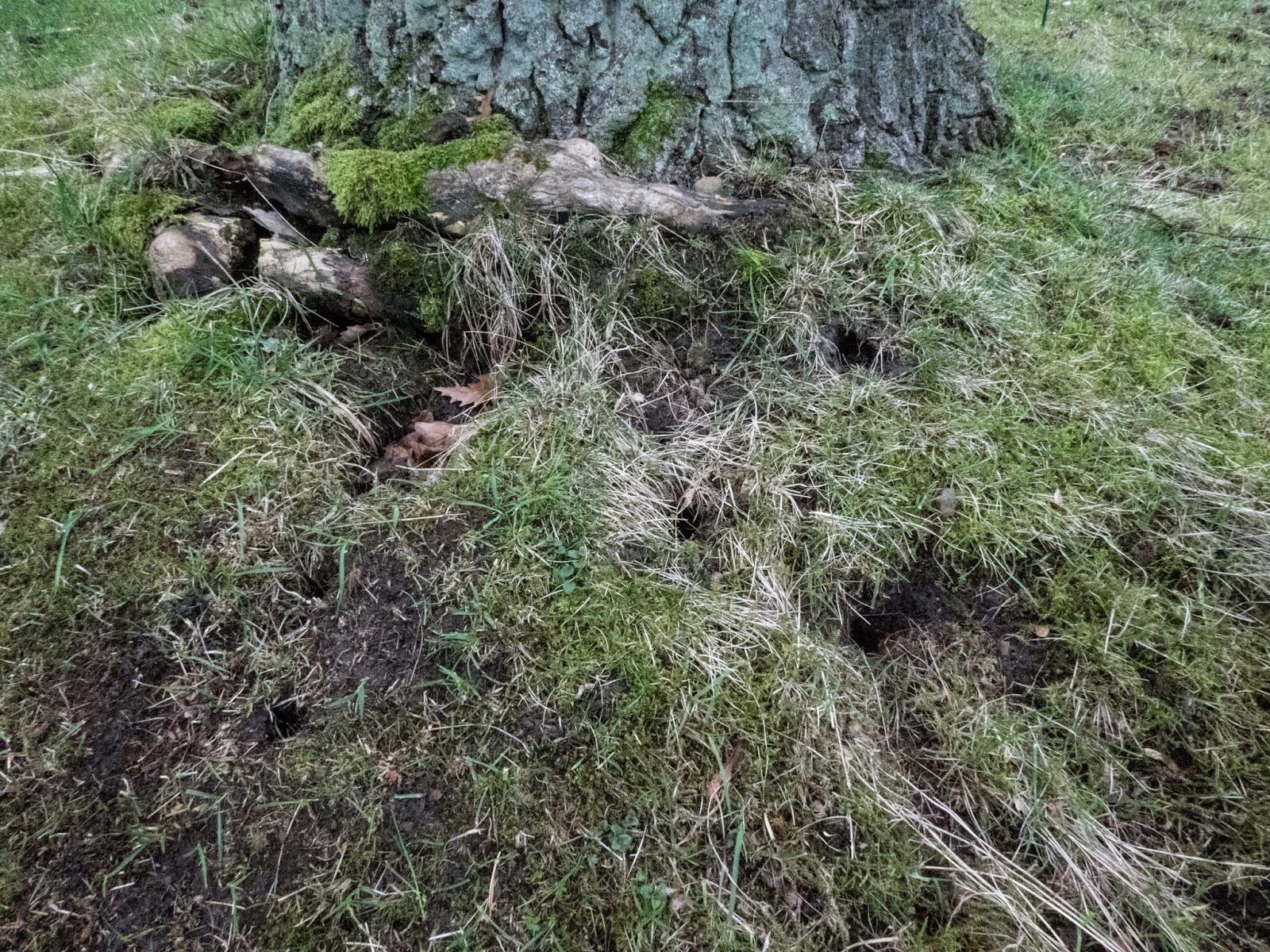
Bank voles and field voles often live in similar habitats although bank voles prefer woodland edge / hedgerow places while field voles prefer long grass.  Here is sort of on the border between these two so it is no surprise to find them both.  The network of holes around the base of the oak tree is extensive so I expect there is plenty of room for them all below ground.

Tuesday, 18 August 2020

CritterCam - the search for a water vole. Part 2

Following on from my previous post, this is the second report on my attempts to catch a water vole on a trail camera. The second camera was about 50m away from the first, the position of both cameras being determined by where I could get some field of view for them near water.  It was difficult because there was mostly just a trickle of water under the grass and rushes.  This was the position of the camera.

There were again plenty of views of voles but most were field voles. This time I used a 150mm cut section of reed as a calibration and unlike the piece of raspberry cane which was dragged off by the voles (I wonder what they did with it) the reed was ignored and stayed more or less in place.  Here are field voles near the reed.


Checking through the videos I did eventually see a larger vole.  Bank voles are 8-11cm long (head and body) with a tail 50% of body length, field voles are 9-11.5cm long with a tail <40% of the body length and water voles are 14-22cm with a tail 60% of the body length.  Obviously the young of each species are smaller.

Here is the calibration reed.

And here is the large vole with the same calibration line.  It measures about 14cm so it must be a water vole.

Unfortunately it doesn't show its tail on the video so we can't use that to check but it is too big even for a large field vole.  As you can see on the video it dragged the apple away and didn't show itself again.  At the start of the video a small vole dashes across, perhaps a bank vole or field vole.  The last clip is a very brief glimpse of a larger vole three days later.


So that is all I saw, not quite as exciting a video as I was hoping for.  There were lots of other brief views of small voles, which could have been bank voles or field voles or young of either species and more brief views of common shrews, wood mice and meadow pipits but once the apple had been dragged away there was nothing to tempt the voles out into view again.

I plan to have another attempt to get better water vole pictures next May when I am up there again.  I may try slightly lower down the stream in the hope of finding a bit more open water and a clearer view.  I think I'll also use larger pieces of apple so they don't disappear so quickly and perhaps fix them so they can't so easily be dragged into cover.  After the excitement of finding three shrew species on the other camera I may put down bait for shrews as well.

Water voles are widely but sparsely spread in this country and are rare in Northumberland.  The map shows sightings reported to iRecord in the last 20 years, indicated by small blue squares, mostly around the rivers South Tyne and Allen in the south west of the county.  This site (red arrow) is about 10km north of the South Tyne and 20km south-east of Kielder (green arrow).

The water vole is one of our most threatened mammals, having lost about 95% of its former sites and being classed as "endangered" on the Red List.  The population decline has mostly been caused by predation by American mink with loss and fragmentation of habitat as additional factors.  In an effort to reverse the decline the Northumberland Wildlife Trust has organised a water vole reintroduction programme - Restoring Ratty.  Since 2016 over 1600 water voles have been released around Kielder in the far west of the county.  Donor animals were collected from the North Pennines, Yorkshire and Scotland and taken to Devon for a captive breeding programme.  The offspring are brought back north for release around Kielder Water.

Kelly Hollings, Northumberland Wildlife Trust's Project Officer in the Restoring Ratty project, says that the released voles have migrated from their release sites to smaller streams and ditches so more recent releases have been in such places, perhaps similar to the one I have been investigating.

The site I have found is between the Kielder release site and established populations farther south.  With luck (and hard work by the Wildlife Trust) water voles will continue to spread and different populations will link up.  This experience also shows that in wilder parts of the country there may be a few more about than are known.

Saturday, 15 August 2020

CritterCam - the search for a water vole. Part 1

This all began in May, when I was doing my bird count near the Wark Forest for the BTO Breeding Bird Survey.  At one point I glimpsed a small mammal running across the track out of the corner of my eye.  It was dark, vole-shaped and rat-sized so I wondered if it could be a water vole.  There is a very small stream running through a pipe under the track, no more than 300mm in diameter, and because of the dry spring weather there was almost no water flow.  The habitat is poor unimproved wet grassland with mostly rushes rather than grass at that point, not a habitat I associated with water voles.  (I used to see them 50 years ago in a slow-flowing lowland river.)

Although the BTO BBS records mammal sightings I wasn't confident enough to record a water vole.  I did, however, send a message to Kirsty Pollard, a water vole expert at Durham Wildlife Trust and she passed my email on to Kelly Hollings, Northumberland Wildlife Trust's Project Officer in the Restoring Ratty water vole re-introduction project in Kielder.  Kelly was very encouraging and said the habitat was good for water voles, similar to some of the release sites in Kielder, so I went back with three trail cameras in July.  The cameras were in for a week, one close to where I thought I might have seen a water vole and two on a slightly larger but still very small stream (<500mm across) a couple of hundred metres away.  They recorded hundreds of videos and on a first look through I couldn't see much very exciting.  There were lots of glimpses of small mammals and I could identify field voles and wood mice, as well as reed buntings, meadow pipits and a roe deer's ankles.

Before giving up I had another look through the videos and could pick out a few where the voles looked bigger.  They were all on the on the trickle of a stream where I had my first sighting and there was very little on the other cameras.  It is difficult to judge scale although there is a slice of apple visible in the first clip.  I sent a very brief extract to Kelly and she replied that she was 99% sure it was a water vole.


So I went back earlier this month with two cameras and put them both on the first stream.  In most places it is difficult to see any water at all as it runs underneath the vegetation.  I spent time clearing a view and making sure the apples were better positioned.  Between them the cameras recorded almost 700 video clips so it is taking a while to work through them.  The first camera was set up here.

There are plenty of images of voles but I think they are probably all field voles.  Bank voles are 8-11cm long (head and body) with a tail 50% of body length, field voles are 9-11.5cm long with a tail <40% of the body length and water voles are 14-22cm with a tail 60% of the body length.  On the video it wouldn't be easy to tell a field vole from a bank vole or a juvenile water vole without seeing the tail but in some images the tail is clearly visible and is short.  (The other name for a field vole is short-tailed vole.)  The first two voles in the video are small whereas the last one which appears briefly nearer the camera looks larger although it still clearly has a short tail.


I also put a piece of raspberry cane next to the apple, 150mm long to act as a scale but the voles didn't approve of my measuring stick and moved and then removed it.


One very interesting sighting was of three shrews - water shrew, pygmy shrew and common shrew.  You can see that shrews don't eat apple but they are very curious (and very fast).  To find all three species in the same place on the same night was a pleasant surprise.


There are another 390 videos from the second camera so I'll report back soon on those.

Friday, 17 January 2020

FieldvoleCam


I have a new neighbour, recently moved in opposite my front door.  It is a field vole and has set up home at the base of an oak tree.  Over the last couple of weeks the holes and adjacent runways have become more noticeable with use and wear.

The field vole (Microtus agrestis) is identified by its greyish-brown colouring and short tail (its other name is short-tailed vole).  Bank voles (Myodes glareolus), which are common in my garden, are slightly smaller, reddish-brown, with a proportionately longer tail.


The field vole builds a system of holes and runways in grass.  This one is in the area that was meadow last year, and will be again this year, perhaps what attracted it.  I first tried my usual low-down camera position but it didn't work for a vole in a runway so I tried putting the camera on a tripod, angled down at about 45°.  Here you can see the vole dashing through the runway and holes as it collects sunflower seeds.


Here is another video recorded at night.  Like most animals and birds I have recorded with this camera, the vole seems unconcerned by the bright lights from the camera.


Here is a closer view of the vole collecting sunflower seeds.


Here it is collecting grass, probably to eat, possibly also for nest material.  Note its short tail.


There are half a dozen or so holes within an area of about half a metre square where the roots of a dead sycamore run across the base of a turkey oak.  The holes must all communicate with the nest inside and presumably allow an escape through a side door if a predator, such as a weasel, comes in through the front door.


Field voles have a lot to worry about.  They are the favoured prey of weasels, barn owls and kestrels and are also hunted by other owls, stoats, foxes, badgers, hen harriers, buzzards, etc.  One morning I opened the front door to see a male kestrel sitting in a birch tree at the edge of the lawn and looking toward the vole's hole 10m away.  Perhaps it had noticed the trail camera and was wondering what the fuss was about.

I read in Wikipedia that a kestrel eats 4-8 voles per day, so roughly 2200 per year, or 4400 per year per pair.  Nestlings each require an average of 3-4 voles per day, there are on average 5 chicks per brood, and fledging takes 32 days, so that is another 600 voles, plus extras for newly fledged birds before they learn to hunt.  In round numbers this means each kestrel pair will get through the equivalent of 5000 voles per year (they do eat other things as well).  Each female field vole produces about 30 offspring per year so you can see it takes an awful lot of voles to feed just one kestrel pair. No wonder there are about 75,000,000 field voles in Great Britain at the end of the summer.


One day the camera detected a burglar.  The first time it sat outside the hole for about half a minute, loitering with intent.  The second time it appeared from inside the hole, ran in and out a couple of times and then ran off.  This is
 a wood mouse (Apodemus sylvaticus).  I don't know whether it was casing the joint or was hoping to take lodgings.  If you thought a field vole was fast have look at the mouse.


These pictures were recorded with the Wingscapes BirdCam Pro, which has the advantages of adjustable preset focus and white light LEDs for colour video at night.  When I used it on the sparrowhawks last month the pictures were a bit overexposed and the output of the LEDs is not adjustable.  So I have modified it by fitting the lenses from a pair of child's sunglasses from Poundland over the two LEDs.  Whether due to that or not, the nighttime video exposure on the vole and the mouse here looks better.

I hope the vole evades the kestrel and sticks around to enjoy the meadow when it flowers in a few months time.  If it does, and I manage more photos, I'll post them here.

Saturday, 7 January 2017

My left hand

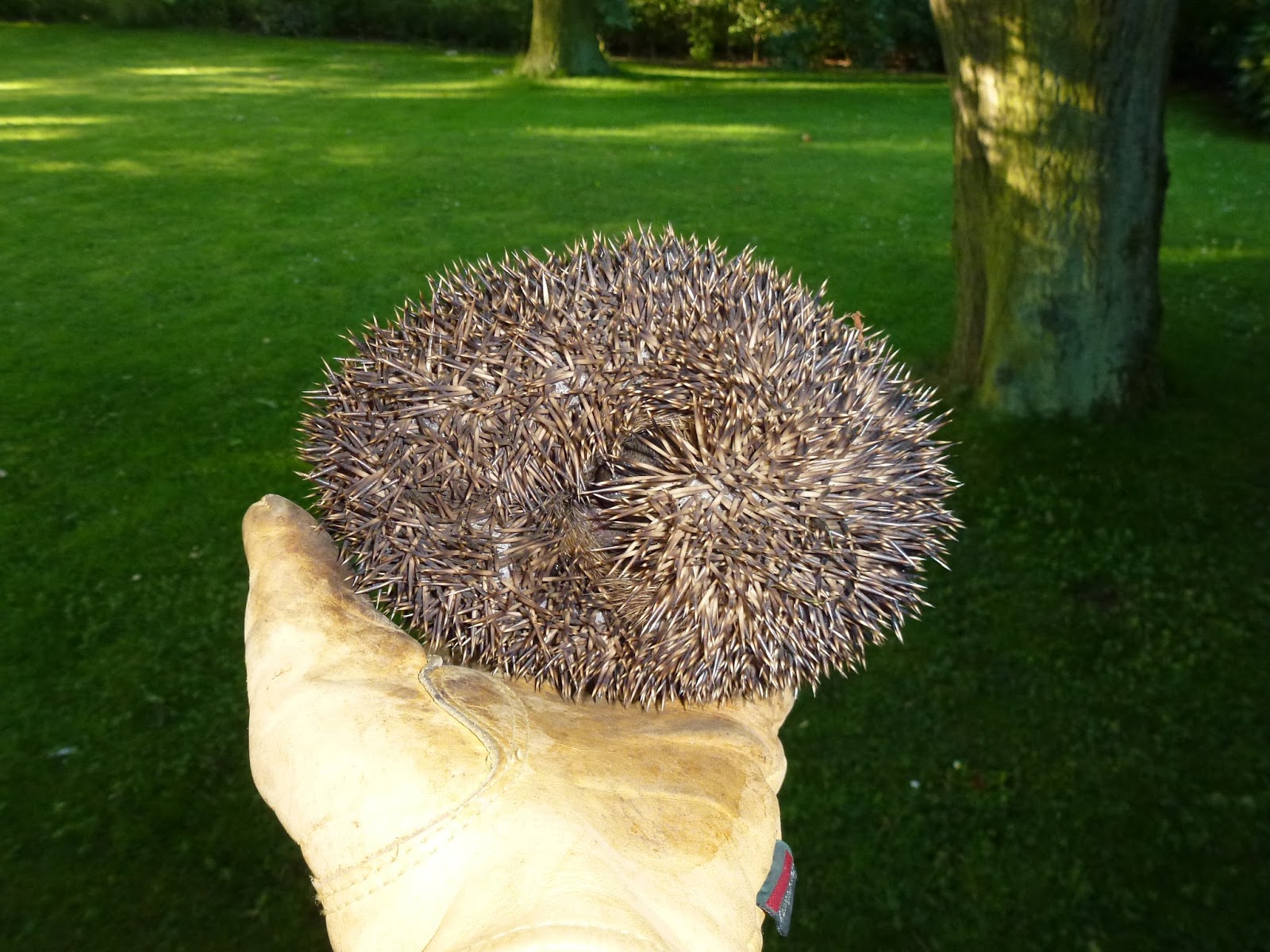
I am right-handed so if I am holding something to be photographed it is in my left hand.  As well as feeding the robin and the pheasant I seem often to be catching birds that have strayed into the house or greenhouse or, occasionally, been stunned by flying into the window and everything has to have its photo taken before release.  Over the last few years I have collected quite a few photos of my left hand and here are some of them.  I wonder what I'll catch this year? Whatever it is, it will have its photo taken.


I expect you'll recognise everything.  The only tricky one is after the pheasant and before the blackbird and is a juvenile whitethroat that got stuck in the greenhouse.