My Blog List

Showing posts with label Kestrel. Show all posts

Friday, 14 August 2026

Close Encounter


I had gone looking for an 11-spot ladybird so I had only a camera with a 90mm macro lens. When I first saw the kestrel sitting on a fence post I assumed I wouldn't be able to get a worthwhile photo but as I moved closer the bird didn't react.  It kept looking up at me but most of the time it was scanning the ground.

Eventually I was standing only one fencepost away, a distance of about 2m, and I was able to take these photos using the ladybird lens.


I thought the bird was looking for small mammals, although there probably wouldn't be any in the parched grass, but then it suddenly dived towards me and caught and ate a black beetle right at my feet, too quick and too close for a photo.  In the time I was watching it caught half a dozen beetles, each time returning to a fence post and each time allowing me to move close again.  I even had time to record some video.  The video has a different aspect ratio from the photos so I found I was too close and had to move back to get the bird in the frame.


You'll see my reactions aren't quite as quick as those of a kestrel!  It is also better at hunting beetles than I am as I never did find the ladybird.

Eventually, after about half an hour, some people came along with a dog and the bird was gone in a flash.  I don't know why it was so comfortable with me standing so close but I felt enormously privileged.

Saturday, 2 May 2020

Garden birds in April

This blog has been rather overrun by mammals recently but I haven't given up on bird photography.  April was a good month for birds in the garden, including the arrival of chiffchaffs and blackcaps from Africa.

I saw the male kestrel again very early one morning.  Twice he dived down to the lawn to catch something which I think was probably a worm.  Although their main prey is small mammals, kestrels eat other things including small birds, insects and worms.


A pair of jays are in the garden every day.  They are the prettiest crows and are great opportunists.  This one was standing under the peanut feeder while a woodpecker was feeding, waiting to catch the bits as they fell.


Jackdaws also come down to the feeders and stand underneath.


Jackdaws are more agile than jays and can get onto the feeders themselves.

I also have a woodpecker feeder which has holes filled with suet.

It also attracts other birds.


And you-know-who is still around, keeping them all on their toes.

There were lots of other birds I didn't take photos of - all the usual suspects plus reed bunting and green woodpecker. The only disappointment is that my camera nest box is unoccupied for the first time since it was put up in 2009.  I have modified it slightly to move the camera so that it can see the whole floor and the entrance hole so it would have given good pictures.  Maybe next year.

Monday, 24 February 2020

Two top predators

We had a little bit of wet snow this morning, the first of the winter.  I wasn't surprised when the sparrowhawk turned up because he has been here every day recently.  The kestrel has also been around a lot in the past few days so I was pleased to get his photo sitting on the gate, although it was a long shot through a rainy window.  It was interesting that the birds on the feeders 20m away took no notice of him, even though they do sound the alarm if he flies over or through the garden.  And they panic at the first hint of a sparrowhawk.

Friday, 17 January 2020

FieldvoleCam


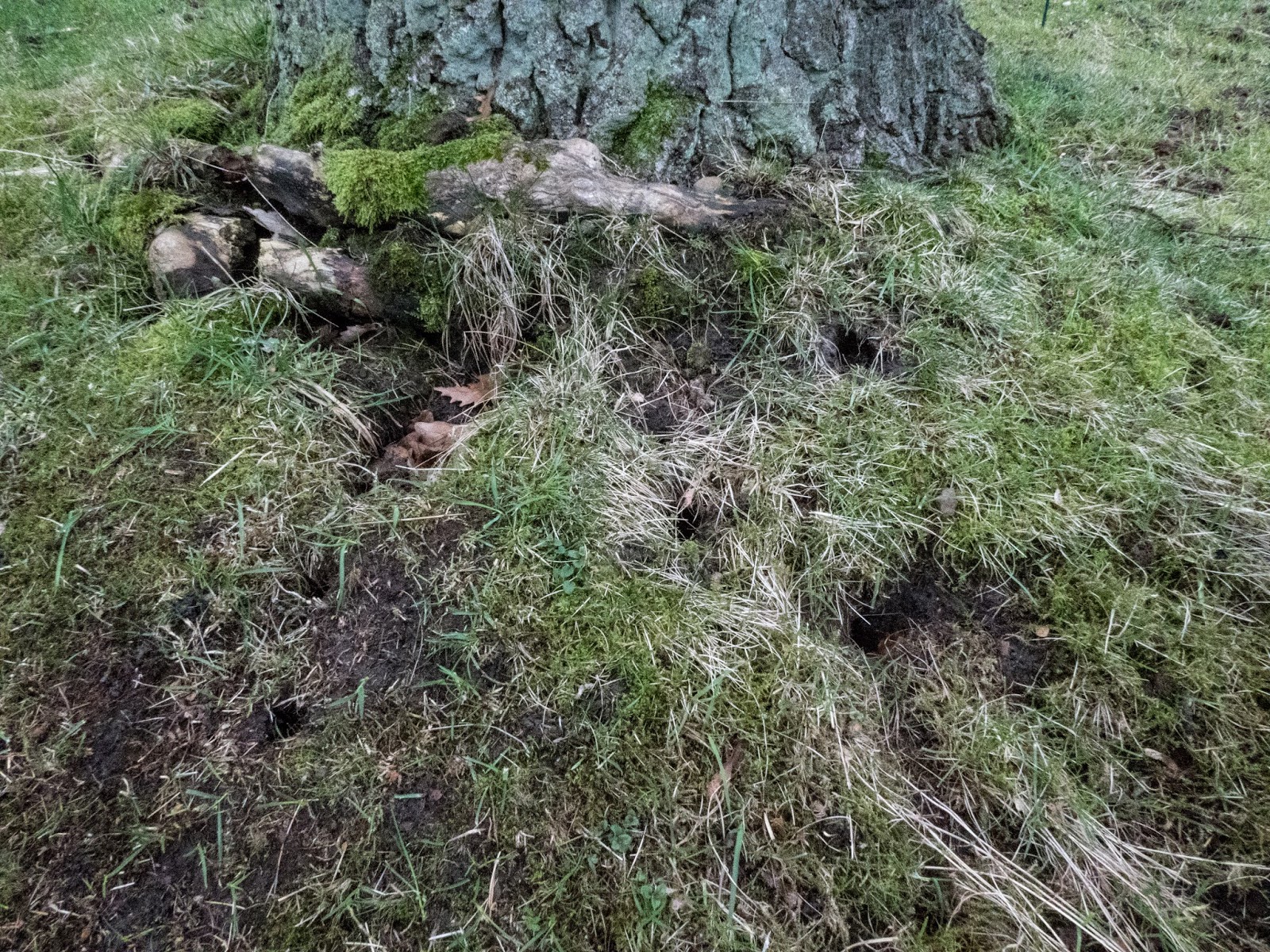
I have a new neighbour, recently moved in opposite my front door.  It is a field vole and has set up home at the base of an oak tree.  Over the last couple of weeks the holes and adjacent runways have become more noticeable with use and wear.

The field vole (Microtus agrestis) is identified by its greyish-brown colouring and short tail (its other name is short-tailed vole).  Bank voles (Myodes glareolus), which are common in my garden, are slightly smaller, reddish-brown, with a proportionately longer tail.


The field vole builds a system of holes and runways in grass.  This one is in the area that was meadow last year, and will be again this year, perhaps what attracted it.  I first tried my usual low-down camera position but it didn't work for a vole in a runway so I tried putting the camera on a tripod, angled down at about 45°.  Here you can see the vole dashing through the runway and holes as it collects sunflower seeds.


Here is another video recorded at night.  Like most animals and birds I have recorded with this camera, the vole seems unconcerned by the bright lights from the camera.


Here is a closer view of the vole collecting sunflower seeds.


Here it is collecting grass, probably to eat, possibly also for nest material.  Note its short tail.


There are half a dozen or so holes within an area of about half a metre square where the roots of a dead sycamore run across the base of a turkey oak.  The holes must all communicate with the nest inside and presumably allow an escape through a side door if a predator, such as a weasel, comes in through the front door.


Field voles have a lot to worry about.  They are the favoured prey of weasels, barn owls and kestrels and are also hunted by other owls, stoats, foxes, badgers, hen harriers, buzzards, etc.  One morning I opened the front door to see a male kestrel sitting in a birch tree at the edge of the lawn and looking toward the vole's hole 10m away.  Perhaps it had noticed the trail camera and was wondering what the fuss was about.

I read in Wikipedia that a kestrel eats 4-8 voles per day, so roughly 2200 per year, or 4400 per year per pair.  Nestlings each require an average of 3-4 voles per day, there are on average 5 chicks per brood, and fledging takes 32 days, so that is another 600 voles, plus extras for newly fledged birds before they learn to hunt.  In round numbers this means each kestrel pair will get through the equivalent of 5000 voles per year (they do eat other things as well).  Each female field vole produces about 30 offspring per year so you can see it takes an awful lot of voles to feed just one kestrel pair. No wonder there are about 75,000,000 field voles in Great Britain at the end of the summer.


One day the camera detected a burglar.  The first time it sat outside the hole for about half a minute, loitering with intent.  The second time it appeared from inside the hole, ran in and out a couple of times and then ran off.  This is
 a wood mouse (Apodemus sylvaticus).  I don't know whether it was casing the joint or was hoping to take lodgings.  If you thought a field vole was fast have look at the mouse.


These pictures were recorded with the Wingscapes BirdCam Pro, which has the advantages of adjustable preset focus and white light LEDs for colour video at night.  When I used it on the sparrowhawks last month the pictures were a bit overexposed and the output of the LEDs is not adjustable.  So I have modified it by fitting the lenses from a pair of child's sunglasses from Poundland over the two LEDs.  Whether due to that or not, the nighttime video exposure on the vole and the mouse here looks better.

I hope the vole evades the kestrel and sticks around to enjoy the meadow when it flowers in a few months time.  If it does, and I manage more photos, I'll post them here.

Saturday, 26 January 2019

Bird of the week - Kestrel


I had the good fortune of seeing this kestrel earlier in the week.  It was hovering over grassland at the top of a cliff and I was at the base of the cliff with the wind behind me.  The bird was directly above and facing me so I was able to take a few photos.


I think this bird is a juvenile because of the heavy markings on its breast feathers but it might be an adult female.

The kestrel (Falco tinnunculus) is the most numerous bird of prey in the UK but is amber listed because of population decline.  This BTO graph shows a 40% decline in the past 20 years.

I can remember 30 or so years ago when kestrels would be seen hovering every few miles along the motorways.  Now they are an uncommon sight, and we are more likely to see buzzards and red kites when driving.  Kestrels are fairly widely distributed but less common in Wales, Scotland, Ireland and south west England.


Thomas Bewick was so struck by the different plumage of male and female kestrels that he illustrated them both in his A History of British Birds (1797), something he rarely if ever did for other birds.


Archibald Thorburn painted male and female kestrels and a comparison with other small falcons.


You can listen to Steve Backshall's BBC Radio 4 Tweet of the Day here.  And read Gerard Manley Hopkins' poem Windhover here.

Wednesday, 22 August 2018

Keeping an eye on things


I have seen this young kestrel swoop past the feeders in the garden several times in the past couple of weeks, presumably in the hope of catching a small bird unawares.  It then flies up into a 30m tree in my neighbour's garden, from where it can see over several gardens.  The photos were taken with the camera balanced on the roof of the car outside the front door.  The distance is about 60m (200ft) with a 600mm lens working at an effective 960mm and heavily cropped, so the photos are not too bad considering.  The kestrel's eyesight is so good it probably has a much clearer view of me.