My Blog List

Showing posts with label Pellet. Show all posts

Friday, 5 November 2021

Gizzard stones

Another surprise.  I found an old pellet on the roof, trapped in a hydrangea branch that had grown over the tiles.  I assumed it had been regurgitated by a tawny owl sitting on a branch of the oak tree above.  The pellet was hard and about 40mm by 10mm.


I could see a claw and what looked like a small stone and a piece of insect wing case but not much else.

A tawny owl pellet is mostly made of fur and will break apart easily to reveal the bones inside - usually the bones and skulls of three or four small mammals.  This one was tough so I soaked it in water.  It was still difficult to tease apart because it was made of decomposed feathers rather than fur.  And the largest bones it contained were the legs and feet of a bird.

So now I think the pellet is not from a tawny owl at all.  The bones were all broken - an owl swallows its prey whole. There were quite a few other bone fragments but no skull or other parts that I could recognise.  My best guess is that the pellet is from a sparrowhawk.  I am a bit puzzled by what look like a few strands of grass, best seen in the top photos.  They were much less obvious in the grey mush once the pellet had been teased apart in water.  I can understand how a bit of grass might be swallowed during eating but I would have expected it to be digested easily. Here are the pellet contents, minus the feathers.  You can see the claws, two lines of bone fragments, skin strips, stones and a few small bits of insect wing case as well.

The several small torn fragments of skin look like bird skin.

The most intriguing finding was these four small stones, about 5-10mm in diameter.

Birds can't chew and they mash up their food in a muscular stomach, the gizzard.  Many birds swallow small stones to help this process, stones known as gizzard stones or gastroliths.

Plant-eating dinosaurs used gastroliths as well.  Their stones were much larger and stayed inside for years, becoming smooth and rounded like pebbles on a beach.  I found this photo of Jurassic gastroliths on Wikipedia.

Wednesday, 28 March 2018

What the sparrowhawk had for breakfast

Sparrowhawks, in common with owls and kingfishers, bring up pellets but I had never seen it happen before.  This time he was on top of the hedge, facing away from me.  I could see what was about to happen but because it was gloomy, and I was using a long lens with an aperture of f/6.3, I had set the shutter speed low and didn't have time to adjust it. This picture is a bit blurred but you can see the pellet about to emerge.

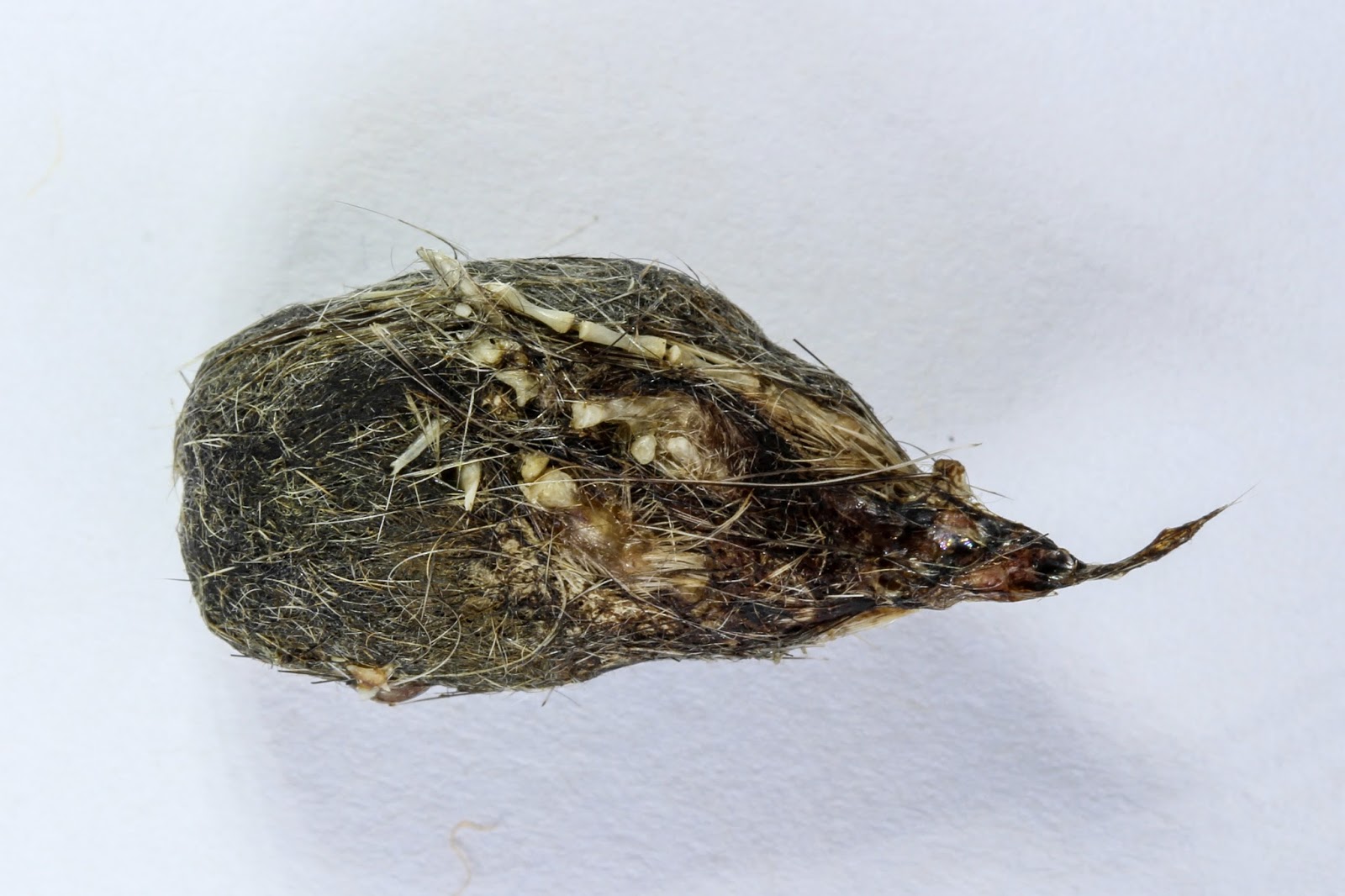
After he had gone I retrieved the pellet.  It was about 30mm long and had a few bits of bone sticking out of it.


This is recognisably the head of a tiny femur.  Having searched online I think it is a mammalian femur, probably that of a bank vole.  The femur of a blue tit looks rather different.  Isn't it amazing what you can find these days?

On this side was a line of bones, probably from a wing.

Once the pellet had dried out I teased it apart.  I had expected to find feathers but it consisted mainly of fur and contained several small bones and fragments of bone.

Here are several of the pieces of bone plus two rodent teeth(!).  The line of bones does look as though it is in the remains of a wing but the other bones could be from rodent or bird.

Here are the teeth, 6mm from end to end.  I think they are upper incisors, possibly from a bank vole, but they have slightly different curvatures and so are probably not both from the same animal.

A male sparrowhawk catches mainly small birds but will also take small mammals.  If it catches a bird it plucks its prey, removing a lot of feathers, and then eats almost everything else.  At the site of a bird kill I can find only feathers and I have watched him swallow the legs, including the feet and claws.  This pellet contains mostly fur and bones and the two teeth prove he is taking small mammals.

I have watched this bird staring at a bank vole below the bird feeder but I haven't seen him try to catch it although, come to think of it, I haven't seen the bank vole recently!

I read that sparrowhawks generally produce one pellet a day, usually first thing in the morning at the roost site.  If they feed well early in the day they may produce a second one in the afternoon.  This one came up at 10.30 am so I don't know if it was a delayed first pellet or an early second one.  So far I haven't found any other pellets, nor seen any others come up, but I'll keep looking.