My Blog List

Showing posts with label Oystercatcher. Show all posts

Monday, 15 November 2021

A grand day out


It seems ages since I last went for a wander up the coast, something I used to do very regularly at this time of year before the pandemic.
  I started at Boulmer and walked north from the village along the beach as the tide was coming in.  The weather was sunny and calm with a flat calm sea.  It is a great place to see waders and here are some of those I came across.

First bar-tailed godwits.  These have been in the news in the past week after one was tracked flying 8108 miles non-stop from Alaska to Australia in 239 hours (almost 10 days) at an average speed of 34mph.  The bird was heading for New Zealand but had to divert over 1000 miles to Australia after encountering headwinds, which makes me wonder how it knew Australia was there.  The godwits I saw are winter visitors from Siberia.


I saw and heard lots of redshanks who know just how deep they can go without getting their feathers wet.


These two spent several minutes fighting but it was difficult to see what it was all about as there was plenty of space for both of them.


Other waders were ringed plovers,

knots,

sanderlings,

dunlins (not a great photo but in for completeness),

turnstones,

and purple sandpipers.


The curlews stayed on the shore as long as possible but were eventually driven into nearby fields by the rising tide.


This is an oystercatcher with a knot and a godwit.

Ducks on the sea were eiders,

wigeons,

and mallards.

One very surprising sighting (to me at least) was little grebe fishing in the sea.  Other birds on the shore or close by included grey herons, carrion crows, rock pipits, pied wagtails, wrens, robins, linnets and house sparrows, some of which I may go back to photograph another time.  Oh, and plenty of seagulls!

Thursday, 3 June 2021

Out and about in May

The birds don't seem to have been much affected by the late spring although the siskins were here until mid May, when they presumably left for the forests to think about nesting.  The starlings were well ahead of them and their chicks fledged on the 16th.  These photos were taken the day before.


Oystercatchers are nesting on a rooftop across the road and come to the golf course to feed.  They seem to be getting juicy grubs rather than worms and are unfazed by the golfers.


May sees the first counts for the BTO Breeding Bird Survey on my 1km squares near Wark Forest and in Harwood Forest.  The first of these was strange this year with only four species recorded (including one pheasant).  The commonest bird was meadow pipit and I stumbled across a nest so I took a quick photo before moving on.  Despite its name the BBS doesn't look for evidence of breeding, just presence in the breeding season.  I'll do another two counts in June.

At Banks Pond the Canada geese have six goslings

and the swans have five cygnets.  There is a lot of conflict between the male swan and the adult geese.


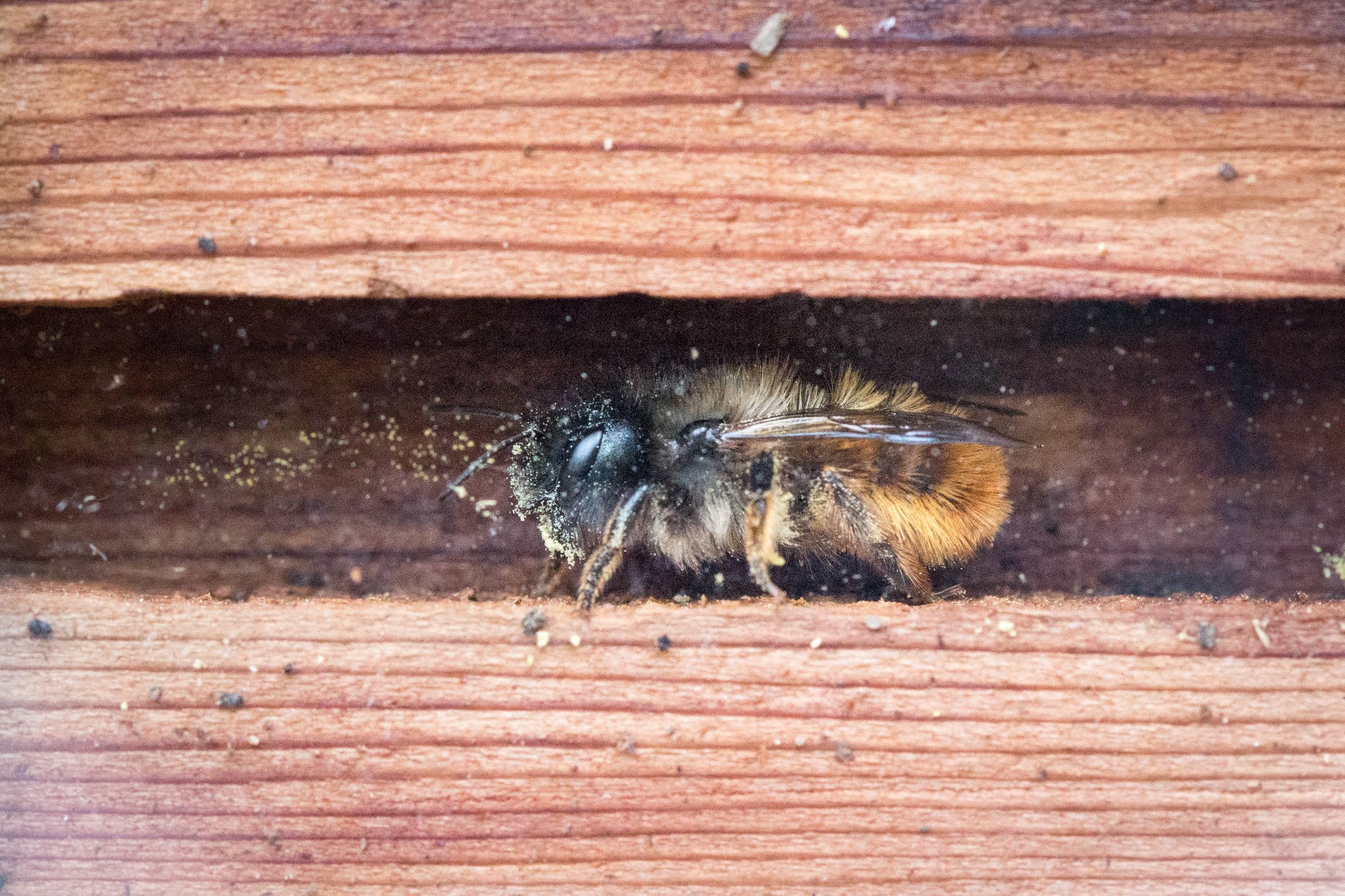
Red mason bees first appeared in the garden in April but then disappeared in the cold weather.  They have been active again in the past week or so.  Two females are building in my observation bee house.


This poor bee tried to fly through the spray from my watering can.  I picked her up and sat her on my finger while she got herself warmed up and dried off a bit, although she lost much of her pollen load.  I think she is a chocolate mining bee (Andrena scotica).

My meadow is in its second year and is already looking better than last year (when there was a drought in spring).  It was satisfying to see a female orange tip butterfly on lady's smock.

Damselflies were out and about by mid May and I have seen large red,

common blue,

azure,

and blue-tailed damselflies.

It was only on the last day of the month that I saw my first dragonflies of the year, four-spotted chasers.  Their emergence is a couple of weeks later than last year - I expect they have been waiting for some decent weather.  The first sign was an exuvia, the discarded exoskeleton of the larva.

Close by was a brand new dragonfly about to make its maiden flight.

This one was still resting on its exuvia, with a damselfly exuvia close by.

As I watched, most of these dragonflies few into the nearby trees where they will stay for a few days until returning to the pond.

It feels as if the calendar has slipped a month.  We had March weather in April and have now had April weather in May. Apart from the last three or four days May was cold and wet, so the spring is late for some things, especially plants and insects.

Monday, 3 May 2021

Out and about in April

It has been a good month for seeing birds in my garden, mostly under the feeders just outside the kitchen window.  The most exciting sighting was a male brambling.  It was only here for a day but I saw it several times throughout the day. By now I expect it is back in Scandinavia or in northern Scotland waiting for a favourable wind for the crossing.

The siskins turned up at the end of March and have been here every day since.  I see at least two females and at least two males but never more than four together.  There may be only four.


Blackcaps arrive from Africa every April and they turned up on time again this year.  There have been two singing males in the copse.  Twice I caught a glimpse of one opposite the front door when I didn't have a camera ready.  The good news is that once when I was waiting with a camera a female turned up, attracted by the song.

I think blackcaps must nest in the garden every year but once the singing stops in May I don't see any sign of them until the youngsters emerge in the summer.  I have never seen an overwintering blackcap but I hear tell of them not far away.  Maybe one winter mine will stay.

Another April visitor every year, but from much closer by, is a male reed bunting.  This one probably came from the nature reserve just north of here.  I expect there isn't much to eat there in April.  Interestingly I have never seen a female here.

Tree sparrows must be well advanced with their nest building.  They can have two or three broods in a season so they need to start early.

I noticed a couple of odd-looking stock doves last month.  This one has scorched-looking primaries so I sent a photo to the BTO and their expert commented that it looks like a genetic or growth problem, which doesn't add much.  The bird seems well.

This one probably has avian pox virus.  It mostly affects tits, sparrows, dunnocks and starlings.  I haven't seen any other affected birds so it probably isn't anything to be concerned about at this stage.

The sparrowhawk still visits regularly but I rarely see it sitting now.  One one occasion it perched on top of the finial on my gazebo after an unsuccessful attack for just long enough for me to get a distant photo.

The dry weather has been tough for birds that rely on earthworms and other soil invertebrates.  Very early one morning I saw this oystercatcher on the golf course opposite the kitchen window, taking advantage of the fact that the greens have been watered.  The oystercatchers arrived to take up their nest sites on the roof of a building across the road in February.  I hope to see one foraging in my garden again in the summer.

The easing of lockdown has meant we are able to travel farther but the cold weather hasn't encouraged expeditions, mainly because the spring is delayed.  In Northamptonshire at the beginning of the month I saw hairy-footed flower bees (Anthophora plumipes), such as this male,

and tawny mining bees (Andrena fulva), such as this female.

At home I saw my first red mason bees (Osmia bicornis).  This male is investigating a hole in the dead sycamore.

This female is sheltering from the cold in the bee house but hasn't started building a nest yet - not here, anyway.  She is adopting a defensive posture, with her middle leg raised, because I have opened the side.

Also in the bee house on the same day was a sleeping queen common wasp (Vespula vulgaris).

At Belsay Hall I saw red-tailed bumblebees (Bombus lapidarius),

whit-tailed bumblebee (Bombus lucorum),

buff-tailed bumblebees (Bombus terrestris),

and common carder bees (Bombus pascuorum).

Also at Belsay I saw blue tits and great tits taking nectar from a very fragrant rhododendron.  I have seen blue tits with pollen on their faces before but have never witnessed this behaviour.


This April may not have been the cruellest month but it was cold and dry.  There was a little bit of rain in the last four days but overall rainfall was very low.  And it was the frostiest April for 60 years.


May isn't starting off much better.  Spring so far is quite late so it will be interesting to see what effect that has on the natural world.