My Blog List

Showing posts with label Red mason bee. Show all posts

Saturday, 8 June 2024

Daylight robbery


I have seen bumblebees 
robbing nectar from comfrey flowers before but as far as I remember I haven't seen this behaviour from solitary bees.  Nectar robbing is when a bee takes nectar from the flower through a hole bitten in the side rather than entering normally and offering pollination, especially a bee with a tongue too short to reach the nectary.  I suspect the holes were made by bumblebees and the others were just taking advantage.  This is a Buff-tailed Bumblebee

and an Early Bumblebee.

A Common Carder Bee was doing it properly.

This was earlier in the week on the comfrey in the corner of the kitchen garden.  The most numerous bees were male red mason bees.


They were also patrolling the flowers in the vain hope of finding a new female.  In reality all the females are busy provisioning their nests and the males don't have long to live but that didn't stop them challenging and knocking each other off the flowers.

Female red masons were also robbing, obviously getting just nectar here and collecting their pollen elsewhere.

The most surprising to me was a nomad bee, a cuckoo that lays its eggs in solitary bees nests (usually mining bees).

It all goes to show that sometimes crime does pay.  You can read more about the biology of nectar robbing here.

Saturday, 22 July 2023

News from the bee house

Fortunately the solitary bee season coincided with warm sunny weather in late spring and early summer.  Now it is wet and gloomy the season is almost over but it has been fascinating to watch and mostly very successful for the bees.  The most numerous residents of the bee houses are always red mason bees.  This is a female in the observation wing having a brief rest before setting off to forage again.

In most previous years I have had between half a dozen and a dozen completed red mason bee nests.  This year, with my new bee house, I have about 80!  Here are 34 of them.

In the next photo the rear cell is complete with a food store of pollen and nectar and an egg. Work has started on the front one contains a bit of pollen and a pool of regurgitated nectar.


A few days later it looks like this.

Here is another bee coming back with a load of pollen.

The bees always reverse in to unload pollen.

Here are a couple of bees plugging the entrances to their nests.

There was one blue mason bee nest from last year with nine cells.  The front six were males. This is one of them.

Once they had chewed their way out of their cocoons five of them sat in the nest for another 24 hours before deciding to brave the outside world.

The females emerged a few days later and one of them moved into my new bee house.

She uses chewed leaves rather than mud to the build the cells.

Here she is in the precess of laying an egg.

Another bee in the new house was a common yellow face bee (Hylaeus communis) but she completed only three cells.  She made several more cellophane walls along the hole before sealing it so three was all she planned.  The nectar pollen mix she brought in was almost black.

The observation part of my original bee house is still in use and this year, for the first time, it was host to a leafcutter bee.  I was very pleased until I realised that she was lining the cells first before working on them so I couldn't see what was going on!  The nest was in an old red mason nest, hence the mud lining.


The bee house has a wire mesh covering as protection against woodpeckers.  Rather than risk dropping the leaf if she flew through the mesh, this bee flew in the bottom each time and then flew vertically upwards to reach the nest.

I was struck by the precision in the final work to seal the nest.

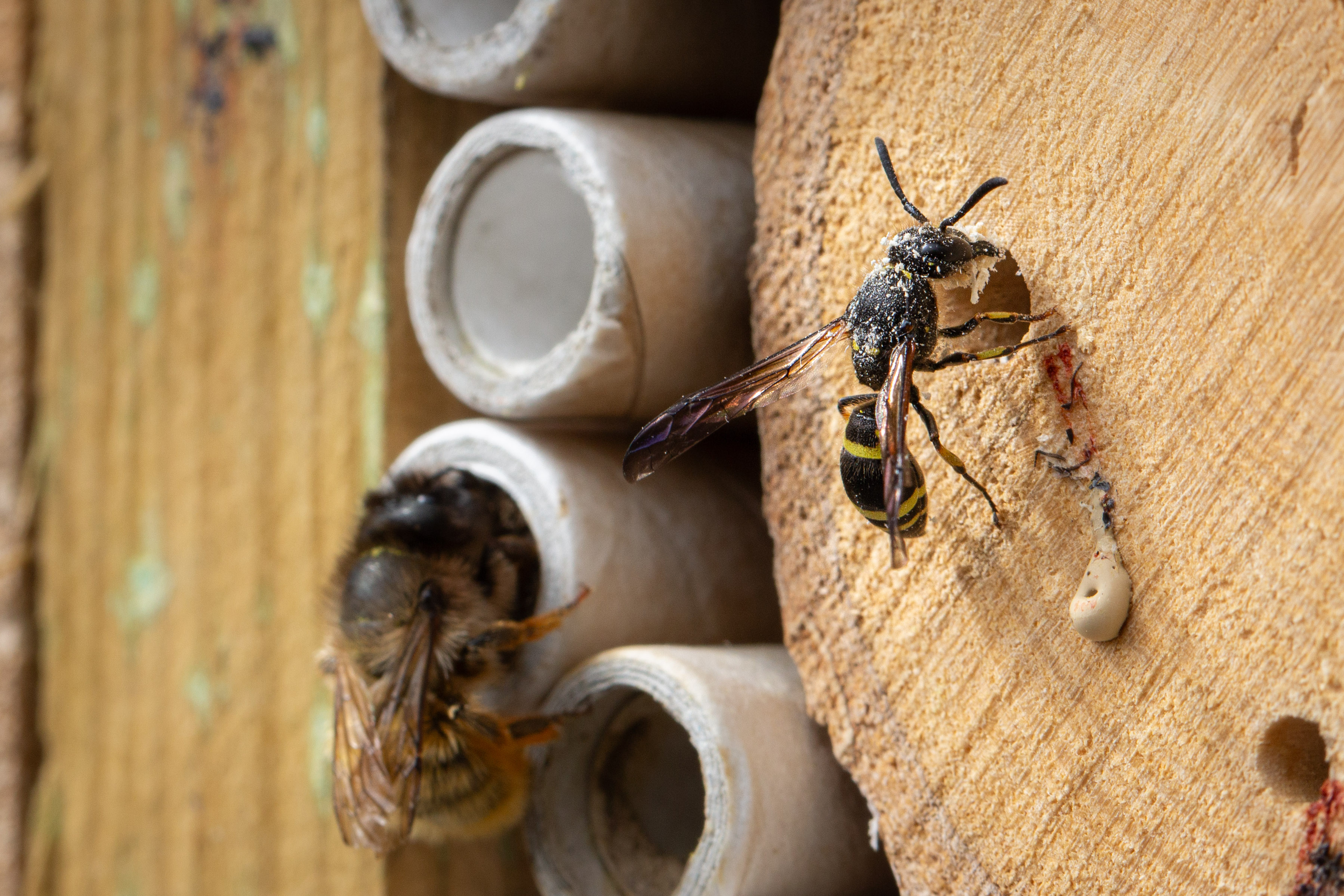
Another resident of the "bee" house was a mason wasp, a solitary wasp that uses mud in the same way as the red mason bee does.  It used a smaller hole and filled the cells with caterpillars rather than pollen.  Here it is clearing out sawdust before starting to build cells, with a red mason bee in the background.

There were other solitary wasps which were tiny.  They made their own holes in the wood, about 1mm in diameter, and stocked them with aphids.  Louise Hislop, our local bee & wasp expert, says they are Passaloecus sp. females.


Perhaps the most exciting bees I saw in the bee house were fork-tailed flower bees.  They nest in rotten wood so I made one panel out of dried rotten wood, specifically in the hope that they would move in.  I made three small starter holes and was surprised and delighted to see that for several days two of them were excavated by female fork-tailed flower bees.  But although I often saw the bees pushing their way out through clouds of sawdust I never saw them going in with pollen.  I wonder if they didn't fancy the holes after all after all that digging.  With luck they did continue when I wasn't looking.  I'll be able to remove the panel later in the year to take a look.


I am already making plans for next year, to make sure there will be room for perhaps an even larger population of bees.


Friday, 23 June 2023

A sinister visitor


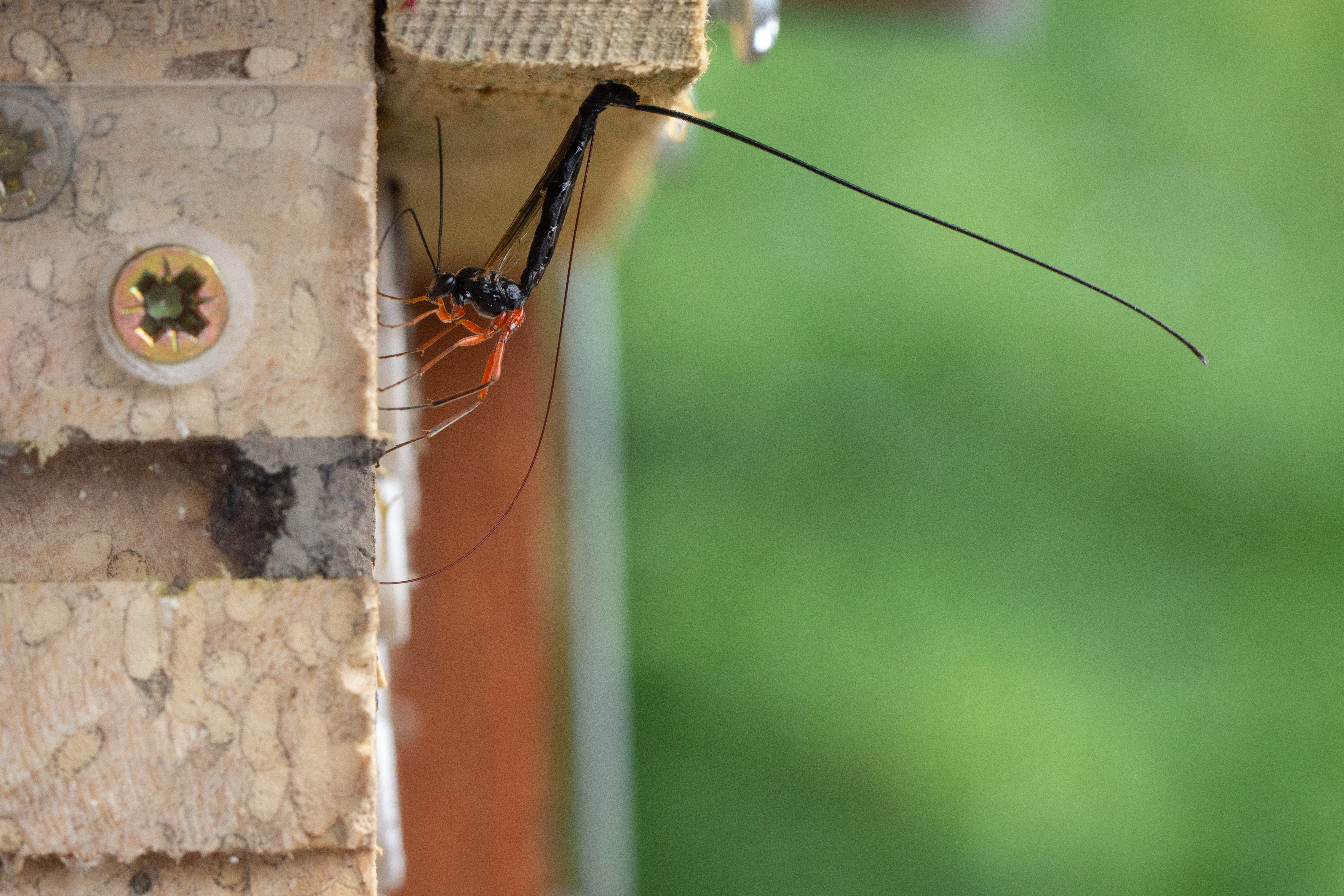
My new bee house is covered in a wire mesh as protection against birds but it is no match for this predator.  This is a female ichneumonid wasp, a parasitoid of solitary bees, possibly Ephialtes manifestator, although ichneumonids aren't easy to identify.  I first saw this one with her very long ovipositor already through the mud seal on one of the completed red mason bee nests.  She was constantly twisting her body to manipulate the tip of the ovipositor by feel to penetrate one of the cells inside.  Once in she lays an egg which will hatch and the larva will devour the bee larva and all the stored pollen and nectar in the cell.  It will then metamorphose into a wasp and wait until next spring to emerge, along with the surviving bees.


At one stage the ovipositor was in up to the hilt (40mm or so) so it may have penetrated more than one cell inside.  The ichneumonid was already in position when I noticed it and it was over 75 minutes before it withdrew, showing extraordinary patience.


Then it was sniffing around the other cells, looking for another opportunity, bending its antennae like this as it probed the mud seal.

At one stage it was considering this blue mason bee nest but couldn't see what I could see, that the completed nest is only half full and the cells would have been out of reach.

The next day it was back, this time attacking a red mason bee nest in the observation section.

After selecting the target it withdrew the ovipositor from its sheath and very carefully probed the mud seal.


And after only two minutes it was through.

Then it spent another 59 minutes trying to get past the second wall but failed, and eventually gave up.


I had thought the empty chamber, which is often at the front of the nest, to be a defence against birds but it will be equally effective against this kind of attack.

There are lots of other parasites around the bee house.  Some, such as this Sapyga quinquepunctata, a parasitic wasp, sneak into an unfinished nest to lay an egg while the owner is away.


Ichneumonids wait until the nest is complete and the host larva is growing before they attack. Another one I see quite often is Gasteruption jaculator which is smaller than Ephialtes manifestator and has a shorter ovipositor, probably targeting small solitary wasps and bees.