My Blog List

Showing posts with label Blue mason bee. Show all posts

Saturday, 22 July 2023

News from the bee house

Fortunately the solitary bee season coincided with warm sunny weather in late spring and early summer.  Now it is wet and gloomy the season is almost over but it has been fascinating to watch and mostly very successful for the bees.  The most numerous residents of the bee houses are always red mason bees.  This is a female in the observation wing having a brief rest before setting off to forage again.

In most previous years I have had between half a dozen and a dozen completed red mason bee nests.  This year, with my new bee house, I have about 80!  Here are 34 of them.

In the next photo the rear cell is complete with a food store of pollen and nectar and an egg. Work has started on the front one contains a bit of pollen and a pool of regurgitated nectar.


A few days later it looks like this.

Here is another bee coming back with a load of pollen.

The bees always reverse in to unload pollen.

Here are a couple of bees plugging the entrances to their nests.

There was one blue mason bee nest from last year with nine cells.  The front six were males. This is one of them.

Once they had chewed their way out of their cocoons five of them sat in the nest for another 24 hours before deciding to brave the outside world.

The females emerged a few days later and one of them moved into my new bee house.

She uses chewed leaves rather than mud to the build the cells.

Here she is in the precess of laying an egg.

Another bee in the new house was a common yellow face bee (Hylaeus communis) but she completed only three cells.  She made several more cellophane walls along the hole before sealing it so three was all she planned.  The nectar pollen mix she brought in was almost black.

The observation part of my original bee house is still in use and this year, for the first time, it was host to a leafcutter bee.  I was very pleased until I realised that she was lining the cells first before working on them so I couldn't see what was going on!  The nest was in an old red mason nest, hence the mud lining.


The bee house has a wire mesh covering as protection against woodpeckers.  Rather than risk dropping the leaf if she flew through the mesh, this bee flew in the bottom each time and then flew vertically upwards to reach the nest.

I was struck by the precision in the final work to seal the nest.

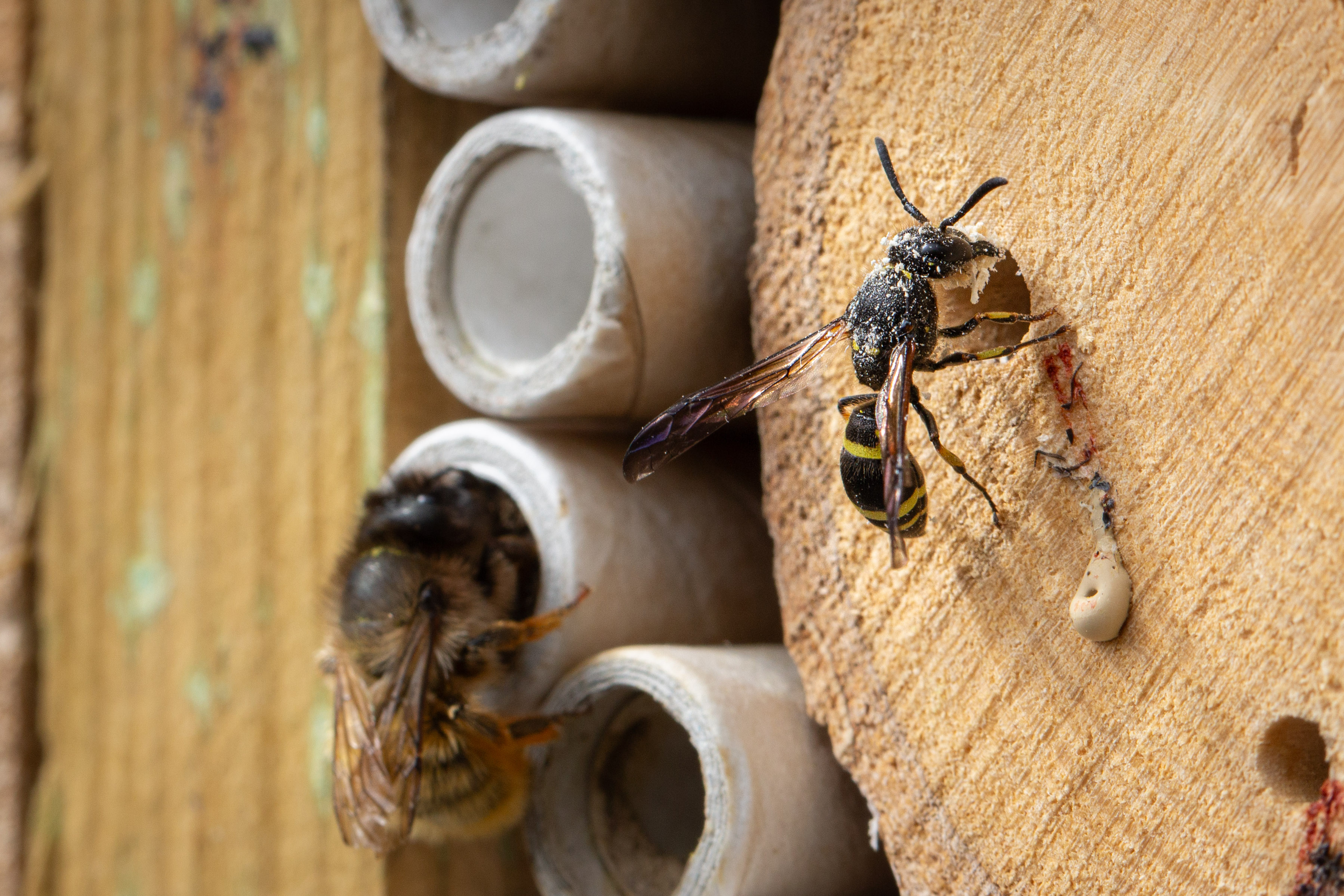
Another resident of the "bee" house was a mason wasp, a solitary wasp that uses mud in the same way as the red mason bee does.  It used a smaller hole and filled the cells with caterpillars rather than pollen.  Here it is clearing out sawdust before starting to build cells, with a red mason bee in the background.
There were other solitary wasps which were tiny.  They made their own holes in the wood, about 1mm in diameter, and stocked them with aphids.  Louise Hislop, our local bee & wasp expert, says they are Passaloecus sp. females.


Perhaps the most exciting bees I saw in the bee house were fork-tailed flower bees.  They nest in rotten wood so I made one panel out of dried rotten wood, specifically in the hope that they would move in.  I made three small starter holes and was surprised and delighted to see that for several days two of them were excavated by female fork-tailed flower bees.  But although I often saw the bees pushing their way out through clouds of sawdust I never saw them going in with pollen.  I wonder if they didn't fancy the holes after all after all that digging.  With luck they did continue when I wasn't looking.  I'll be able to remove the panel later in the year to take a look.


I am already making plans for next year, to make sure there will be room for perhaps an even larger population of bees.


Wednesday, 3 August 2022

A blue mason in the lodge


This little bee appeared in my new bee house on 18th May.  It is a female blue mason bee (Osmia caerulescens) and is the first I have seen.  In the photo above it is in a 4mm hole so you can judge its size.  The next photo shows a red mason bee (below) in an 8mm hole and the blue mason (above) in a 4mm hole to give a size comparison.

Unlike red mason bees, which build the cell walls in their nests with mud, the blue mason bee uses chewed up leaves.  This bee sat around for two weeks but eventually started the first cell on 2nd June.

She then did nothing else until 14th June when she eventually restarted work.  You can see that the pollen she was collecting is mostly grey, probably raspberry as the summer-fruiting raspberries were in flower at the time.

I am puzzled by the delay.  Blue mason bees are scarce locally - Steven Falk's book describes it as "rather localised and rarely common anywhere".  I have only ever seen one male before, four years ago - so I wonder if she was having difficulty locating a mate.  Here is the male blue mason bee from four years ago.  He's smaller than the female.


After the slow start this year's female got on with the job.  Two days later her third cell was almost complete.

Here the bee is regurgitating more nectar onto the pollen in the third cell.

Because there is no room to turn round she then has to reverse to the entrance, turn around,

and reverse back in to unload more pollen from the scopa (pollen brush) under her abdomen.

A short while later the next cell wall is almost complete.

And then on to the next one.  By this time she was also collecting pale yellow pollen.  First more nectar,

then turn around again,

more reversing (you can see the pale pollen on her scopa),

and then unloading the pollen with her back legs.

After the delayed start she eventually completed nine cells in nine days.  The nest is sealed with masticated leaves as well.


Like the red mason bees, she left a space at the front with a false wall to discourage predation or parasitisation.

Here is the bee resting on the garage door, her life's work complete.  That is the last I saw of her.

And this is how it looks now, with a red mason nest above.  Each of the nine cells contains a larva, soon to spin a cocoon and metamorphose into a bee.


Then the bees wait until next spring before emerging to start the cycle over again.  I hope I'll be waiting with a camera to see them emerge.

My first observation bee house contained only 8mm holes.  I am very pleased I provided the 4mm and 6mm holes as well in this one.  Other things have also taken advantage of the smaller holes - more news to follow!

Wednesday, 9 May 2018

Red and blue

I always look forward to the emergence of the red mason bees (Osmia bicornis).  The first males appeared in the garden six days ago, 3rd May, precisely the same date as they appeared last year.  This, despite last year having a warm spring and this year being cold.  When the males emerge they whizz around the garden constantly checking the flowers, the bee house and all the holes in the wall for signs of a new female.  Here is one sniffing out the bee house.

In recent years there has been a two or three week delay between the emergence of the first males and the first females but this year several females were flying three days ago, 6th May.  Perhaps they were encouraged to appear early by the warm weather we have had.  I expect they mate shortly after emergence and then spend time prospecting for a nest hole.  These were checking out the bee house.


I bought some red mason bee cocoons to boost the local population and put the four smallest (assuming they would be males) and the four largest (females) in the observation wing of the bee house, hoping to watch them emerge. However, despite checking regularly I missed all the males.  I suppose it only takes a few minutes for them to chew their way out.  I must have been very lucky to see a female emerge last summer.

At the time of writing the four female cocoons have not yet produced new bees but one other female has already started building her in her chosen nest hole.  Here you can see the first cell almost complete.  This bee does seem agitated when I open the side to see what is going on so I intend to leave her in peace and only look in when I know she is not at home.  I'll post more photos when I have them.

Last winter I also drilled some holes in a couple of dead sycamores outside the front door, hoping that bees might move in.  The male red masons have been checking them out regularly.

I have also seen female red masons investigating the tree.

Then while I was watching I spotted this bee.

He looks and behaves like a red mason bee but is smaller and is the wrong colour.  He paused on the tree for a few seconds so I could take some photos.  He has a blue/green colouration with ginger fur and green eyes.  I checked in Steven Falk's field guide and then with the BWARS Facebook page and this is a blue mason bee (Osmia caerulescens), a species I have never seen before.


The female of this species is not the prettiest bee but she uses chewed up leaves (as opposed to the red mason bee's mud) to construct the cell walls in her nest.  I'll be on high alert over the next week or two trying to find a female, perhaps even in one of these holes in the trees.

All the bees, whether red or blue, have to be on guard as they look for nest holes as this one contains a nasty surprise.