My Blog List

Showing posts with label Ichneumonid. Show all posts

Saturday, 22 July 2023

News from the bee house

Fortunately the solitary bee season coincided with warm sunny weather in late spring and early summer.  Now it is wet and gloomy the season is almost over but it has been fascinating to watch and mostly very successful for the bees.  The most numerous residents of the bee houses are always red mason bees.  This is a female in the observation wing having a brief rest before setting off to forage again.

In most previous years I have had between half a dozen and a dozen completed red mason bee nests.  This year, with my new bee house, I have about 80!  Here are 34 of them.

In the next photo the rear cell is complete with a food store of pollen and nectar and an egg. Work has started on the front one contains a bit of pollen and a pool of regurgitated nectar.


A few days later it looks like this.

Here is another bee coming back with a load of pollen.

The bees always reverse in to unload pollen.

Here are a couple of bees plugging the entrances to their nests.

There was one blue mason bee nest from last year with nine cells.  The front six were males. This is one of them.

Once they had chewed their way out of their cocoons five of them sat in the nest for another 24 hours before deciding to brave the outside world.

The females emerged a few days later and one of them moved into my new bee house.

She uses chewed leaves rather than mud to the build the cells.

Here she is in the precess of laying an egg.

Another bee in the new house was a common yellow face bee (Hylaeus communis) but she completed only three cells.  She made several more cellophane walls along the hole before sealing it so three was all she planned.  The nectar pollen mix she brought in was almost black.

The observation part of my original bee house is still in use and this year, for the first time, it was host to a leafcutter bee.  I was very pleased until I realised that she was lining the cells first before working on them so I couldn't see what was going on!  The nest was in an old red mason nest, hence the mud lining.


The bee house has a wire mesh covering as protection against woodpeckers.  Rather than risk dropping the leaf if she flew through the mesh, this bee flew in the bottom each time and then flew vertically upwards to reach the nest.

I was struck by the precision in the final work to seal the nest.

Another resident of the "bee" house was a mason wasp, a solitary wasp that uses mud in the same way as the red mason bee does.  It used a smaller hole and filled the cells with caterpillars rather than pollen.  Here it is clearing out sawdust before starting to build cells, with a red mason bee in the background.
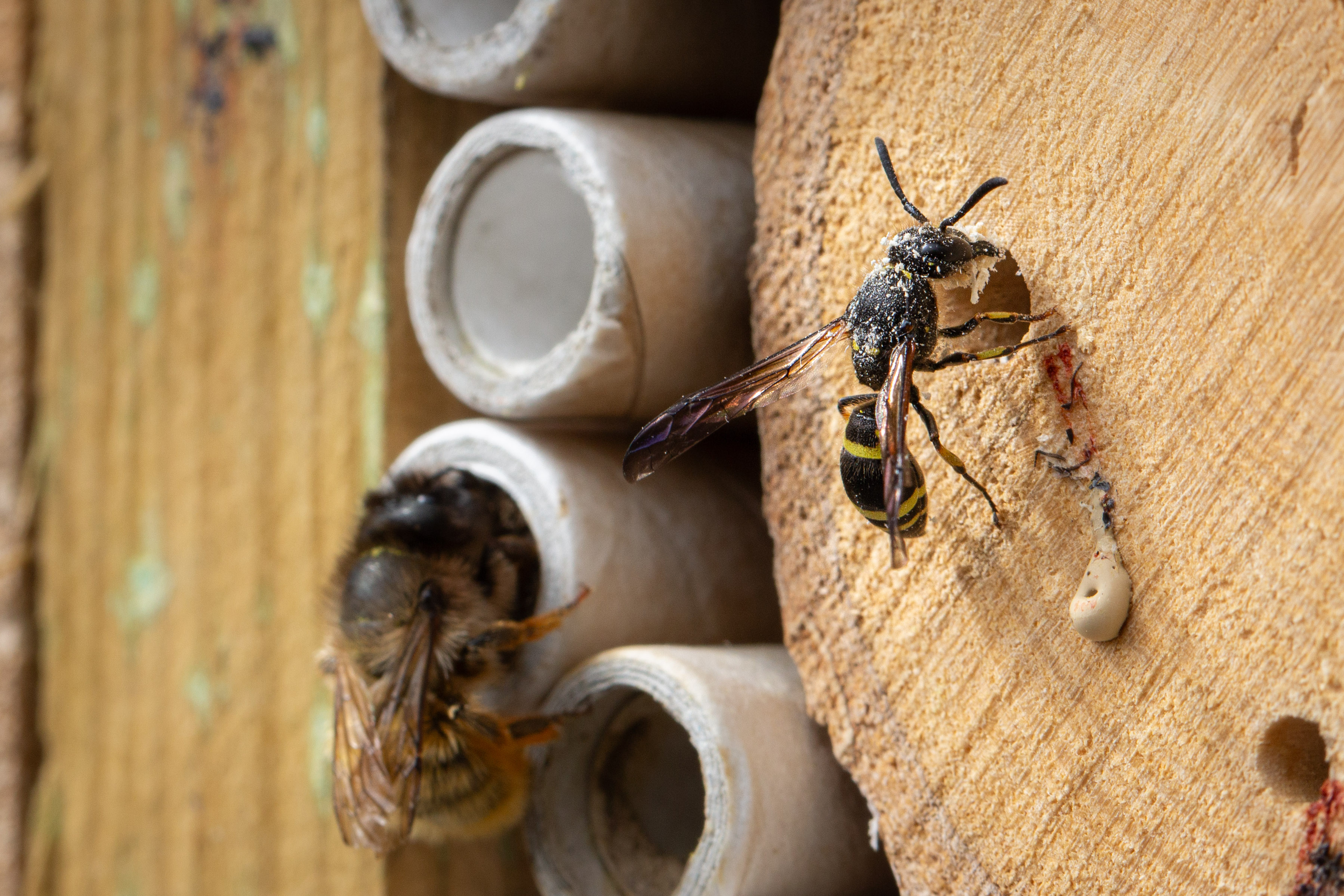
There were other solitary wasps which were tiny.  They made their own holes in the wood, about 1mm in diameter, and stocked them with aphids.  Louise Hislop, our local bee & wasp expert, says they are Passaloecus sp. females.


Perhaps the most exciting bees I saw in the bee house were fork-tailed flower bees.  They nest in rotten wood so I made one panel out of dried rotten wood, specifically in the hope that they would move in.  I made three small starter holes and was surprised and delighted to see that for several days two of them were excavated by female fork-tailed flower bees.  But although I often saw the bees pushing their way out through clouds of sawdust I never saw them going in with pollen.  I wonder if they didn't fancy the holes after all after all that digging.  With luck they did continue when I wasn't looking.  I'll be able to remove the panel later in the year to take a look.


I am already making plans for next year, to make sure there will be room for perhaps an even larger population of bees.


Saturday, 8 June 2019

A walk round the pond - Week 23

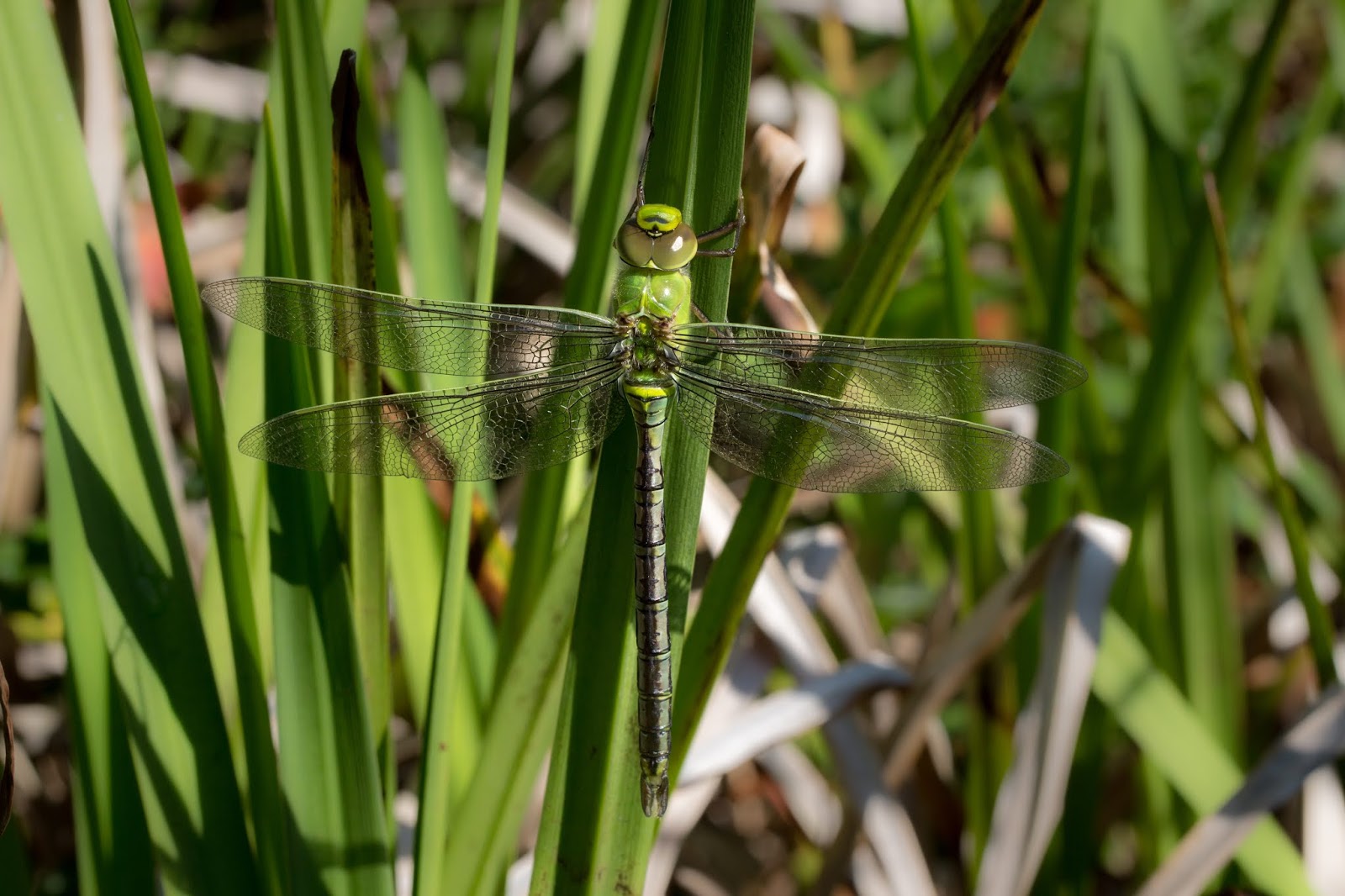
At last!  Some dragonflies.  As I started walking back to leave yesterday morning I saw something flying ahead of me, just above the reeds.  Its silver wings were glinting in the sunshine as it dropped down into the reeds.  When I caught up I couldn't see anything at first and then I spotted this.

It is a teneral male emperor dragonfly (Anax imperator) which had just made its maiden flight.  It was sunning itself as its wings continued to harden.

After a while it flew a few metres farther from the water to rest in the grass.  The abdomen will turn bright blue as it matures.

You can see how well it is camouflaged, useful as at this stage it isn't a strong flier.

This is just about as far north as the emperor gets.  Here is the distribution map on iRecord for the past 10 years.

The emperor wasn't the only new dragonfly of the week.  Four weeks later than last year I finally saw a four-spotted chaser (Libellula quadrimaculata).  There were only three, whereas by this time last year there were probably a couple of dozen flying around.  I don't know why the delay as the other species have emerged on time - the emperor was on precisely the same date as I first saw one last year.


There were many dozens of blue damselflies this week, mostly common blues.

These azure damselflies came to grief in an old spider's web.

These two were also being harassed by another male.

There were still plenty of large red damselflies.

But only occasional blue-tailed damselflies.

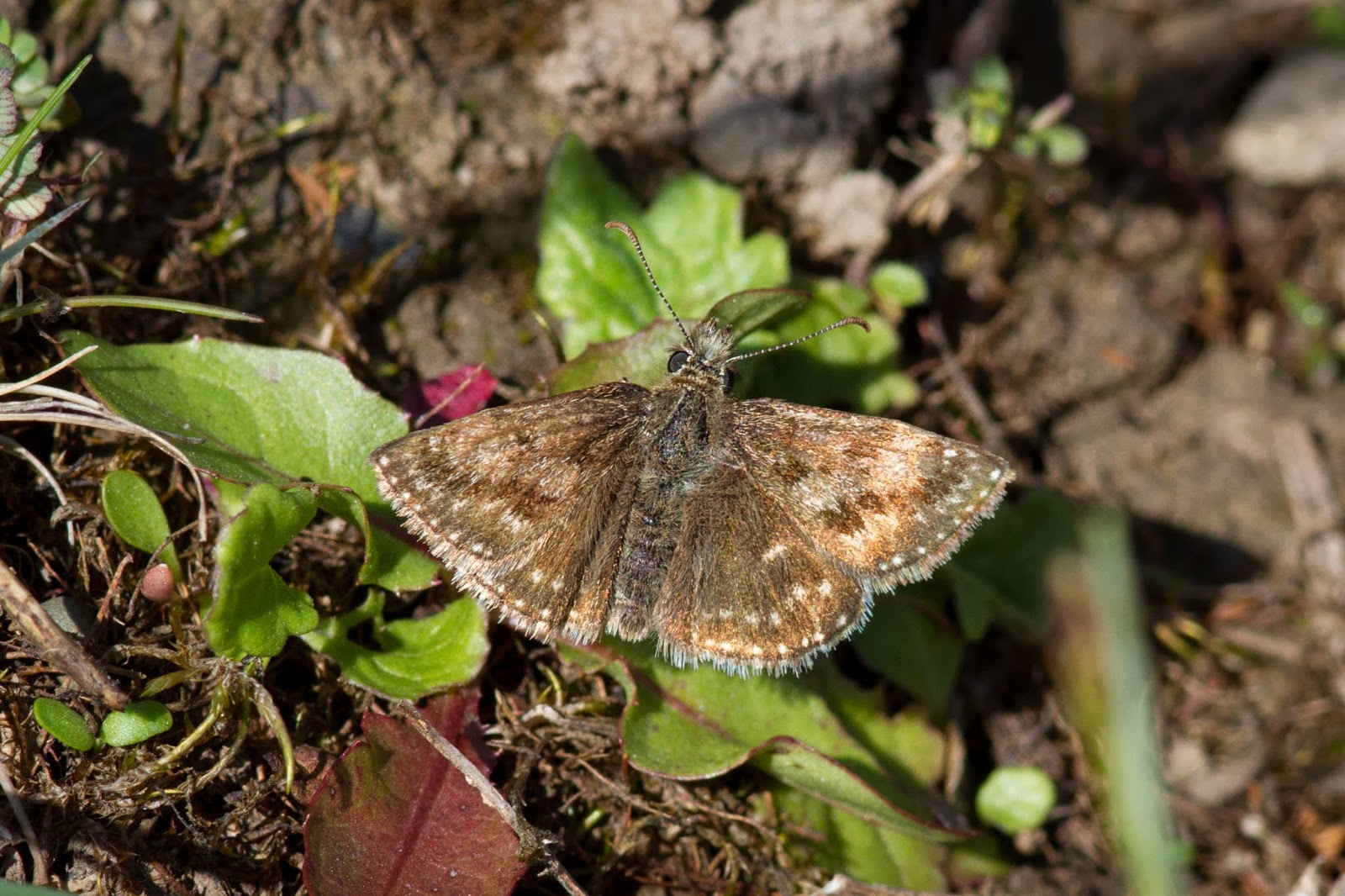
Butterflies this week included common blue,

dingy skipper,

and small copper.

A couple of other interesting insects I saw were this ichneumonid, one of the 2500 UK species,

and a beautiful bejewelled beetle, one of the 4000 UK species.

Plenty of warblers were still singing including blackcaps, chiffchaffs, common whitethroats and willow warblers.  All were typically shy but I did spot a willow warbler.

Long-tailed tits are much more obliging.  There was a large tribe in the hedges, with many young fledglings.


This is a youngster (R) with an adult (L).

Next week I hope to see more chasers and an emperor on patrol.