My Blog List

Showing posts with label Banks' Pond. Show all posts

Tuesday, 7 October 2025

September Ladybirds

Apart from the excitement of the Scarce 7-spot Ladybird and the Hieroglyphic Ladybird there were several other good finds last month.  The smallest ladybird I have seen, and the equal smallest anywhere at 1.1-1.5mm, was the appropriately named Dot Ladybird, another new species from my mother's garden in Northamptonshire.
 

Not quite as small but also black and hairy was a Forestier's Ladybird.

Closer to home I found another small black hairy one, a Scymnus nigrinus,

and another very small ladybird, a Scymnus suturalis,


Also several Adonis Ladybirds,

a 2-spot Ladybird form typica,

and the less common and more striking 2-spot f. sexpustulata.

Rather more camouflaged were a Larch Ladybird,

an 18-spot Ladybird,

and a Striped Ladybird.

Others were an Eyed Ladybird,

a Pine Ladybird,

and a Cream-spot Ladybird.

And finally more Hieroglyphic Ladybirds.  This one was in Elemore Park in Co Durham,

and a rare black form in Havannah, just down the road.

By next month all the ladybirds will be hibernating and attention will shift to overwintering sites such as gravestones.

Saturday, 17 September 2022

WeBS


I signed up to count waterbirds for the Wetland Bird Survey (WeBS) on Banks' Pond at Dinnington last year and I have just completed the first 12 months observations.  WeBS is a partnership funded by the BTO, the RSPB and the JNCC.  It has been collecting data on wetland birds since 1947.  Synchronised counts take place every month with 3000 volunteer counters making 40,000 visits each year to 2800 sites.  "Waterbirds" includes wildfowl (ducks, geese and swans), waders, rails, divers, grebes cormorants and herons and counts of gulls and terns are optional.  Many sites are coastal or estuarine or on large inland water bodies so my site is one of the smallest.

I have seen 12 species in the first 12 months, many predictable but one or two surprises.  I haven't been trying to photograph them as many are shy and I have to do much of the observation from the bridle path before entering the site.  The list of birds is: 

Canada goose
Coot
Grey heron
Little grebe
Mallard
Moorhen
Mute swan
Shelduck
Teal
Tufted duck
Wigeon
Woodcock

All except grey heron, shelduck, teal, wigeon and woodcock breed at the site.  Woodcock is the only "wader", although it doesn't do much wading, and I didn't see any gulls or terns.  The only other bird I can remember seeing in the past while looking for other things (especially dragonflies and bumblebees) is greylag goose.  Previously I have only been to the pond regularly in summer so it will be interesting to see what else turns up with regular winter visits.

The mute swans have been very successful this year with eight cygnets.  Here they are in May

and in September.

The adult swans can't leave until the cygnets can fly, later in the year.  The male swan has been very aggressive towards the Canada geese this year and in the end they managed to raise only one gosling.  I don't know whether the swan had anything to do with the demise of the other goslings but I have my suspicions.  Young geese learn to fly much more quickly than swans so I expect they were pleased to be able to escape a few weeks ago.  I wonder if they will try again next year or find somewhere quieter.

Monday, 5 July 2021

Bee orchid


I usually visit my local pond to look for dragonflies and butterflies but this time it was to see the bee orchids.  One or two have been there before but this time I counted at least 25 flower spikes.

It isn't a rare plant and is happiest in dry, poor chalk or limestone grassland so the recent drought might have suited it.


In the UK the bee orchid is self-pollinating but in Mediterranean regions it is pollinated by male long-horned bees which are fooled by the appearance and scent of the flower into mistaking it for a female bee.  The bee orchid is Ophrys apifera, ophrys being Greek for eyebrow and apifera Latin for bee-carrying.  Here are a few more photos.


Saturday, 3 October 2020

Out and about in September

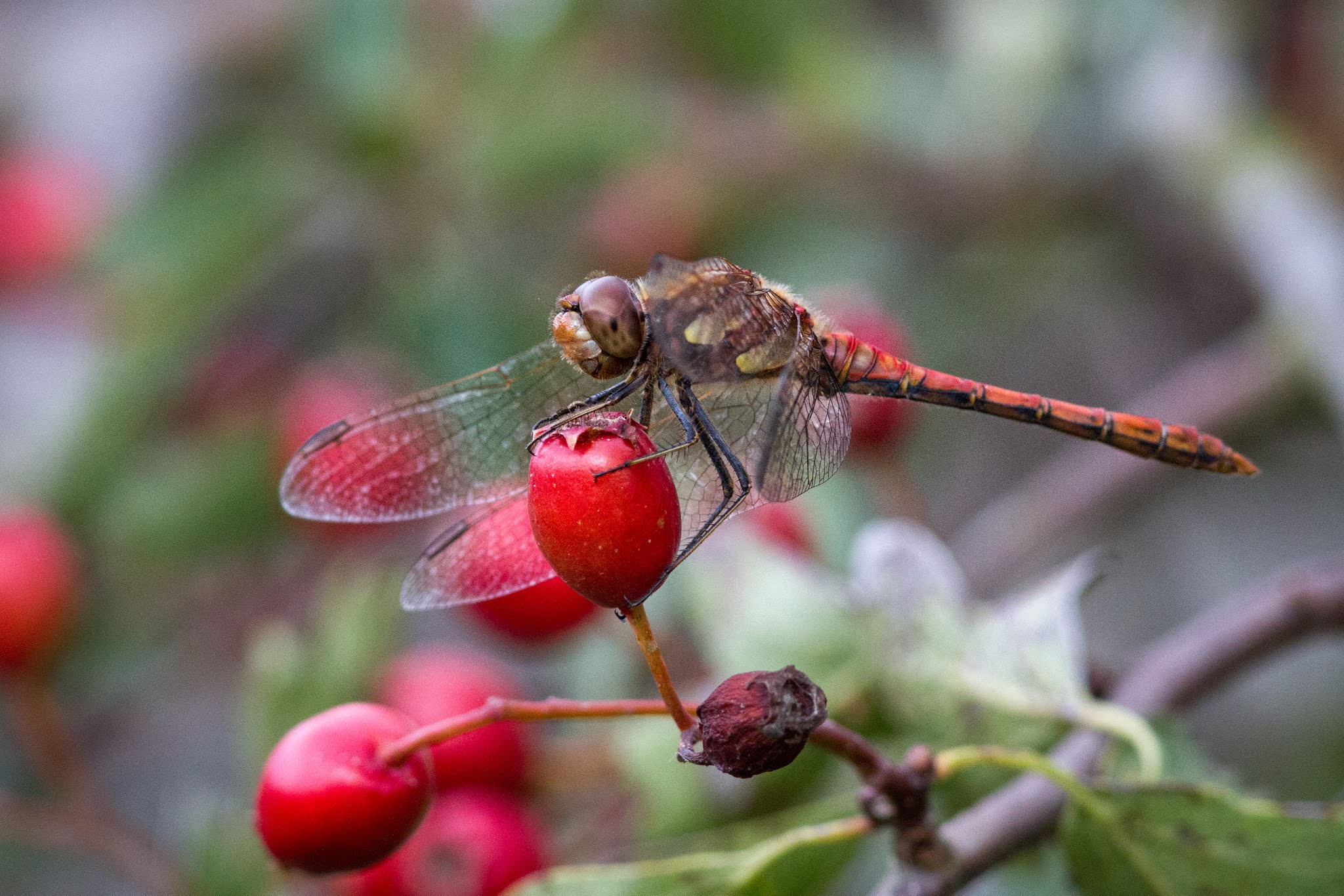
I saw this handsome male migrant hawker sunning himself a couple of weeks ago and took his photo.

When I returned about 10 minutes later I found a female migrant hawker on the very same branch about 3cm lower.  It is obviously a popular spot.

Here's another view of the male.

And another female, this one with blue male-type (andromorph) colouring.


I also tried some flight shots.


This rather shy female migrant hawker was ovipositing in Weetslade Country Park.


Southern hawkers are just about at the end of their season so I was pleased to see a male in Gosforth Nature Reserve. The only camera I had was in the phone which usually gives good quality photos but this pinched zoom was disappointing.  Just a record shot.

Common darters will be around for a few weeks yet if the weather is OK.  There were still newly emerged immatures.

This is a male.

And a rather mature female, almost grey.

These two, ♀ and ♂, were hoping to soak up a few rays of sun.


This was probably my last ruddy darter of the season.

Butterflies I saw included common blue,

green-veined white,

and speckled wood.

This was the only bumblebee I saw in the whole 1km transect on my monthly BBCT Bumblebee Walk.  It is obviously a cuckoo of some kind and is a bit faded but I wasn't sure which species.  After seeking expert advice it can only be narrowed down to Bombus bohemicus/vestalis so I don't feel too bad.

I also saw this ichneumon out hunting.

It is not easy to identify.  There are 2500 species in this country, many of which are very similar.  This page from the wonderful Natural History Museum Beginner's guide to identifying British ichneumonids illustrates the problem.

There seems to be more Robin's pincushion around than usual.  It is a gall on wild rose caused by a tiny wasp, Diplolepsis rosae, so that is one species that is doing well.

Two more swans have arrived at Banks' Pond and are throwing their weight around, trying to intimidate the surviving resident female and her two remaining cygnets.

The youngsters are several weeks away from being able to fly so at the moment they have no escape.  I hope it turns out well for them after all they have been through.

This young great spotted woodpecker in the garden is losing the juvenile red colour on top of its head in a very attractive chequered pattern.

And a wood pigeon on the "sparrowhawk" perch while the sparrowhawk was away.

Averaged out, the weather for September was fairly average, but it was a mixture of warm sunny days and wet stormy days.  October is starting off very wet.