My Blog List

Showing posts with label Wood pigeon. Show all posts

Monday, 6 September 2021

Out and about in August

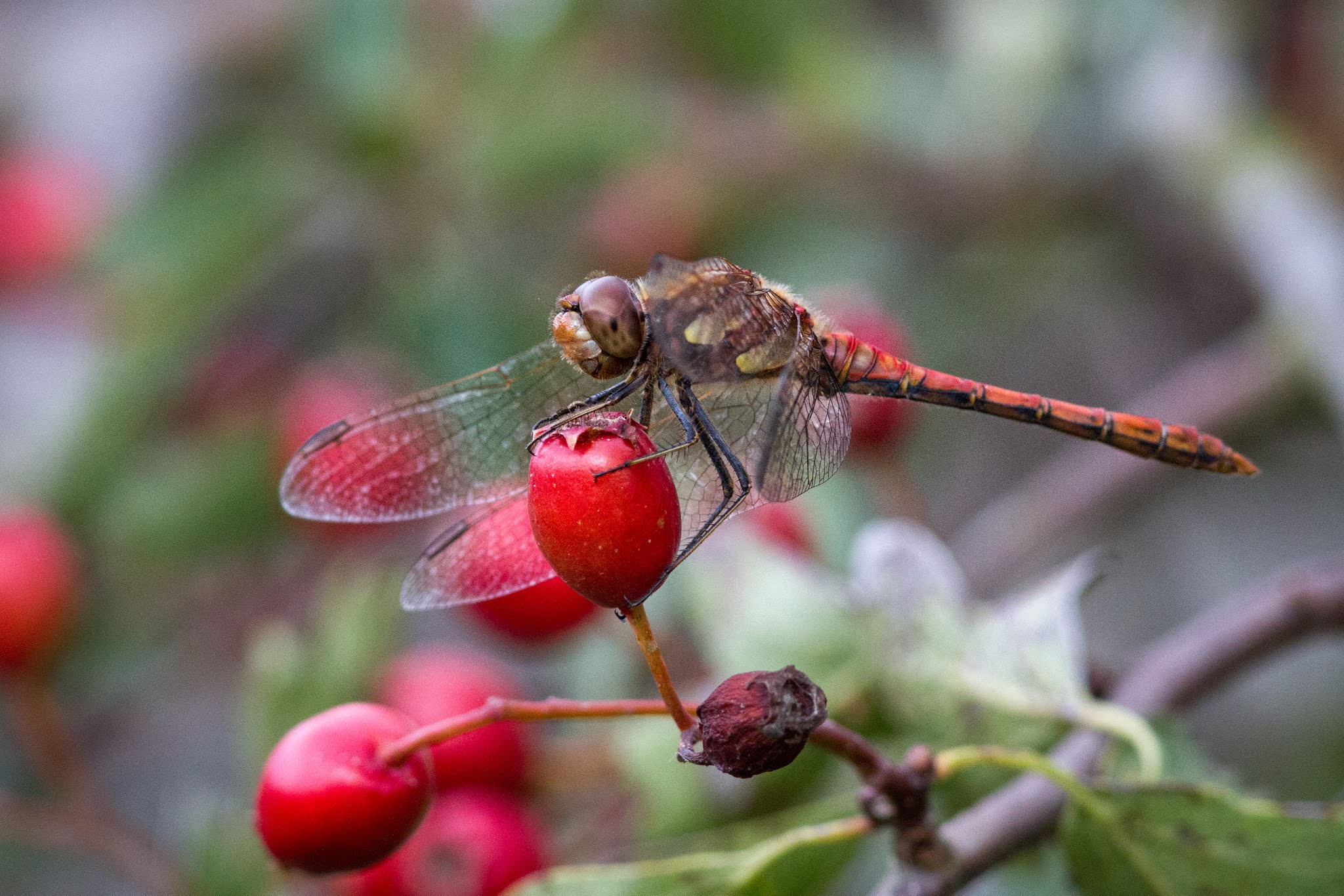
This is a rather belated look back at a few things I saw in August.  It was a good month for seeing dragonflies, especially hawkers in nearby Gosforth Nature Reserve.  It was no surprise to see southern hawkers or migrant hawkers but there have been far more sightings of common hawkers than in previous years.  Common hawkers aren't usually easy to photograph as the males never seem to stop flying but I did see this one pause to catch his breath.

There have been many sightings of ovipositing females, good evidence that there is now a breeding population.

These are female and male southern hawkers.


And these are male and female migrant hawkers.


I even took a phone photo of a female migrant hawker.

At the end of the month I led a late season dragonfly walk in the reserve.  We saw eight species of odonata, including one I had just explained we wouldn't see, a male black darter.  This is a rare sighting for the reserve so I was pleased to get a record shot on my little travel soon, the only camera I was carrying.


There were lots of butterflies on the wing in August.  Here are just three, painted lady, small copper and peacock.


My Agapanthus Royal Blue has been putting on a spectacular show and has been a magnet for bees and hoverflies.


There wasn't much rain in the month but during one rain shower I saw two wood pigeons bathing in a puddle, behaviour I haven't seen before.  For more than five minutes they were both holding their wings up to get them washed underneath by the rain.


Also in the garden a rare sighting of two Gallus gallus domesticus, relatives of the South-east Asian red jungle fowl.

Otherwise foxes, a weasel, moths and the sparrowhawk have been keeping me occupied - all reported previously. August weather was pretty unremarkable compared with reports from other parts of the country and the world.  Here it was drier than usual with average temperature and rainfall.

Saturday, 3 October 2020

Out and about in September

I saw this handsome male migrant hawker sunning himself a couple of weeks ago and took his photo.

When I returned about 10 minutes later I found a female migrant hawker on the very same branch about 3cm lower.  It is obviously a popular spot.

Here's another view of the male.

And another female, this one with blue male-type (andromorph) colouring.


I also tried some flight shots.


This rather shy female migrant hawker was ovipositing in Weetslade Country Park.


Southern hawkers are just about at the end of their season so I was pleased to see a male in Gosforth Nature Reserve. The only camera I had was in the phone which usually gives good quality photos but this pinched zoom was disappointing.  Just a record shot.

Common darters will be around for a few weeks yet if the weather is OK.  There were still newly emerged immatures.

This is a male.

And a rather mature female, almost grey.

These two, ♀ and ♂, were hoping to soak up a few rays of sun.


This was probably my last ruddy darter of the season.

Butterflies I saw included common blue,

green-veined white,

and speckled wood.

This was the only bumblebee I saw in the whole 1km transect on my monthly BBCT Bumblebee Walk.  It is obviously a cuckoo of some kind and is a bit faded but I wasn't sure which species.  After seeking expert advice it can only be narrowed down to Bombus bohemicus/vestalis so I don't feel too bad.

I also saw this ichneumon out hunting.

It is not easy to identify.  There are 2500 species in this country, many of which are very similar.  This page from the wonderful Natural History Museum Beginner's guide to identifying British ichneumonids illustrates the problem.

There seems to be more Robin's pincushion around than usual.  It is a gall on wild rose caused by a tiny wasp, Diplolepsis rosae, so that is one species that is doing well.

Two more swans have arrived at Banks' Pond and are throwing their weight around, trying to intimidate the surviving resident female and her two remaining cygnets.

The youngsters are several weeks away from being able to fly so at the moment they have no escape.  I hope it turns out well for them after all they have been through.

This young great spotted woodpecker in the garden is losing the juvenile red colour on top of its head in a very attractive chequered pattern.

And a wood pigeon on the "sparrowhawk" perch while the sparrowhawk was away.

Averaged out, the weather for September was fairly average, but it was a mixture of warm sunny days and wet stormy days.  October is starting off very wet.

Friday, 20 September 2019

Ugly baby

Only its mother could love it.  This fledgling wood pigeon was sat on the gate when I arrived home and didn't seem to know what to do next, sitting patiently while I got a camera out of the boot to take its photo.  It was weak flyer and even worse at landing so would have been an easy catch for the female sparrowhawk, had she been around.


Because their young are fed on crop milk from the parents in the nest, wood pigeons have a very long breeding season, so this may not be the last of the fledglings.

Wednesday, 10 July 2019

Friend or foe?


As a general rule in life if something is bigger and meaner than you are it is best avoided.  There is a lot to learn for a young woodpecker.  What to eat and where to find it.  Who can be bossed on the feeder and who to give way to.  This youngster was happily trying out the seeds on the feeder when a bully turned up.


The woodpecker's initial plan was to stand its ground but a wood pigeon (600g) looks menacing when you are 75g.


The pigeon wasn't in the mood for sharing and began to chase it round the other side.


Then the woodpecker slipped over the edge and ended up dangling from the tray.


After a very undignified couple of minutes it fell off.


Once on the ground it tried to look unconcerned but was keeping a wary eye on the pigeon.


The pigeon, meanwhile, was giving to woodpecker a menacing stare to discourage it from flying back up.

I am fascinated by the way the birds can tell the difference between a large grey bird flying towards them (a wood pigeon) and large grey bird flying towards them (a sparrowhawk), processing the information fast enough to make a split-second life and death decision on whether to stay or flee.  Once you know it is a wood pigeon you have a bit longer to decide what to do.