My Blog List

Showing posts with label Black darter. Show all posts

Saturday, 23 September 2023

Late summer dragonflies

It has been a funny old season for dragonflies, warm and sunny in June, cool, cloudy and wet in July and August and hot in early September.  Good for early and late species, less so in mid season.  Even now it is still relatively warm and there are hawkers and darters on the wing.  Here are a few of my sightings in the past few weeks.

A male common hawker at Cragside.

An immature male migrant hawker at Gosforth.

A mature male migrant hawker at Gosforth.

A male southern hawker at Gosforth.


A female migrant hawker at Gosforth.

Migrant hawkers at Gosforth.


Common darters at Cragside.

Black darters at Cragside.

Male common darters at Hepple Whitefield.


A male ruddy darter at Gosforth.

A male black darter at Gosforth.

Younger and older emerald damselflies at Hepple Whitefield.


That's probably it for the season although common darters and migrant hawkers will be around for a while.  It will be six months before I see a large red damselfly next spring.

Tuesday, 16 August 2022

Black beauties

The two black dragonflies found locally* are the UK's longest (golden-ringed dragonfly) and the smallest (black darter).  In June I was pleased to take part in a bioblitz at the Hepple Estate in Northumberland.  My job was to survey dragonflies and the first one I found was a male golden-ringed dragonfly (Cordulegaster boltonii).


Last week I went back for a second survey with Mary Gough, the estate's conservation manager. This time we found an ovipositing female golden-ringed dragonfly.  It was very difficult to get an action photo in the reeds but fortunately the dragonfly settled for a short while to get its breath back.  You can see its wings are frayed from bashing against the reeds.


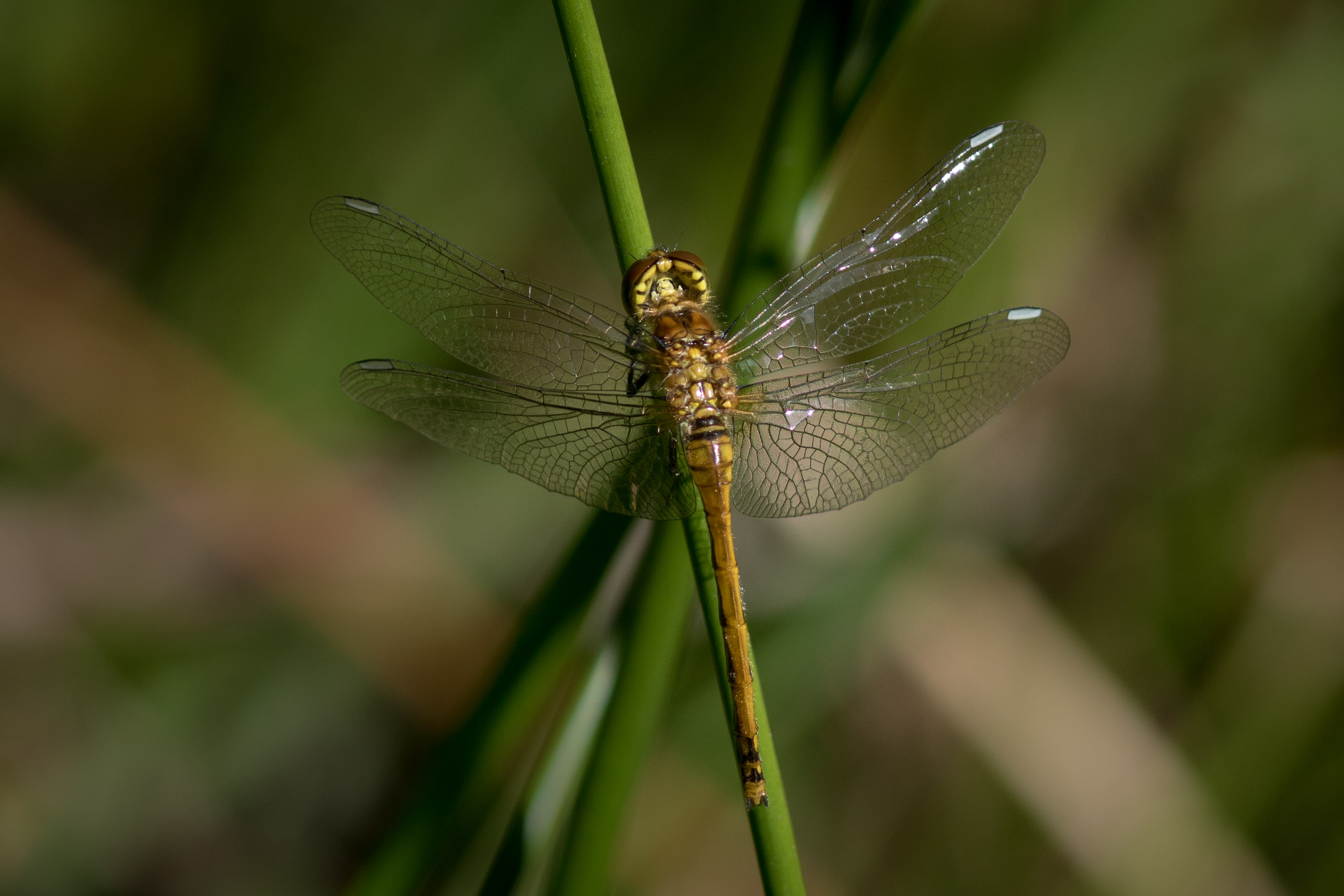
We were also pleased to see both male and female black darters (Sympetrum danae) but so far we don't have evidence of breeding there.  This is a younger mature male

and an older male, almost completely black.

The only glimpse we had of a female.

Also last week I made my regular August trip to Cragside in Northumberland and the black darters were everywhere.  These are males.


This is a teneral female

and a more mature female, although she still has white wing spots.

And a mating pair.  This female has black wing spots.

* Three other predominantly UK black dragonflies are white-faced darter, northern emerald and common clubtail but they are not found in this region.

Wednesday, 13 October 2021

Dragons on a feather bed


It has been a marvellous Indian summer for dragonflies at my local nature reserve (I'll write a review soon).  The warm weather continues but I think the season will be over within a week or two.  Last week I found four male black darters at Gosforth Nature Reserve.  There seem to be no females
 so they spend most of their time sitting around in the sun.  (I think these were dispersing from breeding waters not too far away in the hope of finding new territory.)  There were lots of male common darters as well and they were also resting in between chasing each other and females. Another animal spends quite a lot of its time sitting around and made a very comfortable resting place.


The swan seemed irritated by the dragonflies and kept waking up and shaking or chasing them off.  Once it caught a common darter on its back but it was so quick I couldn't see whether it ate it or just got rid of it.

This one had the sense to keep out of range.

As did this black darter.

Common darters are common so I expect the swans will have to get used to them.  I hope there will be more black darters in future seasons as well.

Monday, 6 September 2021

Out and about in August

This is a rather belated look back at a few things I saw in August.  It was a good month for seeing dragonflies, especially hawkers in nearby Gosforth Nature Reserve.  It was no surprise to see southern hawkers or migrant hawkers but there have been far more sightings of common hawkers than in previous years.  Common hawkers aren't usually easy to photograph as the males never seem to stop flying but I did see this one pause to catch his breath.

There have been many sightings of ovipositing females, good evidence that there is now a breeding population.

These are female and male southern hawkers.


And these are male and female migrant hawkers.


I even took a phone photo of a female migrant hawker.

At the end of the month I led a late season dragonfly walk in the reserve.  We saw eight species of odonata, including one I had just explained we wouldn't see, a male black darter.  This is a rare sighting for the reserve so I was pleased to get a record shot on my little travel soon, the only camera I was carrying.


There were lots of butterflies on the wing in August.  Here are just three, painted lady, small copper and peacock.


My Agapanthus Royal Blue has been putting on a spectacular show and has been a magnet for bees and hoverflies.


There wasn't much rain in the month but during one rain shower I saw two wood pigeons bathing in a puddle, behaviour I haven't seen before.  For more than five minutes they were both holding their wings up to get them washed underneath by the rain.


Also in the garden a rare sighting of two Gallus gallus domesticus, relatives of the South-east Asian red jungle fowl.

Otherwise foxes, a weasel, moths and the sparrowhawk have been keeping me occupied - all reported previously. August weather was pretty unremarkable compared with reports from other parts of the country and the world.  Here it was drier than usual with average temperature and rainfall.