My Blog List

Showing posts with label Cragside. Show all posts

Tuesday, 16 August 2022

Black beauties

The two black dragonflies found locally* are the UK's longest (golden-ringed dragonfly) and the smallest (black darter).  In June I was pleased to take part in a bioblitz at the Hepple Estate in Northumberland.  My job was to survey dragonflies and the first one I found was a male golden-ringed dragonfly (Cordulegaster boltonii).


Last week I went back for a second survey with Mary Gough, the estate's conservation manager. This time we found an ovipositing female golden-ringed dragonfly.  It was very difficult to get an action photo in the reeds but fortunately the dragonfly settled for a short while to get its breath back.  You can see its wings are frayed from bashing against the reeds.


We were also pleased to see both male and female black darters (Sympetrum danae) but so far we don't have evidence of breeding there.  This is a younger mature male

and an older male, almost completely black.

The only glimpse we had of a female.

Also last week I made my regular August trip to Cragside in Northumberland and the black darters were everywhere.  These are males.


This is a teneral female
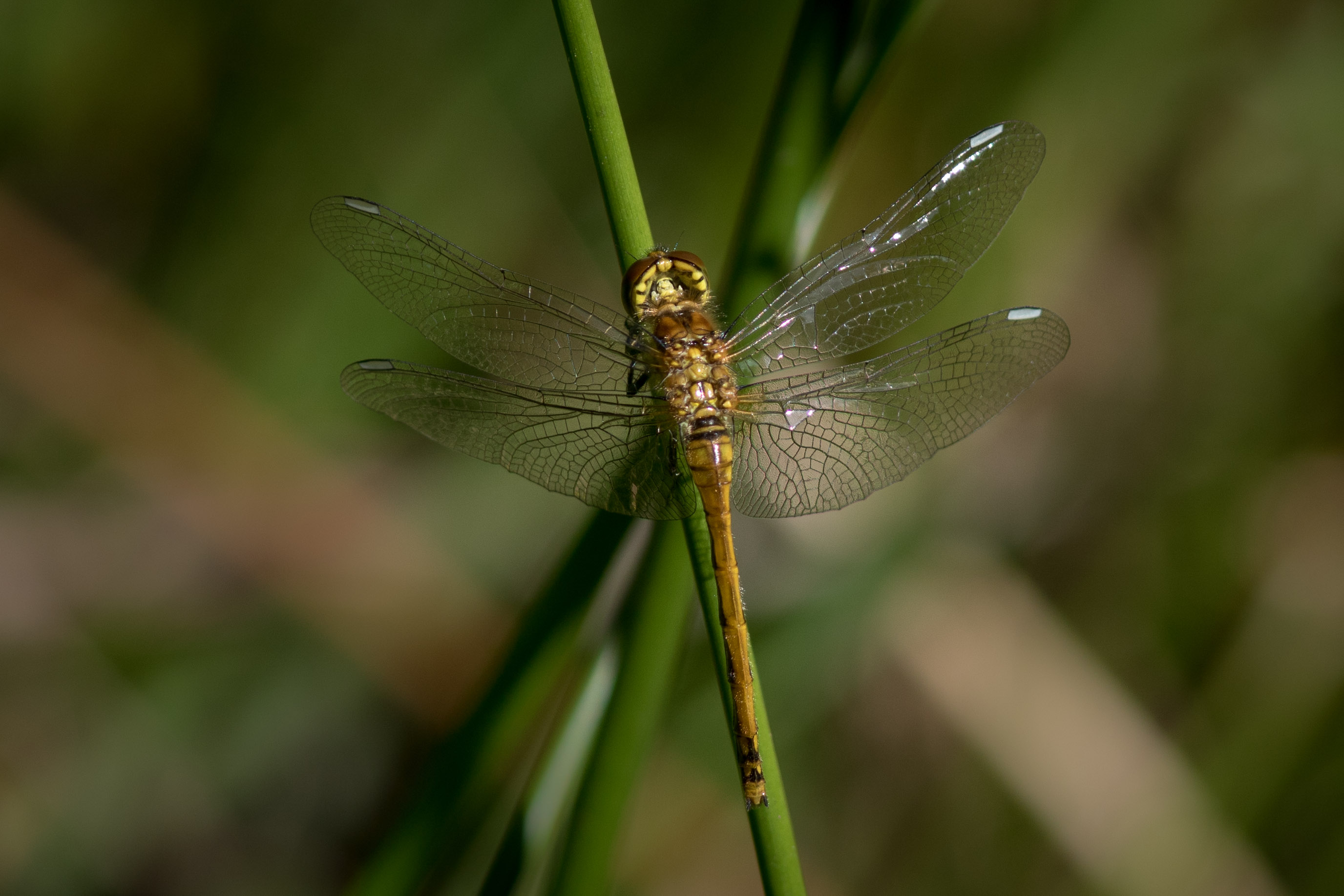
and a more mature female, although she still has white wing spots.

And a mating pair.  This female has black wing spots.

* Three other predominantly UK black dragonflies are white-faced darter, northern emerald and common clubtail but they are not found in this region.

Tuesday, 10 August 2021

An away day

After all the restrictions of the last 18 months it seems quite an expedition to go even as far as Cragside, a round trip of only 50 miles.  I went to Slipper Tarn to look at the dragonflies and I was pleased I went early, partly to miss the crowds and because as soon as I arrived I found a female common hawker already laying her eggs.

Common hawkers usually lay tight in to the edge of the water but this one also ventured out into the middle of the pond, something I haven't seen before.

There were lots of male common hawkers on patrol but none stopped for a photo.  Then I found one freshly emerged and still expanding his wings while hanging on to his exuvia.


A few minutes later the wings were outstretched and he took his maiden flight.

Cragside is the best place I know to see black darters and they were out in numbers.  Here is a male.

And a female.

And a mating pair.

Common darters were common, but not as common as black darters.

I also saw plenty of damselflies - azures,

emeralds,

and large reds.

I found several darter exuviae, only 13mm long so very probably from black darters, our smallest dragonflies.  It is amazing that a 29-34mm long dragonfly comes out of a 13mm exuvia.

I also retrieved the common hawker exuvia for a photo.  This is 44mm long yet the dragonfly is around 70-80mm.

Monday, 19 August 2019

Return to Slipper Tarn


I made my annual August trip to see the dragonflies at Slipper Tarn in the Cragside Estate at Rothbury.  It is a small pool with black acidic water, sheltered on all side by tall trees.  It is home to common and southern hawkers and is the best place I know to see black darters (Sympetrum danae).  These are males in mature colouring.


This is an immature male.

And these are mature females.


The one mating pair I saw was a bit too high in the bushes.

There was a very friendly male southern hawker (Aeshna cyanea) on patrol at the north end of the pond in sunshine. He rested in good view several times.


He was also hovering from time to time so I could practice a few flight shots like this and the one at the top.

Male common hawkers (Aeshna juncea) are generally less sociable, as was this one.  I never saw it at rest.

I did see several female common hawkers ovipositing low down in the vegetation at the water's edge.


The first female dragonfly I saw when I arrived didn't allow a good view.  I managed only a couple of photos into the light and it flew away before I could move to a better position.  I think it was done with ovipositing and I assumed at the time that it was another common hawker.  But when I had a close look at the photos the eyes are green and there is a long ovipositor.  So it is a female golden-ringed dragonfly (Cordulegaster boltonii), only the second one I have seen, and the first I have seen in Northumberland.  The identification has been confirmed on the UK Dragonflies Facebook page and is a first record for the site.

Monday, 6 August 2018

Cragside

I made my regular August trip to Slipper Tarn on the National Trust's Cragside Estate in Rothbury to see the dragonflies.  I saw several common and southern hawkers but none of them would stop for a photo.  The emerald damselflies were much more obliging.


Slipper Tarn is also one of the best places to see black darters.


I met three small boys and ended up entertaining them while their mothers and grandmother had a peaceful picnic lunch.  I was fielding questions such as "do dragonflies eat tuna sandwiches?", "what does acidic mean?", and "have you ever seen a red squirrel?".  By the time the mothers had finished lunch I was in need of a lie down.