I made my regular August trip to Slipper Tarn on the National Trust's Cragside Estate in Rothbury to see the dragonflies. I saw several common and southern hawkers but none of them would stop for a photo. The emerald damselflies were much more obliging.
Slipper Tarn is also one of the best places to see black darters.
I met three small boys and ended up entertaining them while their mothers and grandmother had a peaceful picnic lunch. I was fielding questions such as "do dragonflies eat tuna sandwiches?", "what does acidic mean?", and "have you ever seen a red squirrel?". By the time the mothers had finished lunch I was in need of a lie down.
The season is progressing quickly. There has been a bit of rain in the past week but not enough to affect the water level in the ponds. The emperor still reigns as you can see from above, although I saw only one and he was resting more than usual. There are lots of darters and the common darters now outnumber the ruddy darters. Here is a male ruddy darter,
a male common darter,
a male black darter,
and a pair of common darters.
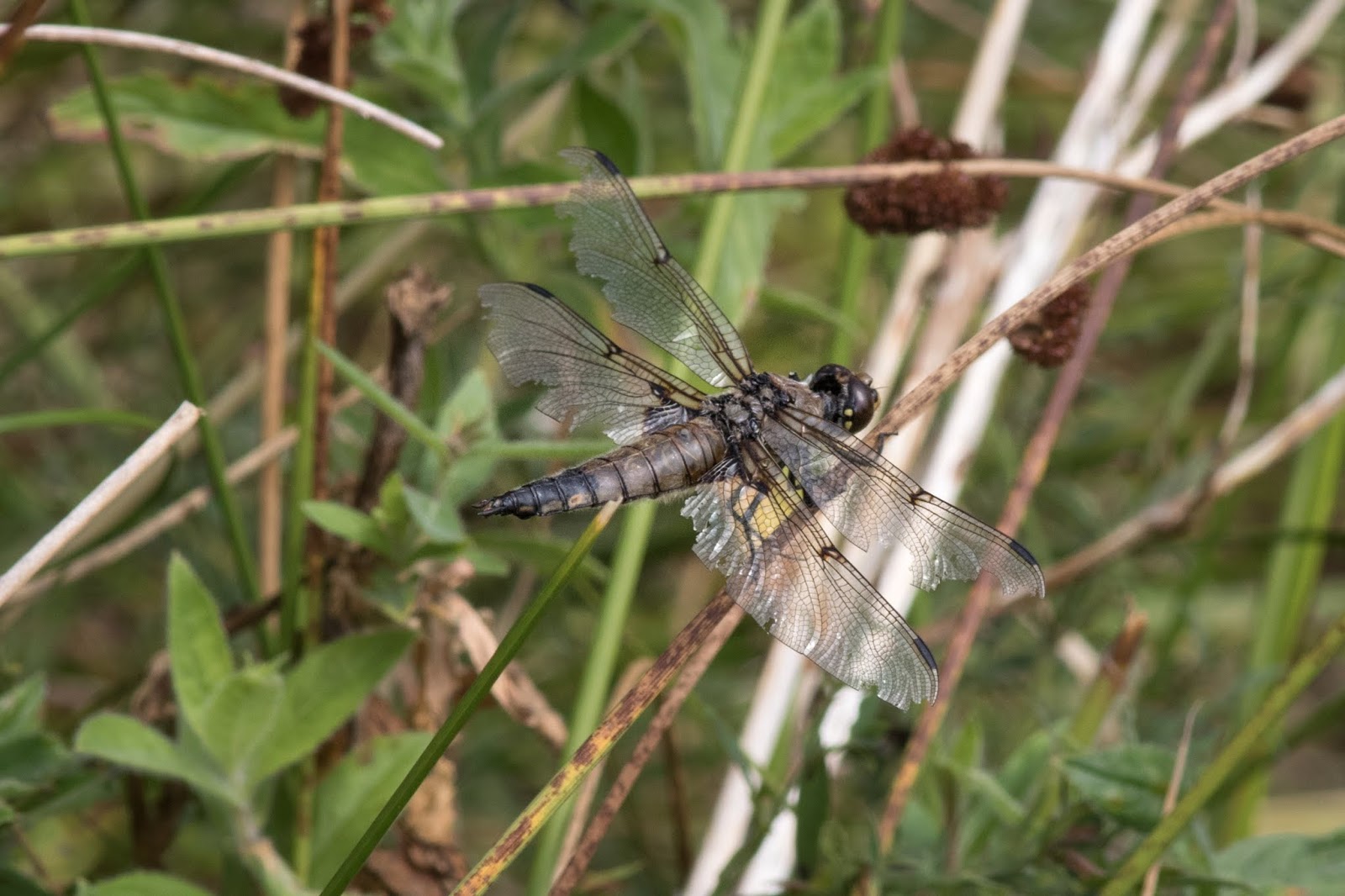
A couple of male common hawkers were flying but I have yet to see a female this year. I saw only one four-spotted chaser but it was a very old and battered specimen and was away from the water so I expect they are almost finished.
This week's damselflies were common blue,
emerald,
blue-tailed,

and azure. I hadn't seen any azure damselflies in the previous two weeks and assumed their season was over but then I saw this one having a snack in a Scots pine.
There are still lots of butterflies. The weather has been good for them but it has been so dry that it may not be good for their caterpillars. Amongst others I saw a male wall,
a female wall,
a speckled wood,
and a comma.
I was surprised to see this bumblebee. It is a male red-tailed cuckoo bumblebee (Bombus rupestris), a kleptoparasite of the red-tailed bumblebee (Bombus lapidarius). I have never seen one up here before and didn't think they were found this far north, although it makes sense as the host species is very common here. As a cuckoo it doesn't make a nest but the B. rupestris female takes over an established B. lapidarius nest, kills the queen, and lays her own eggs, using the host workers to bring up her own young.
It was a good week for unusual insects. Grasshoppers have been singing (stridulating) in the grasses for weeks but are generally hard to see. And when I eventually found one it was pink! This one was happy for me to use the telephoto lens but moved off when I tried to creep up with the macro lens. I think it is probably an unusual colour form of the field grasshopper (Chorthippus brunneus).
The little grebes now have only three chicks. I noticed last week that two were a lot smaller than the other three so I suspect the two smallest have not survived.
After the Canada geese left a couple of weeks ago I was hoping we would be spared more but this week a new pair has arrived. I am sure they are different, as they are very wary whereas the others would come begging for food. I fear these two may be laying claim to the site, hoping to breed here next year. With luck they were just passing through.
A few more photos of the cub from a couple of weeks ago. He is growing up fast but is still very wary of the larger foxes and prefers to be here on his own.
Just over a week after my first white-letter hairstreak I have now seen my first purple hairstreaks (Neozephyrus quercus). I was walking through an oak wood with my nephews Joel and Sam when Joel's sharp eyes spotted a butterfly. As it flew off we saw a flash of purple and a few moments later Joel found another one. It is was fairly worn female, with a patch of purple on each front wing as it catches the light.
The purple hairstreak is a fairly small butterfly, about the size of my thumbnail.
Then this morning I found another one, this time in Gosforth Park Nature Reserve. This was a male and he was a bit reluctant to open his wings. When he did they looked brown in most lights, but as he turned you can see the purple colour extends to the edge.
And this afternoon another one in the same spot, this time a female. Although purple hairstreaks live on oak trees this one had hopped onto an adjacent elm.
Purple hairstreaks spend most of their time in the tops of oak trees. They live on honeydew and rarely come down to look for flowers so I feel very privileged to have seen these three.