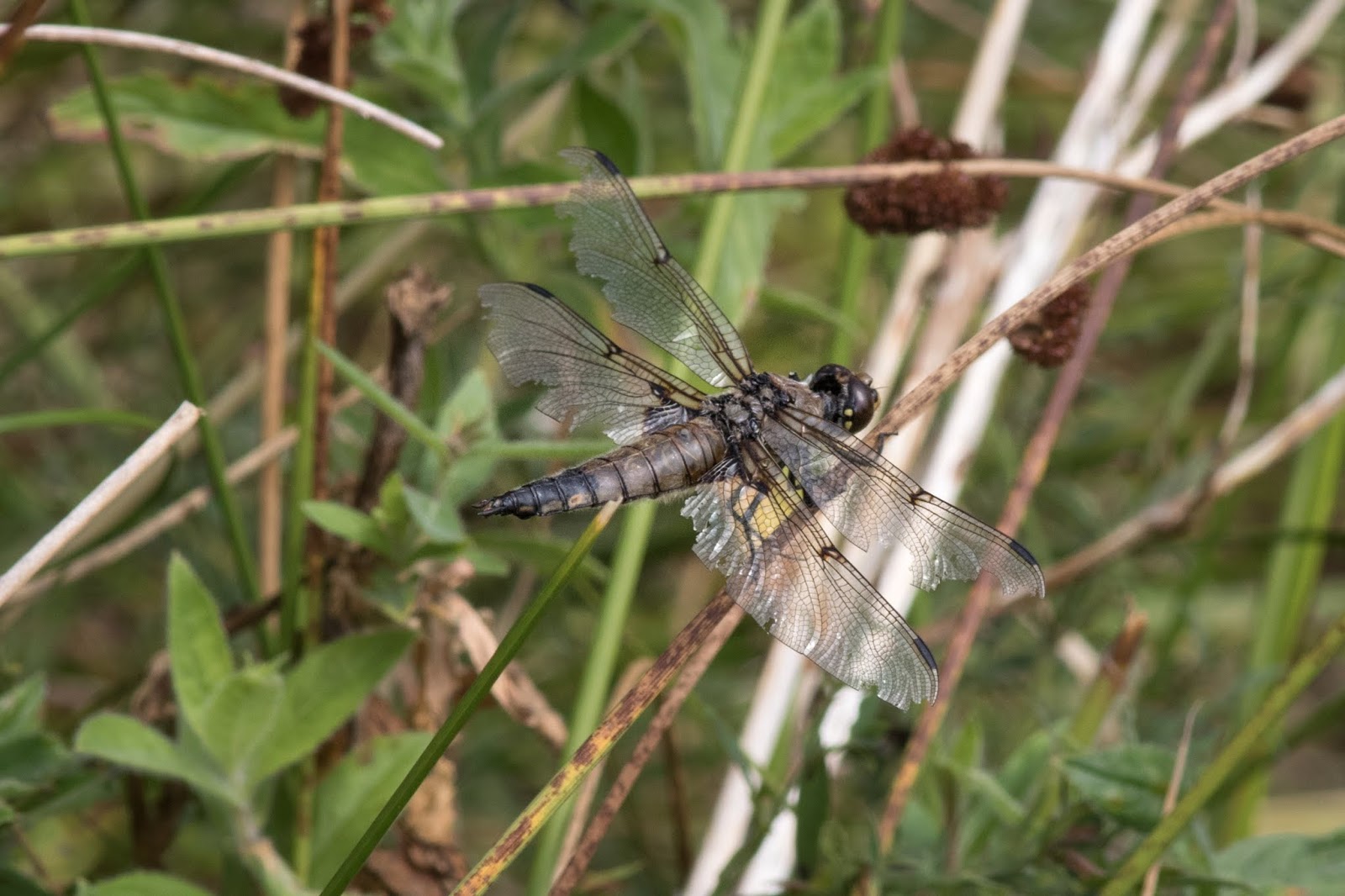
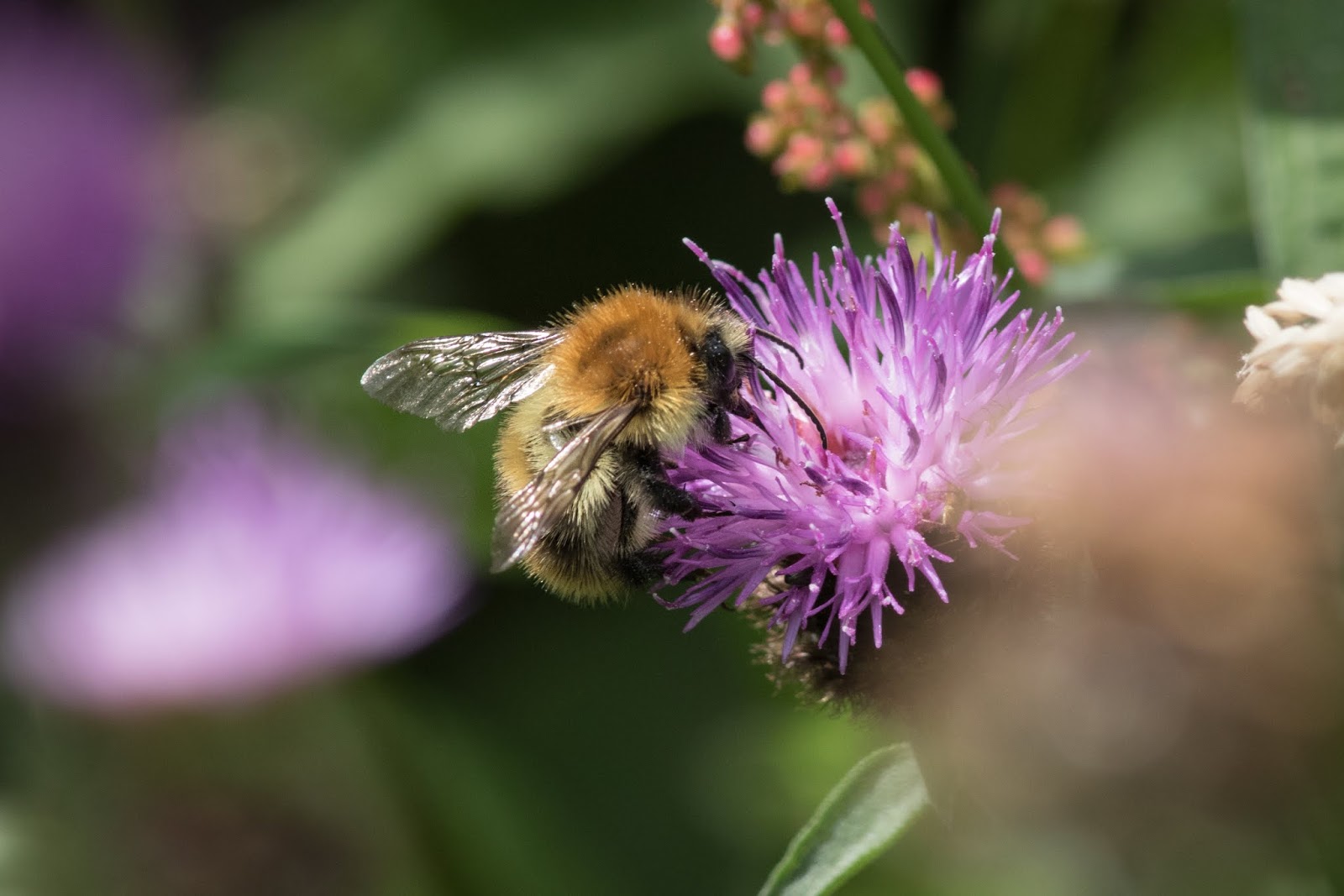
The season is progressing quickly. There has been a bit of rain in the past week but not enough to affect the water level in the ponds. The emperor still reigns as you can see from above, although I saw only one and he was resting more than usual. There are lots of darters and the common darters now outnumber the ruddy darters. Here is a male ruddy darter,
a male common darter,
a male black darter,
and a pair of common darters.
A couple of male common hawkers were flying but I have yet to see a female this year. I saw only one four-spotted chaser but it was a very old and battered specimen and was away from the water so I expect they are almost finished.
This week's damselflies were common blue,
emerald,
blue-tailed,

and azure. I hadn't seen any azure damselflies in the previous two weeks and assumed their season was over but then I saw this one having a snack in a Scots pine.
There are still lots of butterflies. The weather has been good for them but it has been so dry that it may not be good for their caterpillars. Amongst others I saw a male wall,
a female wall,
a speckled wood,
and a comma.
I was surprised to see this bumblebee. It is a male red-tailed cuckoo bumblebee (Bombus rupestris), a kleptoparasite of the red-tailed bumblebee (Bombus lapidarius). I have never seen one up here before and didn't think they were found this far north, although it makes sense as the host species is very common here. As a cuckoo it doesn't make a nest but the B. rupestris female takes over an established B. lapidarius nest, kills the queen, and lays her own eggs, using the host workers to bring up her own young.
It was a good week for unusual insects. Grasshoppers have been singing (stridulating) in the grasses for weeks but are generally hard to see. And when I eventually found one it was pink! This one was happy for me to use the telephoto lens but moved off when I tried to creep up with the macro lens. I think it is probably an unusual colour form of the field grasshopper (Chorthippus brunneus).
The little grebes now have only three chicks. I noticed last week that two were a lot smaller than the other three so I suspect the two smallest have not survived.
After the Canada geese left a couple of weeks ago I was hoping we would be spared more but this week a new pair has arrived. I am sure they are different, as they are very wary whereas the others would come begging for food. I fear these two may be laying claim to the site, hoping to breed here next year. With luck they were just passing through.
The hot dry weather continued until yesterday but in the last 24 hours we have had rain. I reckon the smaller pond is at least 20cm below normal level and the larger one 30cm below. There is a little more rain in the forecast but I expect it may not do much to refill the ponds, although it may at least refresh the vegetation. Ruddy darters were still the most numerous dragonflies this week. There were several mating pairs.
Common darters are around but I saw only one male with mature colouring and he was camera shy. His outfit was a perfect match for the berries.
Emperors, four-spotted chasers and common hawkers were all flying but this week I saw no black darters, although I expect they are still around. Common blue, blue-tailed and emerald damselflies are still present as well.
There were plenty of burnet moths. It isn't always easy to count the spots but these look like six-spot burnets, whereas a few weeks ago I was seeing five-spot burnets.
One of this pair has orange spots.
They were joined on their flower by a male red-tailed bumblebee looking for nectar.
I did monthly the bumblebee walk for the Bumblebee Conservation Trust this week and saw far more bees than in previous months. It was hot a sunny and most were feeding on common knapweed. This one is a common carder bee (Bombus pascuorum). You can tell he is male because he has no pollen baskets on his hind legs and has 13 segments in his antennae (as opposed to 12 in a female). In the second photo there is a scorpion fly in the background.
The continuing warm weather has also been good for butterflies. This week I saw lots of peacocks,
and a small copper,
and some fresh-looking walls, presumably from a second emergence as there have been none for the past few weeks.
The green woodpeckers were much in evidence and I now recognise their squeaky contact calls. I saw four but whether they are all youngsters or one is an adult I couldn't say. I also found a stone surrounded by smashed snail shells which I am sure is a song thrush's anvil.
I haven't seen the little grebes for many weeks although I have heard them calling from the reeds. This week they reappeared with a second brood of five chicks.
One parent caught what looks like a tadpole but it seemed to be a bit too big for the chicks. It was offered and passed around for several minutes but I didn't see if one of the chicks managed to swallow it.
Two of the chicks preferred to take a ride on mum's (or dad's) back.
And - for the first time since my first walk in week 13 - no Canada geese. The youngsters must have grown strong enough to fly but they have left the place looking a bit like the morning after at a festival site. I'll hope for a pair of swans instead next year.
The season is progressing quickly after the recent warm weather. This week there were dozens of large red damselflies including many mating pairs.
The common blue damselflies
and azure damselflies now have mature colouration.
There was another new species this week, the blue-tailed damselfly. This is a mature male.
I think these are immature males. Note the two-coloured wing spots.
Female blue-tailed damselflies come in five different colours. I have seen all five at the pond in previous years so I'll try to find them again in coming weeks.
There were a lot more four-spotted chasers than last week, doing what chasers do - chasing and resting. They are easier to photograph when they rest.
I can now see that the little grebes have four chicks.
It is interesting that they return to the nest. The chicks are not yet able to fly or to feed themselves but they know to dive at the first sign of danger.
The Canada goslings are growing fast.
There are still eight of them but it is difficult to get them all in the same frame. Here are seven.
Other birds I saw included coots and moorhens. I don't know what this was all about but the moorhen came out the winner.

I saw a nomad cuckoo bee as I was leaving. I am not sure which species it is as the tricoloured ones aren't so easy to separate.
I also saw this little beast which is probably a parasitic wasp of some kind.