Here we go! Right on schedule, the first damselflies of the year. I saw several large red damselflies (Pyrrhosoma nymphula) of both sexes when I visited earlier this week. This is predictably the first species of the season and reports of emergence have been spreading up the country over the past couple of weeks, consistent with spring travelling north at 1.8 miles per hour. These are immature females with pale colours and yellow shoulder stripes.
And these are immature males, also with yellow shoulder stripes which will turn red with maturity.
This week's butterflies included orange-tips. They have been present for the past few weeks but this is the first time I have managed a photo as they rarely stop for a rest. These are males
and females, all feeding on lady's smock.
The coot is still sitting on her eggs and the goslings still number eight.
With luck and good weather we may see the first dragonfly next week.
Every time I arrive at the pond the heron takes one look at me and flies off. This time it was reluctant to leave, perhaps because it was busy eating frogs or frogspawn on the far bank.
The swans are back to four, one adult and three youngsters, so the new arrival from last week has been seen off. Here the adult is walking from the smaller to the larger pond.
At first I could see only one Canada goose and I was half hoping the fox had had another good dinner.
Then I spotted Mrs CG on the island, already incubating a clutch of eggs.
This was time to do my first bumblebee walk of the year for the Bumblebee Conservation Trust. I saw only three bees, all buff-tailed bumblebee queens (Bombus terrestris). This one was searching for a nest hole.
I saw several peacock butterflies but they were all rather frantic and I didn't manage a decent photo. I also saw the first bee fly (Bombylius major) of the year. It mimics a bee but is a parasitic fly, targeting solitary bees and wasps.
The good news is that all the swans survived the week - in fact there is even an extra one this week. The newcomer is a full-grown cygnet, in almost adult plumage with just some brown on the wings. I presume he has flown in from a nearby pond or lake, possibly Big Waters, which is only 1km away as the swan flies.
I think he is a he is he has a very powerful neck.
The others didn't appreciate his arrival. Most of the time he kept his distance but if he got too close one of the resident youngsters was keen to chase him off.
Here is the challenger, presumably also a male, in full display.
At one point he chased the newcomer onto the bank.
Less good news is the arrival of a pair of Canada geese, presumably with a view to nesting here.
The Canada goose family last year did a lot of damage to the surrounding vegetation, possibly worsened by the drought. I wonder if the fox likes the taste of goose?
The season is progressing quickly. There has been a bit of rain in the past week but not enough to affect the water level in the ponds. The emperor still reigns as you can see from above, although I saw only one and he was resting more than usual. There are lots of darters and the common darters now outnumber the ruddy darters. Here is a male ruddy darter,
a male common darter,
a male black darter,
and a pair of common darters.
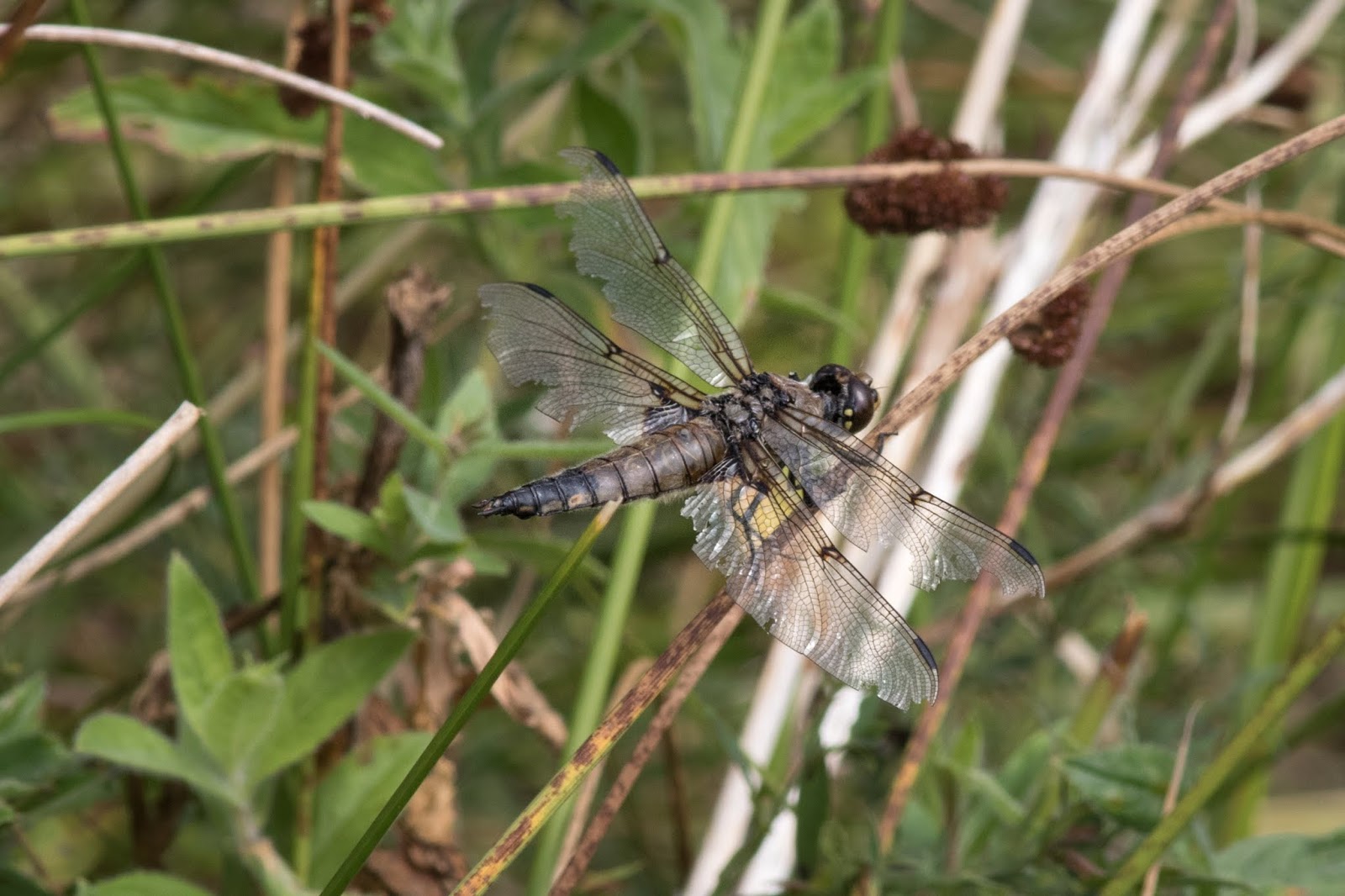
A couple of male common hawkers were flying but I have yet to see a female this year. I saw only one four-spotted chaser but it was a very old and battered specimen and was away from the water so I expect they are almost finished.
This week's damselflies were common blue,
emerald,
blue-tailed,

and azure. I hadn't seen any azure damselflies in the previous two weeks and assumed their season was over but then I saw this one having a snack in a Scots pine.
There are still lots of butterflies. The weather has been good for them but it has been so dry that it may not be good for their caterpillars. Amongst others I saw a male wall,
a female wall,
a speckled wood,
and a comma.
I was surprised to see this bumblebee. It is a male red-tailed cuckoo bumblebee (Bombus rupestris), a kleptoparasite of the red-tailed bumblebee (Bombus lapidarius). I have never seen one up here before and didn't think they were found this far north, although it makes sense as the host species is very common here. As a cuckoo it doesn't make a nest but the B. rupestris female takes over an established B. lapidarius nest, kills the queen, and lays her own eggs, using the host workers to bring up her own young.
It was a good week for unusual insects. Grasshoppers have been singing (stridulating) in the grasses for weeks but are generally hard to see. And when I eventually found one it was pink! This one was happy for me to use the telephoto lens but moved off when I tried to creep up with the macro lens. I think it is probably an unusual colour form of the field grasshopper (Chorthippus brunneus).
The little grebes now have only three chicks. I noticed last week that two were a lot smaller than the other three so I suspect the two smallest have not survived.
After the Canada geese left a couple of weeks ago I was hoping we would be spared more but this week a new pair has arrived. I am sure they are different, as they are very wary whereas the others would come begging for food. I fear these two may be laying claim to the site, hoping to breed here next year. With luck they were just passing through.