My Blog List

Saturday, 22 June 2024

The weasel has a takeaway


My previous attempts at filming a weasel collecting food were thwarted by its high speed smash-and-grab technique - all we could see was a blur as it departed.  This time I had two mice and I thought if I put them both out the weasel might be spoilt for choice.  And it worked.

The mice were fresh and only four hours after I put them in the camera box a male weasel turned up.  As you will see in the video, he was very undecided but eventually took one mouse away.  He was back very early next morning and brought the rather chewed mouse with him.  He obviously knew the second mouse was there but left again with the first one.


Four hours later he was back and took the second mouse, seeming to play fight with it before he left.  Another two hours later he returned, apparently without the mouse, but I think it was just outside because after another minute he threw it back in, just as an ambulance went by.  After checking to see whether it was an ambulance or a police car he returned for his prize and left.


I knew weasels were in the habit of carrying their food around but it is fascinating to see it. Because of their small size, body shape and hyperactive lifestyle weasels need to eat one third of their body weight in a day, roughly one mouse a day.  If they are able to catch more than this they will cache food for later, presumably not bothered if it is a bit ripe.

Friday, 14 June 2024

Ten years of blogging


I'm not one for birthdays or anniversaries or big round numbers but I did notice that today it is 10 years since my first post on this blog.  
That was on great spotted woodpeckers feeding their young, a subject that has been repeated several times at this time of year.  To come full circle the young woodpeckers have once again appeared outside my kitchen window this week so here are a couple of photos taken through the kitchen window yesterday.

In the last ten years there have been over 1500 posts on this blog but it isn't possible to say how many views or readers.  In 2017 the blog was targeted by French spambots and something similar has been happening over the past year, although this time I can't tell the source.  Blogger removes all the spam so I never see it, but strangely it still counts all the "views".  The real readership is about 2500 views a month so it is probable that there have been about 300,000 real views rather than the 425,000+ that Blogger lists.  Still quite a big number.  I hope I'll be able to complete another 10 years, probably always with woodpeckers in the second week of June.

Saturday, 8 June 2024

Daylight robbery


I have seen bumblebees 
robbing nectar from comfrey flowers before but as far as I remember I haven't seen this behaviour from solitary bees.  Nectar robbing is when a bee takes nectar from the flower through a hole bitten in the side rather than entering normally and offering pollination, especially a bee with a tongue too short to reach the nectary.  I suspect the holes were made by bumblebees and the others were just taking advantage.  This is a Buff-tailed Bumblebee

and an Early Bumblebee.

A Common Carder Bee was doing it properly.

This was earlier in the week on the comfrey in the corner of the kitchen garden.  The most numerous bees were male red mason bees.


They were also patrolling the flowers in the vain hope of finding a new female.  In reality all the females are busy provisioning their nests and the males don't have long to live but that didn't stop them challenging and knocking each other off the flowers.

Female red masons were also robbing, obviously getting just nectar here and collecting their pollen elsewhere.

The most surprising to me was a nomad bee, a cuckoo that lays its eggs in solitary bees nests (usually mining bees).

It all goes to show that sometimes crime does pay.  You can read more about the biology of nectar robbing here.

Monday, 3 June 2024

First moths of the year


This was the first time I have set up the moth trap this year.  Previously it has been in the corner of the walled flower garden, just over the wall from the golf course.  This time it was 50m away, at the edge of the meadow and close to the copse, so a slightly different environment.

There weren't many moths but they included some real beauties.  New to me was this Pebble Prominent.

This is one I have seen before, a Common Swift.

Another star was a White Ermine.

It has these amazing colours underneath.  I wonder why as they are hidden and it lives mostly in the dark.

Another new one was a Buff Ermine.  I didn't get to see what colour this one is underneath.

And one of my favourites, a Poplar Hawk-moth.

When I tried to move it for a better photo it got a firm hold of my finger and wouldn't let go.  I could feel the tiny claws on its feet.

Tuesday, 28 May 2024

First dragonflies

My dragonfly season always seems to get off to a slow start - perhaps I am just too impatient. This year the weather has been poor with just an occasional sunny day in between all the rain, not good for dragonflies.  On 17th May, I eventually saw a dragonfly, a female Broad-bodied Chaser at Prudhoe.

A week later I saw an emerging Four-spotted Chaser at Gosforth Nature Reserve, a mile or so from here.  I was a few minutes too late to see the start but was able to watch as it pumped up its abdomen and wings.


Here it has climbed higher up the reed.  It is always amazing to compare the size of the nymph with the fully expanded dragonfly, a miracle of packaging.

I waited as it readied itself for its first flight.


I am hoping to see a dragonfly emerge from my new pond this year.  In between all the floods over the past six months I managed a bit of work to deepen one end and in doing so I saw several dragonfly nymphs which looked to be large enough to be ready for this year.  I put one of them in a tray of water for a few photos.  It was covered in silt so the photos aren't great but it was fun to try.


This must mean that a Broad-bodied Chaser laid eggs in the pond in 2022 in its first season, even though I didn't see one there that year.  I am now checking the pond every morning in the hope of seeing an emergence.

Tuesday, 21 May 2024

A hornet in the garden


Four days ago in the meadow I spotted something large and yellow out of the corner of my eye but it flew off before I could see what it was.  Armed with a camera I stood waiting for another view and after a few further brief glimpses I got a couple of blurry photos to confirm it was a European Hornet queen (Vespa crabro).


The hornet was flying around the trees, looking as though it was searching for a nest site rather than hunting.  Yesterday I was standing by the pond in the meadow when the hornet flew down for a drink.  One thing I have learnt is always to carry a camera in the meadow so this time I was ready for it.


An hour later it was back for more water.  Hornets collect water to use with chewed dead wood to make the papier-mâché they use to build their nests so I am very hopeful this one has a nest nearby, perhaps even in the garden.  If it sticks around you can expect more photos here.

Hornets are present in most of England and Wales but are rare in the north.  I was pleased to find that this is the most northerly confirmed British record.  This image shows records in iRecord with mine in red.

I am about 2km north of Gosforth Nature Reserve where hornets were present in 2018 but haven't been seen since early the following year.  Here are a couple of my favourite photos from then.

Wednesday, 15 May 2024

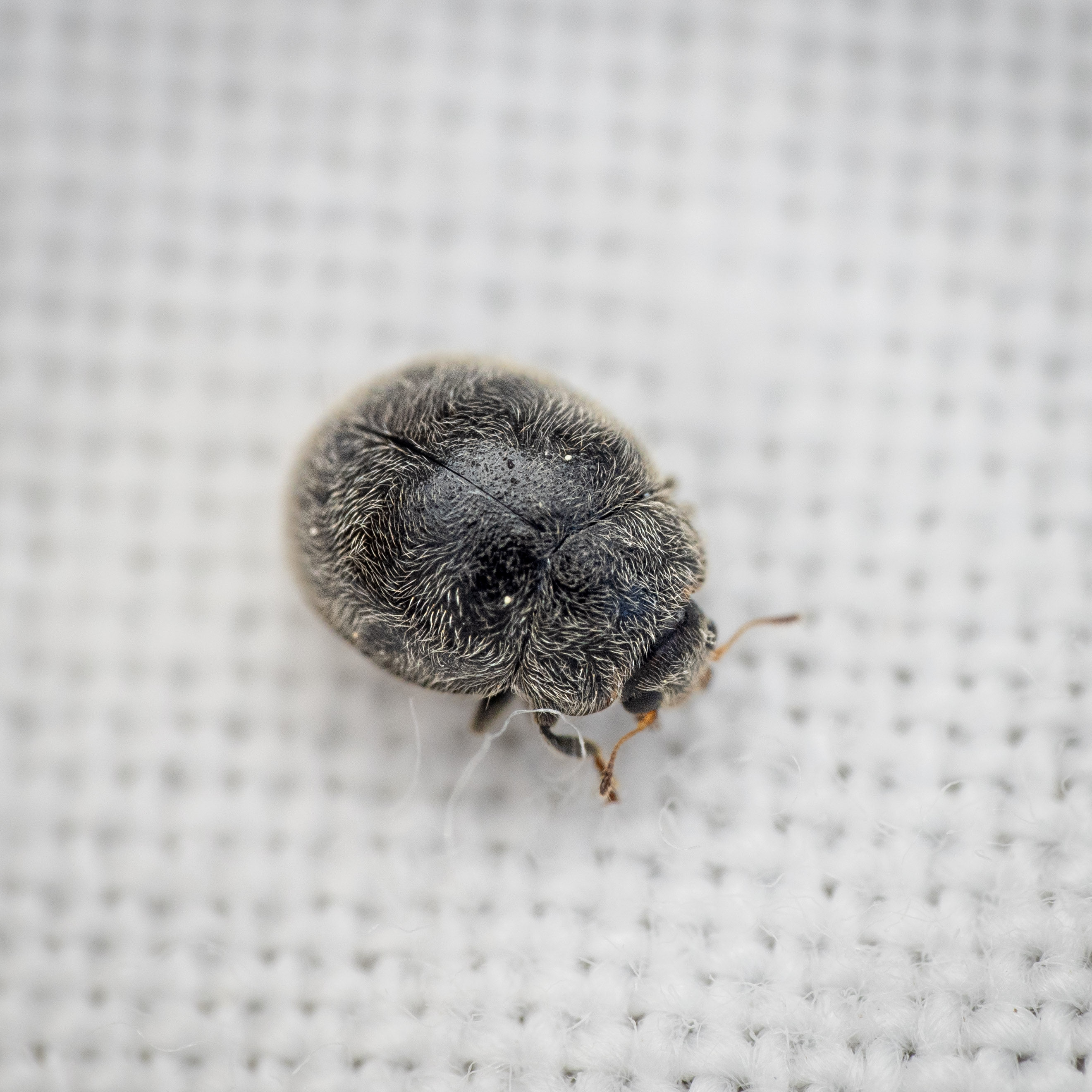
An Aussie ladybird


A new ladybird for me, this is a native of Australia but was found in ivy in my mother's garden in Northamptonshire.  Rhyzobius forestieri eats scale insects and because of this has been introduced to various parts of the world as a biological control agent, notably to California in the 1890s and to Mediterranean countries in the 1980s to control scale insects on olive trees.  It was first reported in England in the garden of the Natural History Museum, presumably because there was someone there who could recognise it, and has since spread out across the South East and Midlands and has been added to the list of established British ladybirds.

Rhyzobius forestieri is small and black and covered in wavy white hairs.  The abdomen underneath is orange and this one obligingly rolled over for a photo of its tummy.