My Blog List

Thursday, 15 October 2020

Hibernating queen

A queen common wasp (Vespula vulgaris) has moved into the kitchen and is hibernating on the curtain.  Its wings, antennae and five legs are all tucked away for safety.

When I checked on it a few days later it had moved a few millimetres to the right and was hanging by its other front foot.


It certainly seems to be a restless sleeper and has changed position each time I look.  These photos are on the last five consecutive days.


The wasp is planning to hibernate until next spring but I suspect the kitchen may be too warm for it over the winter so I shall probably have to move it to somewhere cooler.

Monday, 12 October 2020

OtterCam - Making tracks

The tracks on the sluice gate wash away in less than 24 hours so when I arrive I can tell whether an otter has been through the culvert recently.  Sometimes there are two sets of prints, from the mother and pup.

And on this occasion the trail camera confirmed it was this pair that had been through about six hours earlier.  The pup still finds it quite slippery in the pipe and zigzags its way through.

Two nights later there was a single set of footprints.  You can see the characteristic five toes and heel pad of a mustelid (a member of the weasel family).


And the camera showed the dog otter going on his patrol.  There are two views of the same event.  In the second one, with a higher camera position, you can see the new footprints after he has gone through.


Friday, 9 October 2020

More on the sparrowhawks

There is a sparrowhawk in the garden nearly every day at the moment but he doesn't often come to sit on the perch. This is the current visitor, a very handsome mature male.

I have now realised that I have had three different birds in the last month.  The first rather scruffy individual turned up at the end of August and was a yearling as he was just moulting his tail feathers for the first time.  He was also here briefly as a juvenile a year before.

Another bird arrived in mid September and was clearly a different bird although he didn't stay long and hasn't returned so I never got a good close up view.

And the current visitor is different again.  Here are the three latest birds in order of appearance, as they say.  Compare the shape of the lower mandible, the shape of the cere (the waxy-looking yellow structure at the base of the bill), the shape of the eyelids, the shape of the nostril and the feather colours.

This means that there have been eight different sparrowhawks sitting on the perch in just under four years.  And here they are:


No 1 was an adult male in early 2017, the first one to occupy the perch when I set it up.

No 2 was a juvenile male in the 2017/2018 winter.

No 3 another juvenile here in 2018/2019.

Nos 4&5 a juvenile and an adult who were both here throughout last winter.

Nos 6, 7 and 8 are the three from the last few weeks.

And here are the eight in portrait mode.

To begin with I wasn't taking close up views but I think they are probably all different birds.  If the brown marks on the cere persist over time, as I think they do, the latest bird is new and wasn't here as a juvenile.  He has a very distinctive ?-shaped or P-shaped mark which none of the previous birds had.

Here are a couple of comparisons between last winter's adult male (L) and the present visitor (R), taken in different light.  The dark marks on the cere are different but I suppose they could have extended.  The colouring in front of the eyes is also different.  Otherwise these two are fairly similar.


The latest sparrowhawk did come to sit on the perch last Saturday in the pouring rain.  I put a couple of photos on Facebook and he attracted a lot of sympathy.

He is the best looking of the three recent birds so I hope he will be a regular over the coming winter.

Tuesday, 6 October 2020

News from OtterCam

 It is often hard to tell one otter from another.  The mother is easy because she is trailed by the pup and the baby is easy because that is the one that pushes my camera into the water.  But a lone otter is difficult.  I assume that the powerful-looking solo animal that goes through the culvert two or three times a week is the resident male.  It (he) is quite used to the cameras and either sniffs them or ignores them as he passes.  And then this happens.

Because the camera doesn't start recording until about 400ms (0.4s) after it can "see" its target it is always hard to guess what came before.  Here the otter does a complete 360° turn before continuing past the camera.  Perhaps he was momentarily startled by the infrared light or perhaps he thought he had forgotten something.

On another night, with two cameras recording, a lone otter startles and retreats.  Both before and since then the otter I assume to be the dog has been trotting happily past the cameras taking no notice so I wonder if this was a different animal.  It is a pity otters don't have unique markings like humpback whales or zebras.


And the latest view of mother and pup.  I think the pup is about seven or eight months old now but it is is still fairly clumsy and slips over a lot in the culvert.  You can see why my camera ended up in the water!


Saturday, 3 October 2020

Out and about in September

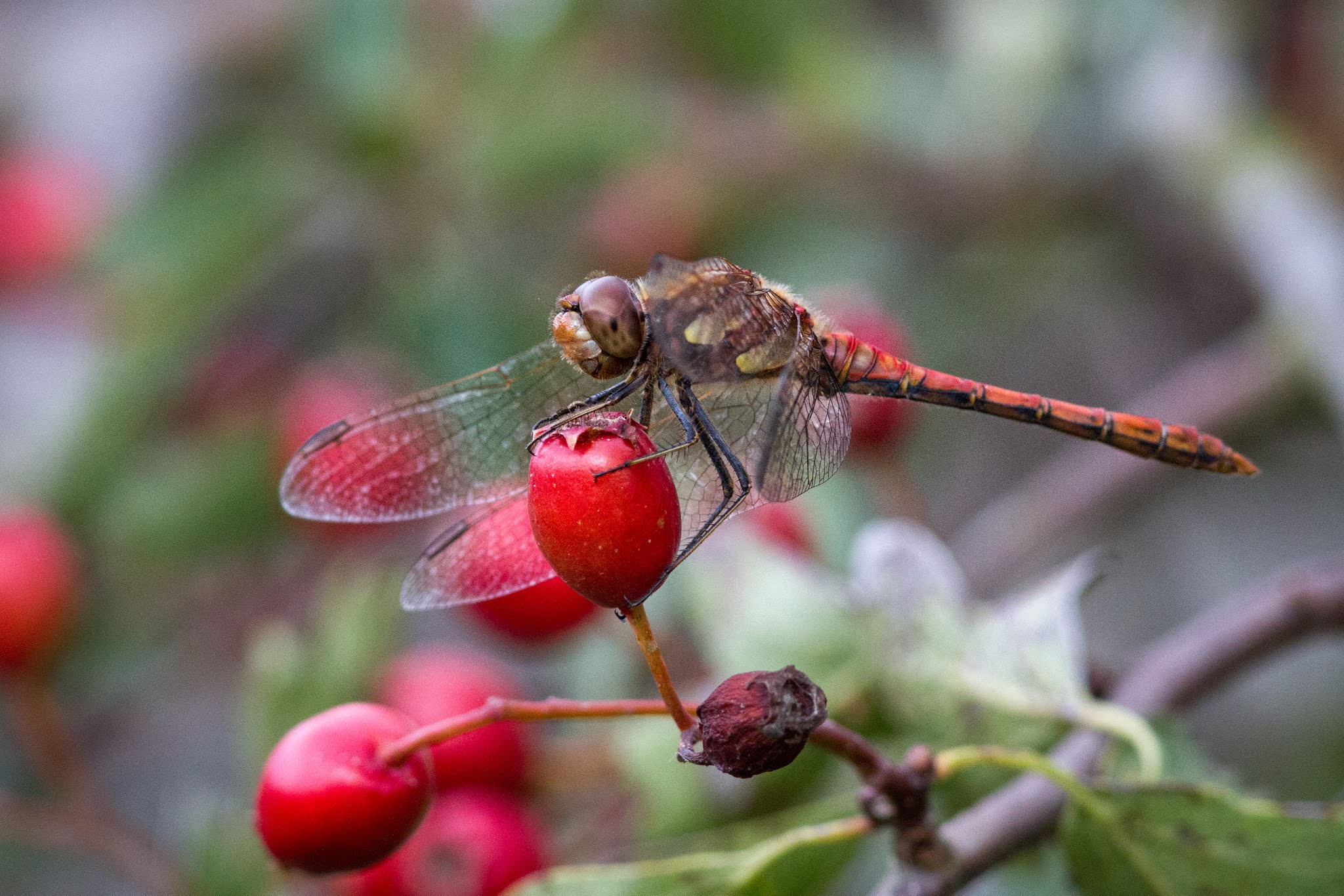
I saw this handsome male migrant hawker sunning himself a couple of weeks ago and took his photo.

When I returned about 10 minutes later I found a female migrant hawker on the very same branch about 3cm lower.  It is obviously a popular spot.

Here's another view of the male.

And another female, this one with blue male-type (andromorph) colouring.


I also tried some flight shots.


This rather shy female migrant hawker was ovipositing in Weetslade Country Park.


Southern hawkers are just about at the end of their season so I was pleased to see a male in Gosforth Nature Reserve. The only camera I had was in the phone which usually gives good quality photos but this pinched zoom was disappointing.  Just a record shot.

Common darters will be around for a few weeks yet if the weather is OK.  There were still newly emerged immatures.

This is a male.

And a rather mature female, almost grey.

These two, ♀ and ♂, were hoping to soak up a few rays of sun.


This was probably my last ruddy darter of the season.

Butterflies I saw included common blue,

green-veined white,

and speckled wood.

This was the only bumblebee I saw in the whole 1km transect on my monthly BBCT Bumblebee Walk.  It is obviously a cuckoo of some kind and is a bit faded but I wasn't sure which species.  After seeking expert advice it can only be narrowed down to Bombus bohemicus/vestalis so I don't feel too bad.

I also saw this ichneumon out hunting.

It is not easy to identify.  There are 2500 species in this country, many of which are very similar.  This page from the wonderful Natural History Museum Beginner's guide to identifying British ichneumonids illustrates the problem.

There seems to be more Robin's pincushion around than usual.  It is a gall on wild rose caused by a tiny wasp, Diplolepsis rosae, so that is one species that is doing well.

Two more swans have arrived at Banks' Pond and are throwing their weight around, trying to intimidate the surviving resident female and her two remaining cygnets.

The youngsters are several weeks away from being able to fly so at the moment they have no escape.  I hope it turns out well for them after all they have been through.

This young great spotted woodpecker in the garden is losing the juvenile red colour on top of its head in a very attractive chequered pattern.

And a wood pigeon on the "sparrowhawk" perch while the sparrowhawk was away.

Averaged out, the weather for September was fairly average, but it was a mixture of warm sunny days and wet stormy days.  October is starting off very wet.