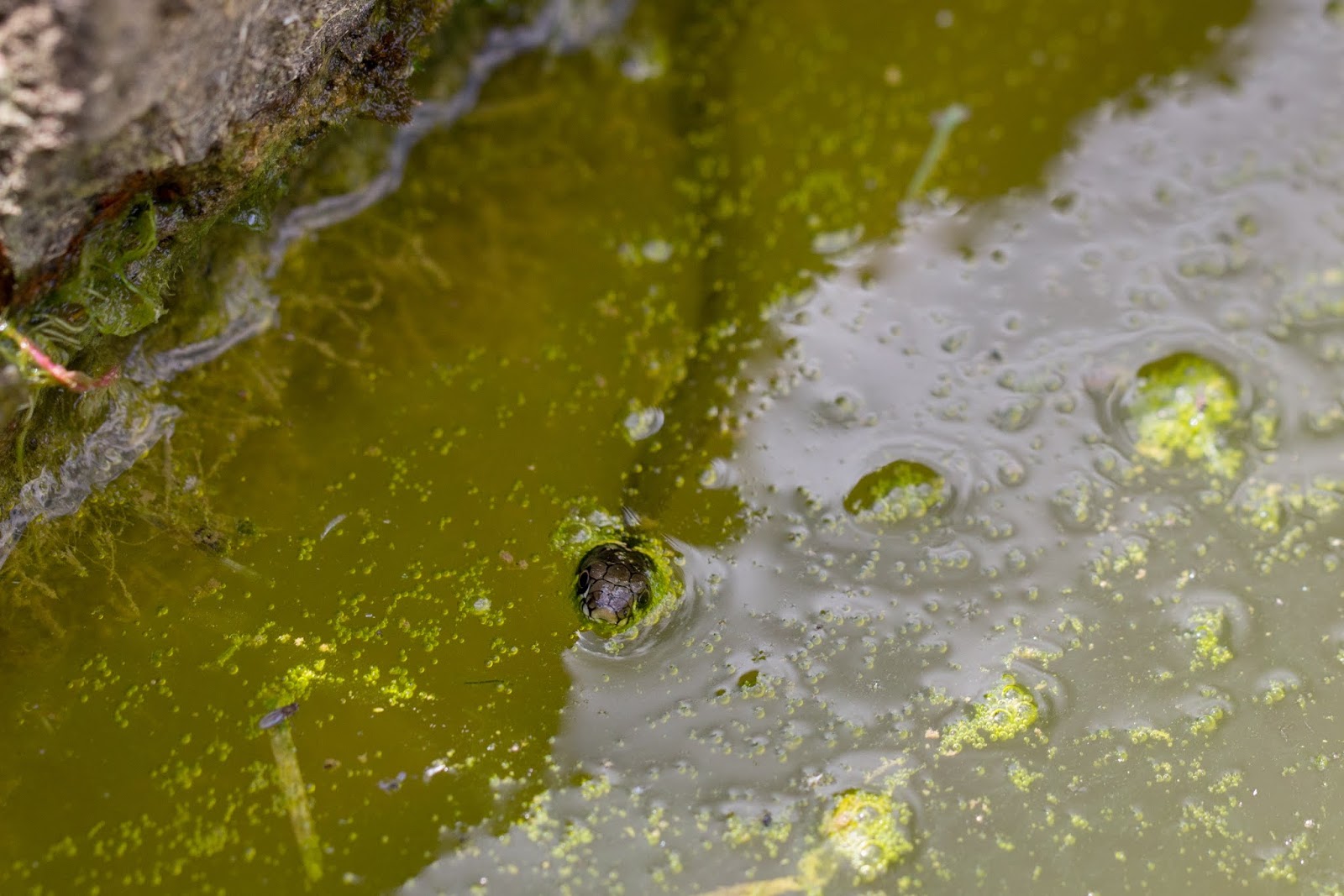
Yet another exciting and unexpected encounter. I saw this tiny grass snake swimming in a sheer-sided moat in a garden in Northamptonshire. It was swimming up and down and trying unsuccessfully to escape from the green water.
I managed to scoop it out without falling in and without injuring it so it kindly agreed to a few photos before being released into the grass where it belonged.
This little snake was only about 20-25 cm long so will have hatched last summer. With luck (and if it doesn't fall in again) it will eventually reach a length of over a metre and live for up to 25 years.
The grass snakes in this country are Natrix helvetica, also known as Western European grass snakes or barred grass snakes. They were recognised as a separate species only two years ago after genetic analysis studies. Prior to that they were considered to be a subspecies of Natrix natrix but that species is now confined to the east of the River Rhine in Germany.
This is the wonderfully named Hairy-footed Flower Bee (Anthophora plumipes). This photo shows a male displaying his middle leg to show where he gets his name from.
The first time I was aware of these bees was when I saw them in The Alnwick Garden last spring. I later saw them in the wall in Nether Heyford, Northamptonshire and wrote about them on this blog and on Rusty Burlew's blog. Here is another male just leaving a nest hole in a wall and showing his hairy middle leg and his yellow face.
The hairy-footed flower bee is quite distinctive and easily recognised but might be mistaken for a bumblebee. It is large as solitary bees go and the sexes look quite different. The males emerge in early spring and spend a week or two foraging and waiting for the females to emerge. These two males are drinking nectar from lungwort (Pulmonaria).
As with most solitary bees, the females emerge a little later and live a bit longer as they have more work to do. The female bee is almost all black, apart from orange hairs on the pollen-collecting brush, the scopa, on her back leg.
Here is a female drinking nectar from a cowslip.
This female is approaching a flower with her proboscis extended.
The female excavates a hole in the wall. Although these are solitary bees they nest in large aggregations. Each female has her own nest hole.
This photo shows an opened nest chamber from a newly emerged bee.
Here are a couple of males hovering behind a foraging female, hoping for a chance to mate. I notice that the females usually fly off when males appear but this one simply ignored them.
Here are another couple photos of males hoping to strike lucky.
The photos above were all taken in Northamptonshire last week. The hairy-footed flower bee is a common springtime bee in the south of the UK but this distribution map from the BWARS (Bee, Wasp and Ant Recording Society) website shows that the Alnwick population (the northernmost red dot) is a northern outlier.
And finally a few photos of bees foraging in The Alnwick Garden yesterday. This is a male on pulmonaria. He looks to be a brighter ginger than the Northamptonshire males but this is probably just because he is newer. I noticed variation in the colours of the Alnwick males.
This photo shows a good view of the female's middle leg and she doesn't have a hairy foot like the male.
This female has collected blue and white pollen from at least two different flowers.
This one prefers white pollen.
And this one yellow pollen.
You can read more about the hairy-footed flower bee here or download this BWARS information sheet.