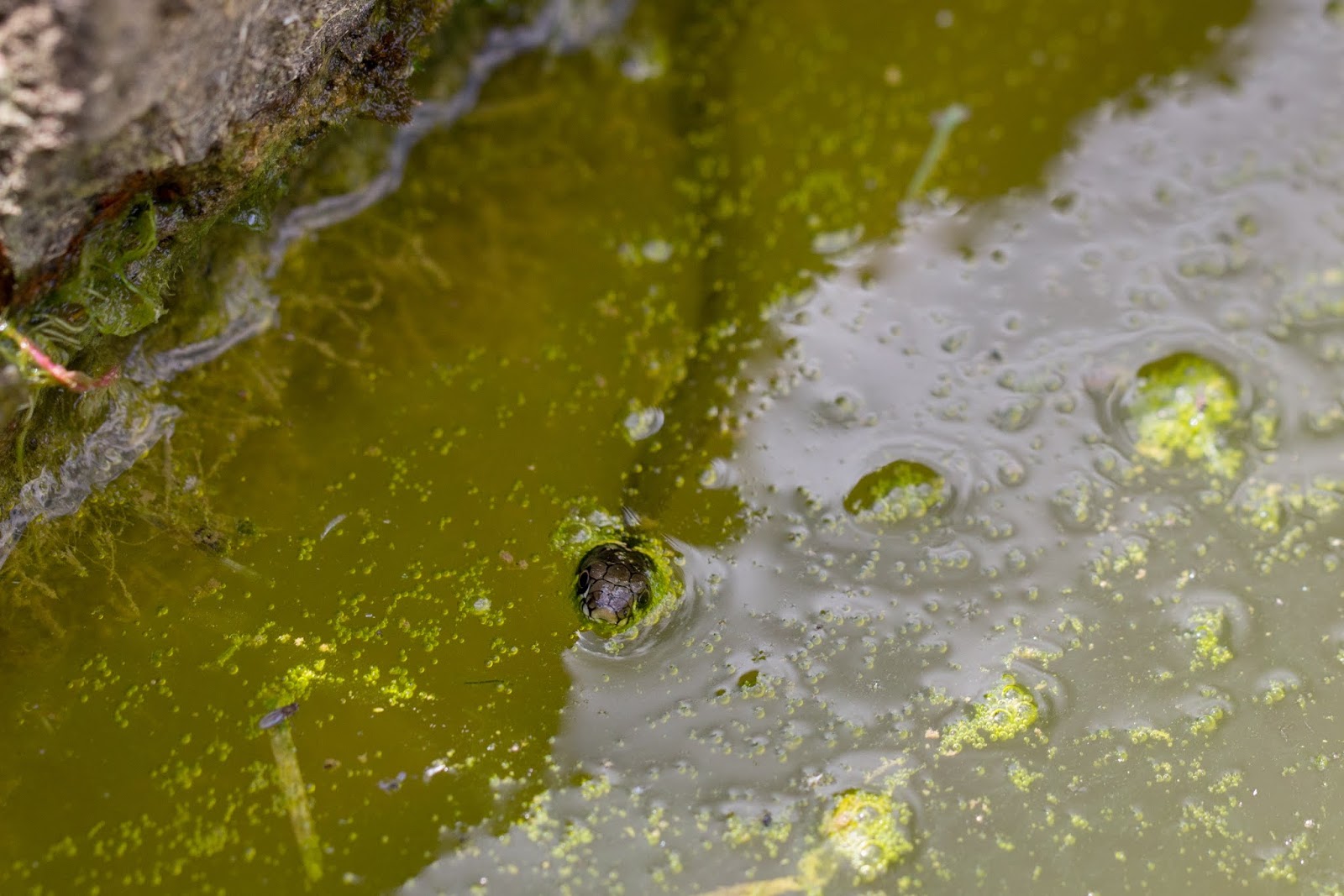
Yet another exciting and unexpected encounter. I saw this tiny grass snake swimming in a sheer-sided moat in a garden in Northamptonshire. It was swimming up and down and trying unsuccessfully to escape from the green water.
I managed to scoop it out without falling in and without injuring it so it kindly agreed to a few photos before being released into the grass where it belonged.
This little snake was only about 20-25 cm long so will have hatched last summer. With luck (and if it doesn't fall in again) it will eventually reach a length of over a metre and live for up to 25 years.
The grass snakes in this country are Natrix helvetica, also known as Western European grass snakes or barred grass snakes. They were recognised as a separate species only two years ago after genetic analysis studies. Prior to that they were considered to be a subspecies of Natrix natrix but that species is now confined to the east of the River Rhine in Germany.
As a comparison to yesterday's post on the adders, here are a few photos taken by my sister Cherry in the courtyard of her garden near Bath (pronounced Barth) in Somerset. They show a grass snake (Natrix helvetica) which first appeared in her garden last week after emerging from hibernation, possibly under the flagstones.
On Saturday the snake reappeared and climbed on top of a juniper bush, hoping for some sunshine.
Then it headed over to the birdbath, perhaps hoping to find a frog.
Yesterday another one appeared, right outside Cherry's back door. It was longer and fatter than the first, so possibly a female. It also had more prominent yellow and black markings around the neck.
Sadly, the grass snake is a species that doesn't get this far north. This distribution map is from the Amphibian and Reptile Conservation Trust website. (The northern outlier data points on the map are very dubious.)
Compare it with the distribution map for adders,
One interesting difference is that grass snakes lay eggs whereas adders give birth to live young. Another is that the grass snake allowed Cherry to get quite close (0.5m) to take its photo. If it senses she is too close it freezes (which helps with the photography) whereas an adder would slide away if it felt threatened.
Many thanks to Cherry for the photos. With photos like these I think she needs to start her own blog.