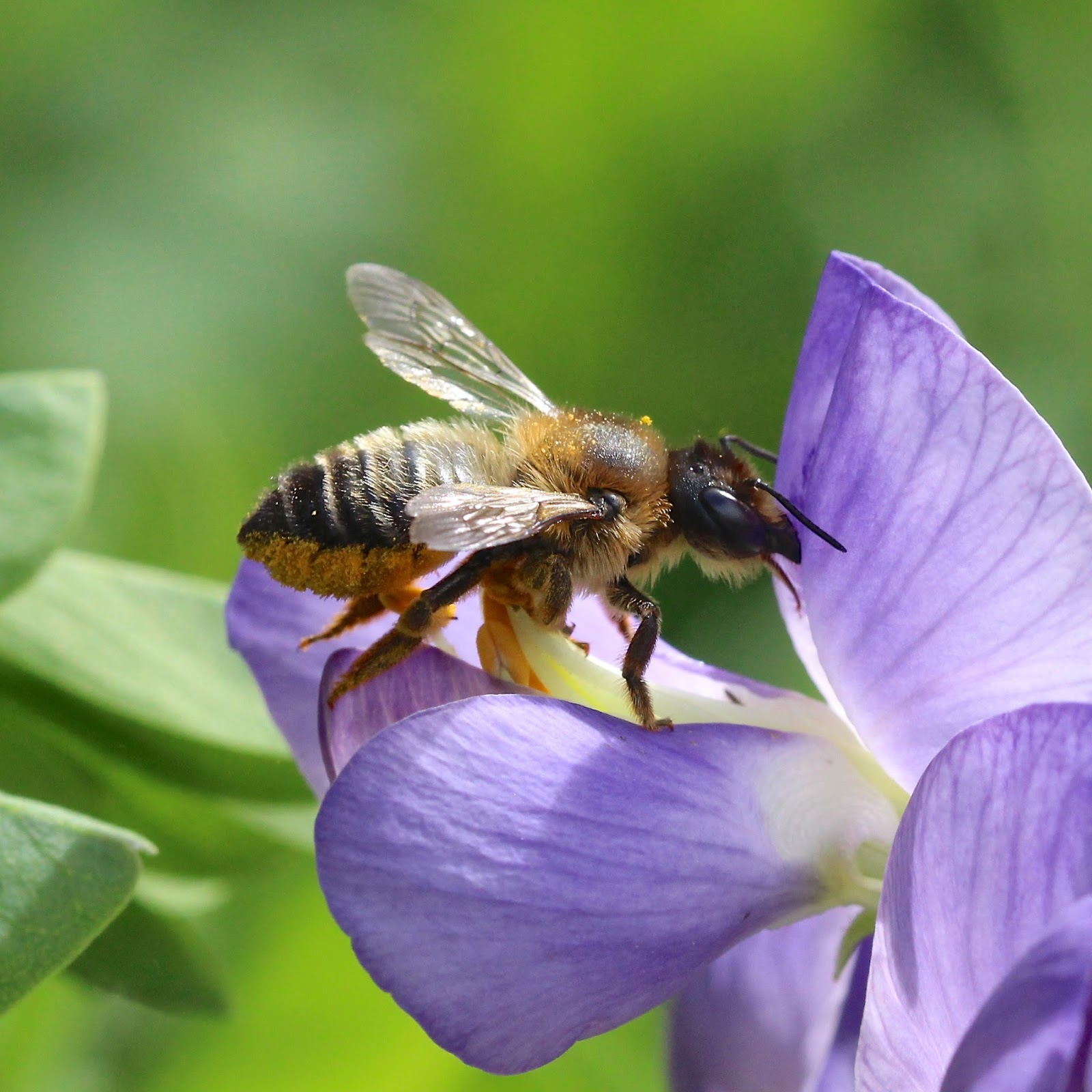
Leafcutter bees are midsummer bees. They are solitary bees and nest in holes in walls, wood, etc. This male Megachile willughbiella was hanging around in my bee house six weeks ago, waiting for the females to emerge. His hairy front legs remind me of a shire horse.
Despite looking carefully in Stephen Falk's book I find female leafcutter bees difficult to identify. This one might be Megachile versicolor as it has a two-tone scopa (pollen brush) under its abdomen.
This one could be Megachile centuncularis and has a good load of bright yellow pollen. The photo shows its powerful mandibles used for cutting leaves.
I am not at all sure about this one. It was difficult to photograph as it was head down in the flowers all the time.
This one is collecting blue-grey pollen from rosebay willowherb.
There have been female leafcutters in the garden but I haven't found where they chose to nest - it wasn't in my bee house. Two photos I am very keen to take are of a bee cutting a leaf and one returning to the nest with a leaf. I have found evidence of them cutting the raspberry leaves but never caught them at it.
To see Ed Phillips' astonishing photo of a leafcutter carrying a piece of leaf click here.
This is the wonderfully named Hairy-footed Flower Bee (Anthophora plumipes). This photo shows a male displaying his middle leg to show where he gets his name from.
The first time I was aware of these bees was when I saw them in The Alnwick Garden last spring. I later saw them in the wall in Nether Heyford, Northamptonshire and wrote about them on this blog and on Rusty Burlew's blog. Here is another male just leaving a nest hole in a wall and showing his hairy middle leg and his yellow face.
The hairy-footed flower bee is quite distinctive and easily recognised but might be mistaken for a bumblebee. It is large as solitary bees go and the sexes look quite different. The males emerge in early spring and spend a week or two foraging and waiting for the females to emerge. These two males are drinking nectar from lungwort (Pulmonaria).
As with most solitary bees, the females emerge a little later and live a bit longer as they have more work to do. The female bee is almost all black, apart from orange hairs on the pollen-collecting brush, the scopa, on her back leg.
Here is a female drinking nectar from a cowslip.
This female is approaching a flower with her proboscis extended.
The female excavates a hole in the wall. Although these are solitary bees they nest in large aggregations. Each female has her own nest hole.
This photo shows an opened nest chamber from a newly emerged bee.
Here are a couple of males hovering behind a foraging female, hoping for a chance to mate. I notice that the females usually fly off when males appear but this one simply ignored them.
Here are another couple photos of males hoping to strike lucky.
The photos above were all taken in Northamptonshire last week. The hairy-footed flower bee is a common springtime bee in the south of the UK but this distribution map from the BWARS (Bee, Wasp and Ant Recording Society) website shows that the Alnwick population (the northernmost red dot) is a northern outlier.
And finally a few photos of bees foraging in The Alnwick Garden yesterday. This is a male on pulmonaria. He looks to be a brighter ginger than the Northamptonshire males but this is probably just because he is newer. I noticed variation in the colours of the Alnwick males.
This photo shows a good view of the female's middle leg and she doesn't have a hairy foot like the male.
This female has collected blue and white pollen from at least two different flowers.
This one prefers white pollen.
And this one yellow pollen.
You can read more about the hairy-footed flower bee here or download this BWARS information sheet.
This strange-looking insect is a bombyliid fly or large bee-fly (Bombylius major). Despite its fearsome appearance it is harmless (to us) and the long proboscis is used for sipping nectar.
The bee-fly is not harmless to solitary bees and wasps, however, because it is a parasite. It is a bee mimic so that it can get close to bees and their nests. The female bee-fly flicks her eggs into or near the nest of a solitary bee or solitary wasp and the larvae that hatch eat the food stored in the nest as well as the bee or wasp larvae.
When I saw hairy-footed flower bees in The Alnwick Garden the other day I noticed bee-flies were taking nectar from the same flowers at the same time, illustrating how good the mimicry is, to our eyes at least. This is a large bee-fly
And this is a male hairy-footed flower bee.
I presume that hairy-footed flower bees are unwitting hosts of bee-flies. They are also parasitised by the cuckoo bee Melecta albifrons but I didn't see any of those. Maybe they aren't found this far north (yet!).
This was a surprise. The hairy-footed flower bee (Anthophora plumipes) Is mainly found in the south of England, where it is a common solitary bee at this time of year. I noticed a group of all black bees, looking like small bumblebees, in the walled garden at The Alnwick Garden. They all had yellow or orange back legs, although some were carrying pollen, and they were being chased by smaller, brown-coloured bees. I took a few photos (difficult as they move so fast) and when I got home was able to confirm that these were hairy-footed flower bees. The Alnwick population has been noted recently and seems to be a northern outlier compared with the normal range of this bee.
This is the female who is all black apart from orange back legs which look yellow when carrying pollen.
And this is the male who is smaller and has white facial hairs like many male solitary bees.
Here you can see why it is called the hairy-footed flower bee (hairy-legged might be more accurate).
Hairy-footed flower bees have a louder and higher-pitched buzz than bumblebees and move noticeably faster when foraging. They usually nest in old walls but also in cliffs and banks. They have long tongues and prefer deep-throated flowers such as pulmonaria (lungwort) as seen here in Alnwick.
For really good pictures of the hairy-footed flower bee see Ed Phillips' photos here and Stephen Falk's photos here.