My Blog List

Showing posts with label Anthophora plumipes. Show all posts

Saturday, 10 April 2021

The march of hairy feet


The first time I saw these bees I didn't know what they were.  I saw smaller brown bees and larger black bees in The Alnwick Garden a few years ago and it was only when I got home to look them up I found they were the male and female of the same species, Anthophora plumipes, the hairy-footed flower bee.  At the time the Alnwick population was a complete outlier, 100km or so from the next nearest confirmed population.  In recent years they have been spreading south in Northumberland and recently they were reported in Morpeth, only 15km north of here as the bee flies, so yesterday I went to have a look.  I soon found up to a dozen males flying around the cowslips and primula hybrids in the Turner Garden,  They were patrolling and chasing each other, always on the lookout for a female and occasionally sipping nectar to refuel.  It makes photographing them a challenge but eventually a couple paused for breath to show how the get their name.

Most of the time they were zooming around between the flowers but there was a brief opportunity when they were refuelling.  Note the long proboscis which allows them to use long tubular flowers


When a female arrived it caused great excitement and they hovered close by, hoping to strike lucky, even though she had no interest in them as she was presumably already mated and was busy collecting nectar and pollen.


This male must be a bit short-sighted as he was propositioning a queen red-tailed bumblebee (Bombus lapidarius).

The females are black with an orange pollen brush on each back leg.

This one has already loaded up with yellow primula pollen.

The female also has a long proboscis to reach the nectar.  It it often cleaned while flying between flowers.

The tongue is even longer and is pushed out through the tube-like proboscis.

There were plenty of other bees about while I was watching, including a garden bumblebee (Bombus hortorum) the longest-tongued of our bumblebees.

You can see how short the red-tailed bumblebee's tongue is in comparison but she can obviously still reach the nectar.

And this tiny bee which is a male tawny mining bee (Andrena fulva).

And just before I left a female tawny mining bee landed right in front of me, wanting also to have her photo taken.

On the way back to the car, several hundred metres away I saw this.

And near the car park, this.

So hairy-footed flower bees seem quite well established in the town and must have been there for some time.  It is only six years or so since they were first recorded in Northumberland and in that time they have moved 30km south from Alnwick to Morpeth to be only 15km away from here.  If they continue to spread I hope to see them here within a few years.  I have already drilled holes in the walls so they will have somewhere to live and there are plenty of pulmonaria flowers, grape hyacinths and cowslips for them in my garden.

Wednesday, 23 May 2018

All in all it's just another bee in the wall


I made another trip to the Ox Hovel in Nether Heyford, Northants on a sunny but frosty early morning.  The bees were warming up before setting off for the day and the two old boys in the photo above are faded male hairy-footed flower bees (Anthophora plumipes).  All the females will have mated by now so there is nothing for these two to do in the remainder of their short lives except sip nectar and sit in the sun.  When I first saw them one was asleep on his back.

Most of the Anthophora bees I saw were females.  They were also waiting to warm up so I had the unusual opportunity of photographing them at rest (normally they whizz in and out too fast for me to focus).


Also warming up were several cuckoo bees, Melecta albifrons, the cleptoparasite of Anthophora plumipes.


I saw a few female red mason bees (Osmia bicornis).  The photos show well the two horns on the face used for building the mud walls between the cells in the nest hole.


Because I was expecting solitary bees this bee puzzled me for a moment.  It is a tree bumblebee (Bombus hypnorum) so they also have a nest in the wall.


I posted a few Anthophora plumipes photos on the UK Bees, Wasps and Ants Facebook page recently and this lead to an amusing exchange, which went along the lines of:

We don't need no pollination,
We don't need no swarm control,
No dark Melecta in the mortar,
Keeper leave them bees alone,
Hey, Keeper, leave them bees alone,
All in all it's just another bee in the wall.

If you are too young to follow this, click here.

Wednesday, 11 April 2018

The hairy-footed flower bee


This bee is one of my favourites (I have a lot of favourites).  The hairy-footed flower bee (Anthophora plumipes) emerges in early spring and is mainly found in the south of the country, although there is an outlier northern population in The Alnwick Garden in Northumberland.  These photos (all of males) were taken last week in Nether Heyford, Northamptonshire.  The season is significantly delayed this year as I saw only two females and far fewer males than the same week last year.

These two pictures show the long hairs on the middle legs.


The males were exploring the holes in the wall, hoping to come across a freshly emerged female.  Some of them were also using the holes for a rest.


The wall holds hidden hazards for small bees, such as this spider.

These two unfortunate bees ended up in the larder.  You can see the bee's very long proboscis in the second photo.


Female hairy-footed flower bees don't have hairy feet but are saddled with that name because of their mates.  They also look very different - being larger and completely black apart from orange hind legs.  I hope to see more of them when I next visit.

Sunday, 9 July 2017

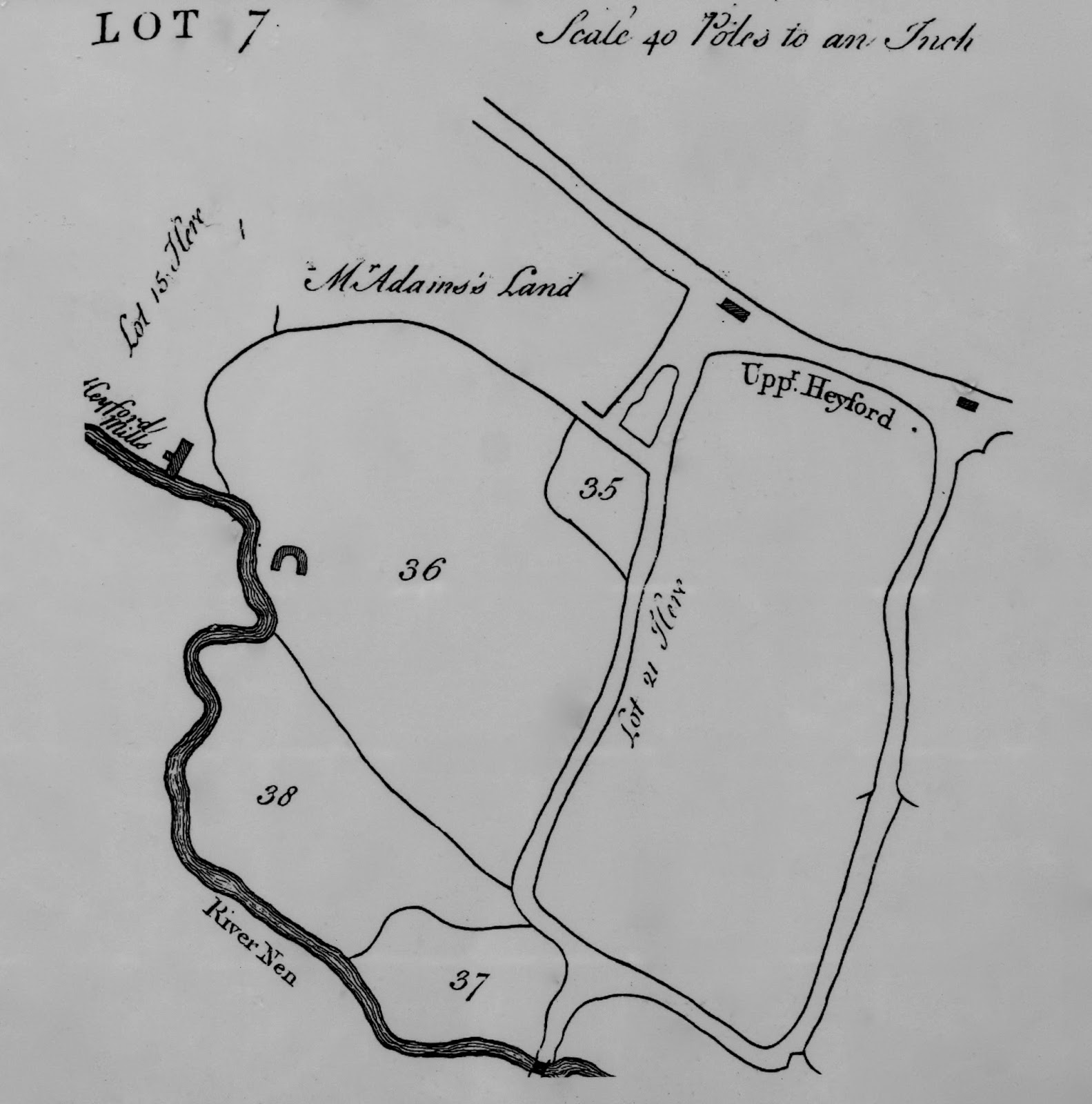
The Ox Hovel

This is a place I know from 50 years ago.  It is the ox hovel, an ancient cattle shelter just north of the village of Nether Heyford, Northamptonshire where I grew up.


The ox hovel is on the bank of the River Nene just downstream from Heyford Mill.  It is a rare building of its type, not found elsewhere in Northamptonshire.  The rounded corners and substantial stonework suggest it was an important building on the farm.  The roof was originally thatched but is now corrugated iron.  The old stone walls are home to several species of solitary bees and wasps and the nearby river hosts several types of damselfly and dragonfly.


The ox hovel was mentioned when the farm was part of several estates being sold in 1758 after the death of their owner, William, Duke of Powis.  It and the surrounding fields were sold at auction in Covent Garden to John Devall for £2440.


The old walls of the ox hovel are a great place to look for solitary bees.  Bees I have seen there include male hairy-footed flower bees (Anthophora plumipes),


female hairy-footed flower bees,


male red mason bees (Osmia bicornis),


female red mason bees,


and one male green-eyed flower bee (Anthophora bimaculata).


Other things lurk in the walls.  Such as spiders waiting for unwary bees


or demoiselles.

This ruby-tailed wasp is a parasite of solitary bees but wouldn't come out while I was watching.


This bumblebee was just having a rest.

A male beautiful demoiselle rested on a comfrey leaf against the wall.


Close by one can find green woodpeckers, kingfishers, barn owls and herons, half a dozen species of bumblebees plus banded demoiselles,


white-legged damselflies,


and blue-tailed damselflies.

I expect there was even more to see 50 years ago but I was less aware and less observant then (and took many fewer photos).