My Blog List

Showing posts with label Demoiselle. Show all posts

Sunday, 12 July 2026

East Anglian dragonflies

I booked a few days away in Wicken Fen last month, not knowing I would be in the epicentre of the red zone of the recent heatwave.  The temperature was over 30℃ every day, peaking at over 37℃, which might have been good for dragonflies but wasn't so good for me.  I was mainly out in the mornings and evenings but did manage to see some things I had never seen or never photographed before.

Wicken Fen is the National Trust's oldest nature reserve and is a haven for dragonflies.  The highlight perhaps were the Norfolk Hawkers which, unlike most other hawkers I have come across, were happy to pose for photos.  This is a male.

One species I had never seen before was Scarce Chaser, which certainly wasn't scarce there but doesn't get much farther north.  Here is a male.

And a mating pair, both looking a bit battered.

Similar in appearance but with clear wing bases and green eyes was this male Black-tailed Skimmer.

I saw several male Hairy Dragonflies but none would stop for a photo.  Then on the last morning I found female ovipositing.  Females are pretty shy so this was a good find and the first I have seen.  This is another species which doesn't get as far north as the North East. 

The Hairy Dragonfly was at the end of its flight period but also on the last morning I found a newly emerged female Southern Hawker, one we do see up here.

Also familiar were Emperor Dragonflies.


Because it isn't found in the North East I had hoped to see a Variable Damselfly, said to be common in Wicken Fen, but every blue damselfly I saw was either Common Blue or Azure.

Another one which doesn't get up here but which was common there was Red-Eyed Damselfly. Here a male.

And a mating pair.

Both at Wicken Fen and RSPB Lakenheath I found Banded Demoiselles.


Also photographed but not shown here were Four-spotted Chaser, Common Blue Damselfly, Azure Damselfly and Common Darter.  Also seen but not photographed was Brown Hawker.

Sometimes it was even a bit too hot for the dragonflies.  They are said to go into the obelisk position, pointing at the sun like this female Ruddy Darter, to prevent overheating.  I had a wonderful few days down at Wicken Fen - ten or fifteen degrees cooler and it would have been perfect.

Monday, 26 May 2025

Beautiful and Hairy

The dragonfly season is well underway.  The first I saw this year was an immature male Broad-bodied Chaser in Gosforth Nature Reserve on 9th May, also the first sighting of a dragonfly in Northumberland this year.

A few days later I saw three Broad-bodied Chasers emerge from my pond but so far they haven't returned (while I was watching) and no more have appeared.  My next dragonflies were two male Four-spotted Chasers on 19th May, again in Gosforth Nature Reserve.  They were already patrolling and chasing so they must have emerged a few days earlier, unnoticed.

At the weekend I was down in Northamptonshire and saw lots of Beautiful Demoiselles, a species that is not recorded in the North East, although it does occur in Cumbria and on the west coast of Scotland.  This is a mature male.

And an immature male with brown eyes and brown wings.

This is a female.

I also saw one male Banded Demoiselle, a species that we do see up here.

On the way home I called in at RSPB Old Moor near Barnsley and had my first good sighting of Hairy Dragonflies, two males and a fleeting glimpse of an ovipositing female.  This one is also unknown in the North East.  Eventually one of the males landed for long enough for me to take a few photos, even though it was a fair way off and the photo is heavily cropped.  It doesn't look hairy in the photo but closer up the body is a bit furry, an adaptation to cooler weather in its early flight season.   Otherwise it looks a bit smaller and darker than the hawkers we see later in the summer.


This is just the start, with plenty to look forward to as the season progresses.  Let's hope it is a good one.

Thursday, 8 July 2021

Les demoiselles


I took a trip down south last week and had time for a walk down to the river with my mother, now 90 years old.  We had gone especially to see the demoiselles and found them right by the coach bridge.  When I was young this was a lovely old brick bridge but it is now rather soulless concrete and steel.  The first we saw was a female banded demoiselle (Calopteryx splendens).

Next were several female beautiful demoiselles (Calopteryx virgo).

Most striking of all were the male beautiful demoiselles, one of which came to sit on the railings.

The only view of a male banded demoiselle was a bit distant.

It was only a brief visit to the river but worth it to see these dazzling insects.

Friday, 12 July 2019

More demoiselles

Last weekend I was down south and took the opportunity to walk down to the river to see the demoiselles.  This is peak season for them so there were plenty around and most were in mature colours.  These are male and female beautiful demoiselles (Calopteryx virgo).


And these are male and female banded demoiselles (Calopteryx splendens).  I am a bit puzzled that the second female has no wing spots, possibly because she is not fully mature.


Nearby was a male white-legged damselfly (Platycnemis pennipes), an uncommon species found only in the south of the country.

Wednesday, 12 June 2019

Les demoiselles

When I was down south recently I had the chance to see our two most beautiful damselflies.  Both are large and spectacularly coloured.  The banded demoiselle (Calopteryx splendens) is found up here, although I haven't yet seen one this year.  These are males.  Recent research shows that the area of banding in the wings gets larger as the season progresses, not expanding in individuals but getting more pronounced in later emerging males.


The females have subtle green and pale gold colours with white wing spots near the wing tips.


Beautiful demoiselles (Calopteryx virgo) don't get this far north.  Females have green and bronze colours and the wing spots are farther from the wing tips.

We only saw immature male beautiful demoiselles, which are pretty spectacular in the sunshine.  As they mature their wings will turn a very dark metallic blue and their eyes will turn black.

Sunday, 9 July 2017

The Ox Hovel

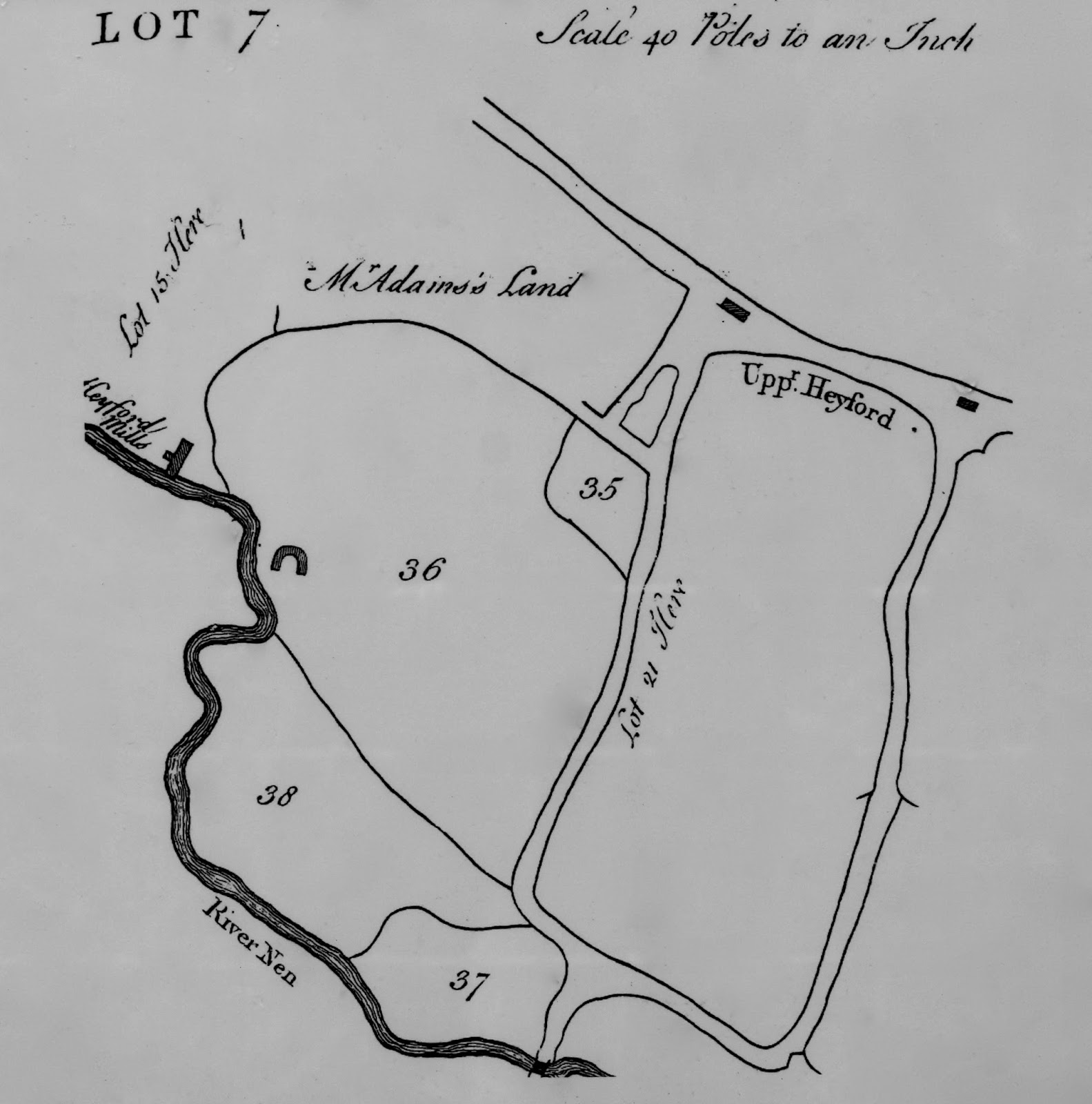
This is a place I know from 50 years ago.  It is the ox hovel, an ancient cattle shelter just north of the village of Nether Heyford, Northamptonshire where I grew up.


The ox hovel is on the bank of the River Nene just downstream from Heyford Mill.  It is a rare building of its type, not found elsewhere in Northamptonshire.  The rounded corners and substantial stonework suggest it was an important building on the farm.  The roof was originally thatched but is now corrugated iron.  The old stone walls are home to several species of solitary bees and wasps and the nearby river hosts several types of damselfly and dragonfly.


The ox hovel was mentioned when the farm was part of several estates being sold in 1758 after the death of their owner, William, Duke of Powis.  It and the surrounding fields were sold at auction in Covent Garden to John Devall for £2440.


The old walls of the ox hovel are a great place to look for solitary bees.  Bees I have seen there include male hairy-footed flower bees (Anthophora plumipes),


female hairy-footed flower bees,


male red mason bees (Osmia bicornis),


female red mason bees,


and one male green-eyed flower bee (Anthophora bimaculata).


Other things lurk in the walls.  Such as spiders waiting for unwary bees


or demoiselles.

This ruby-tailed wasp is a parasite of solitary bees but wouldn't come out while I was watching.


This bumblebee was just having a rest.

A male beautiful demoiselle rested on a comfrey leaf against the wall.


Close by one can find green woodpeckers, kingfishers, barn owls and herons, half a dozen species of bumblebees plus banded demoiselles,


white-legged damselflies,


and blue-tailed damselflies.

I expect there was even more to see 50 years ago but I was less aware and less observant then (and took many fewer photos).