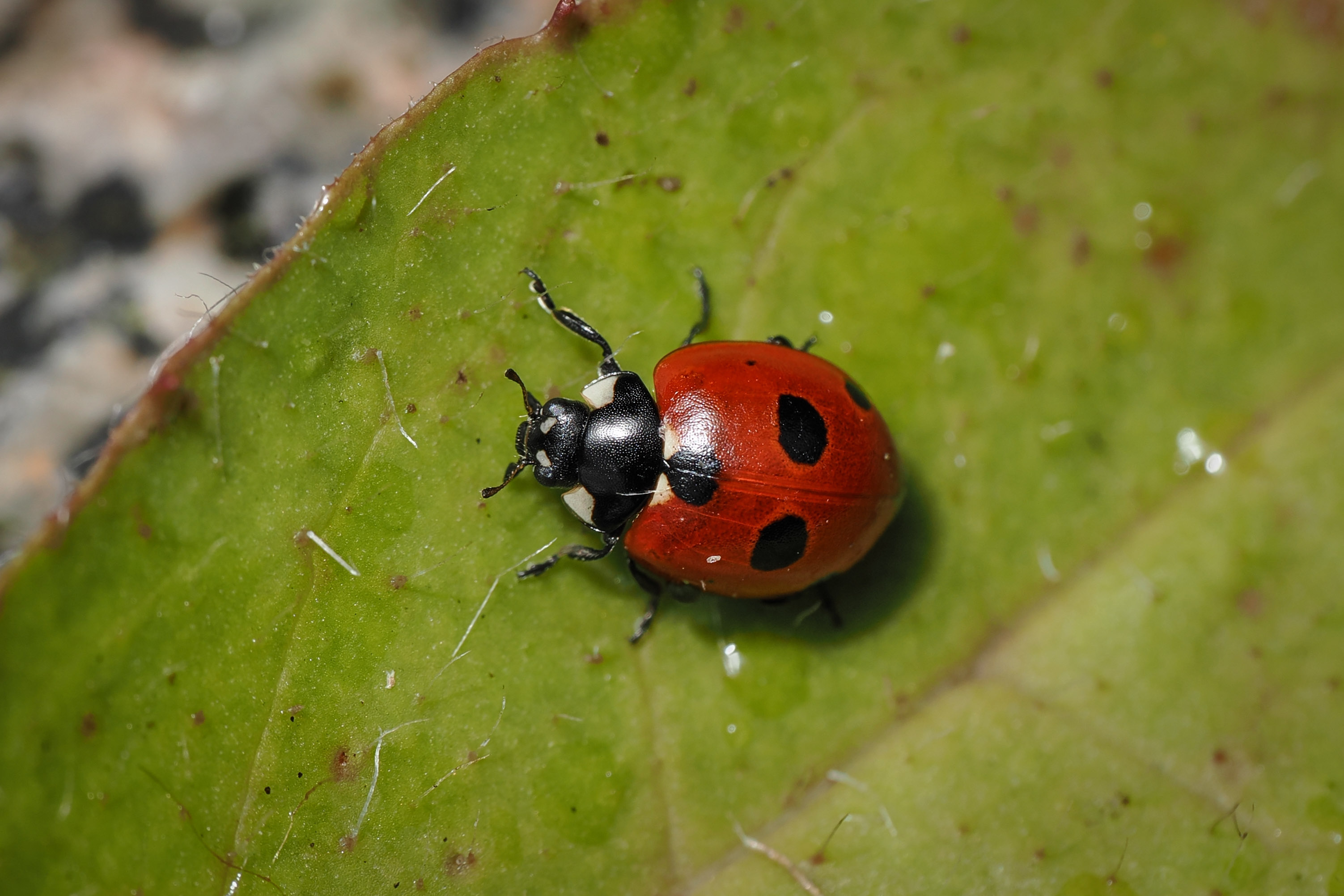
I have been up to Scotland for a few days (more on that soon) and on the way I stopped to look for a rare ladybird - the 5-spot Ladybird (Coccinella quinquepunctata). It is found only on unstable river shingle in North-East Scotland and a few places in Wales. According to the book the 5-spot can be found in the shingle or within a few metres in nearby nettles, thistles, docks etc. I travelled up at the end of Storm Babet when the rivers were in spate, so the edge of the water wasn't where it had been a few days before. I had also heard that nearby pine trees were worth a look. Most records on iRecord seemed to be a fair distance from the nearest road and I didn't have much time to spare so I searched on the map and on Google Streetview for somewhere there would be riverside Scots pines near where I could park the car. I settled on Blair Atholl, downstream from the Bridge of Tilt at the back of the museum car park. And would you believe it? Within 15 minutes I had found a 5-spot ladybird in a pine tree.
After a few photos I put it back in the tree and went on my way. The 5-spot Ladybird's very restricted distribution in the UK is odd because it is apparently fairly common and widespread on the Continent where it can be seen in car parks and on brownfield sites. I also am intrigued by how it copes with floods. I checked a couple of weeks before and the River Spey (the 5-spot Ladybird hotspot) rose over 3m (10') in a few hours. I suppose ladybirds can fly to escape the rising water, but what about their larvae? They must also be able to cope somehow, otherwise they would be wiped out by floods every summer.
The storm over the the past couple of days probably means this is nearly the end of the season for most of our insects. Earlier in the week the butterflies were making the most of some October sunshine, fuelling up on rotten apples before going into winter hibernation. I saw up to 20 red admirals and just a few commas.
.
It hasn't been a great year for apples, with quite a lot of fallers but at least the butterflies and wasps have benefitted.
Ivy is one of the last plants to flower and provides a welcome resource for late season insects. The ivy in my garden is now providing nectar and pollen to a wide variety of insects. I first noticed a lot of pollen being brought into the hives and when I went into the copse I found honey bees,
wasps,
hoverflies,
flies,
crane flies,
and ladybirds, mostly harlequins,
and one cream-spot ladybird. Until now I didn't know that ladybirds would eat pollen.
Ivy nectar is rich in sugar, 49% w/w, and the pollen has a high level of amino acids. The ivy will probably provide nectar and pollen until at least the end of this month. Later the berries will be eaten by thrushes, blackcaps, wood pigeons and other birds.
The wide-angle lenses on the otter cameras continue to prove their worth and I now have three deployed. The camera by the water's edge sees the otters as they visit their sprainting spot but also records lots and lots(!) of pictures of baby rats. The video shows a couple of visits from otters. The first one appears to have a small injury on its back so these are probably two different animals.
Those two never quite got into the same position in the frame so it isn't easy to compare their size, although from the head shapes I think the first was a male and the second a female. I did look back at the same camera in one of the videos in my previous post and it is easy to see the larger dog otter (on the right) compared with the female.
I check for footprints on the sluice gate every time I pass. One set puzzled me recently. On the left were standard otter prints
but on the right was a very smudged trail.
The camera provided the answer. The first otter had tobogganed across using only its front feet while the second walked normally. They were three hours apart and both were very quick so the video is slowed down to 25%. The second otter looks larger and it is probably the dog again.
Since first seeing a weasel in my camera box last month I have had four cameras watching, one in the box and three outside. The other day one of them saw a stoat investigating the pipe leading into the box. Unfortunately the stoat thought better of it and turned round and came back out.
You can see in the photos above, and in the video below, the straight border between the stoat's brown and white fur (in the weasel it is wiggly) and its long black-tipped tail.
When I first made this camera box I used old Victorian land drain pipes as entrances and in retrospect they were too small. There was one very brief visit from a weasel but otherwise the camera has seen only shrews, mice and voles. As soon as I used larger pipes last month the weasels were in. Although a weasel can fit in a very small hole I suspect it is more comfortable exploring a hole in which it can easily turn round. The same is probably true for the larger stoat, so when it saw the smaller entrance at the far end of the pipe it gave up and left.
As soon as I saw the video I spent the rest of the afternoon making a new camera box. This one is again made from a plastic under-bed storage box but now the larger pipes fit inside the box and there is nothing smaller inside. There is a still larger pipe on one side.
I have lined the box with slates so it looks OK inside. And the next day a weasel came to check it out. The weasel moves so quickly that it was already behind the camera by the time recording started - there is a 400ms (0.4s) trigger delay.
I have been hoping that the stoat would return and enter the new box but so far that hasn't happened. A weasel has been back, and again it was in so quickly that it caught out the camera. It is difficult to see in the video because of the speed of movement but the weasel has a quick wee on the floor to leave its scent mark - that accounts for its hunched spread-legged posture. It is probably done as a message to other weasels and stoats and doesn't seem to have deterred nocturnal visits from the small mammals, although they now don't appear in daylight. This time we get a good view of the wiggly border between the brown and white fur of the weasel.
Stoats are part of the natural world here but on the other side of the world, in New Zealand, where there are no native land mammals, they are a non-native invasive species. Early European settlers took rabbits to New Zealand and when the rabbits got out of control they brought in stoats to control the rabbits. It probably seemed like a good idea at the time but in retrospect it was a predictable disaster. The stoats devastated the native ground-nesting birds and there is now a stoat eradication plan. (There is a similar problem, and similar plan, on Orkney.)
I read on a New Zealand website that stoats are partial to mayonnaise so I thought I would give it a try. For good measure I added a bit of peanut butter. And look who turned up to take the peanut butter - our own non-native invasive species, an American grey squirrel.
The mayonnaise was eaten by bank voles and wood mice overnight so that plan didn't work either. Next morning I put in a few sunflower seeds for the voles but of course, now that it knows there might be food in the box, the squirrel turned up to eat them.
So I think the plan at the moment is to put in no food and hope that the weasels' and stoats' curiosity will attract them to the camera box.
It has been a funny old season for dragonflies, warm and sunny in June, cool, cloudy and wet in July and August and hot in early September. Good for early and late species, less so in mid season. Even now it is still relatively warm and there are hawkers and darters on the wing. Here are a few of my sightings in the past few weeks.
A male common hawker at Cragside.
An immature male migrant hawker at Gosforth.
A mature male migrant hawker at Gosforth.
A male southern hawker at Gosforth.
A female migrant hawker at Gosforth.
Migrant hawkers at Gosforth.
Common darters at Cragside.
Black darters at Cragside.
Male common darters at Hepple Whitefield.
A male ruddy darter at Gosforth.
A male black darter at Gosforth.
Younger and older emerald damselflies at Hepple Whitefield.
That's probably it for the season although common darters and migrant hawkers will be around for a while. It will be six months before I see a large red damselfly next spring.