My Blog List

Wednesday, 3 August 2022

A blue mason in the lodge


This little bee appeared in my new bee house on 18th May.  It is a female blue mason bee (Osmia caerulescens) and is the first I have seen.  In the photo above it is in a 4mm hole so you can judge its size.  The next photo shows a red mason bee (below) in an 8mm hole and the blue mason (above) in a 4mm hole to give a size comparison.

Unlike red mason bees, which build the cell walls in their nests with mud, the blue mason bee uses chewed up leaves.  This bee sat around for two weeks but eventually started the first cell on 2nd June.

She then did nothing else until 14th June when she eventually restarted work.  You can see that the pollen she was collecting is mostly grey, probably raspberry as the summer-fruiting raspberries were in flower at the time.

I am puzzled by the delay.  Blue mason bees are scarce locally - Steven Falk's book describes it as "rather localised and rarely common anywhere".  I have only ever seen one male before, four years ago - so I wonder if she was having difficulty locating a mate.  Here is the male blue mason bee from four years ago.  He's smaller than the female.


After the slow start this year's female got on with the job.  Two days later her third cell was almost complete.

Here the bee is regurgitating more nectar onto the pollen in the third cell.

Because there is no room to turn round she then has to reverse to the entrance, turn around,

and reverse back in to unload more pollen from the scopa (pollen brush) under her abdomen.

A short while later the next cell wall is almost complete.

And then on to the next one.  By this time she was also collecting pale yellow pollen.  First more nectar,

then turn around again,

more reversing (you can see the pale pollen on her scopa),

and then unloading the pollen with her back legs.

After the delayed start she eventually completed nine cells in nine days.  The nest is sealed with masticated leaves as well.


Like the red mason bees, she left a space at the front with a false wall to discourage predation or parasitisation.

Here is the bee resting on the garage door, her life's work complete.  That is the last I saw of her.

And this is how it looks now, with a red mason nest above.  Each of the nine cells contains a larva, soon to spin a cocoon and metamorphose into a bee.


Then the bees wait until next spring before emerging to start the cycle over again.  I hope I'll be waiting with a camera to see them emerge.

My first observation bee house contained only 8mm holes.  I am very pleased I provided the 4mm and 6mm holes as well in this one.  Other things have also taken advantage of the smaller holes - more news to follow!

Friday, 29 July 2022

Red masons in the lodge

Red mason bees have been the most reliable occupants of my bee houses.  Early in the year I made a new double-sided observation house and fixed it in a south-facing position on the garage wall.  It has a choice of 4mm, 6mm and 8mm holes.

The first red mason bee I saw this year was a male on 25th March, inspecting holes in a dead sycamore in the meadow.


The next day a female had moved into the bee house, although it was another month before she (or another bee) started building.  There were eventually three bees using the bee house as a roost or shelter.

The weather was pretty cold in early April and presumably discouraged the bees.  This one is keeping warm in one of the 8mm holes.

Here she is standing at the entrance, sniffing what is going on outside with her antennae.

Here is a bee working on the first cell on 29th April.  She has partly built the cell wall and is head first in the cell regurgitating nectar onto the pile of pollen.  She then turned round and scraped pollen off the scopa (pollen brush) on the underside of her abdomen.  Once the provisioning was complete she laid an egg and closed up the partition wall with mud before moving on to the next cell.

In the older bee house here is another bee regurgitating nectar,

and unloading pollen,

before trudging back along the hole and setting off on yet another foraging trip.

On 10th May I witnessed an extraordinary wrestling match between two females in the new bee house.  It was already underway when I opened up to have a look and went on for several minutes, long enough for me to fetch a camera and then go back for a tripod.  I think what had happened was that one bee had gone into the wrong hole and was met by the rightful owner as she tried to leave.  There wasn't room to pass and so the struggle ensued.

Red masons seem to prefer the 8mm holes because they can turn round inside them, which makes life easier as they have to unload the nectar while facing forwards and the pollen while facing outwards.  They will use 6mm holes but have to reverse to the entrance each time and turn around before reversing back in.

This bee completed 12 cells and finished off with a mud wall at the entrance with a small empty cavity behind.  The smaller front cells will produce male bees which emerge first and the females are in the larger cells behind.

Here is a larva which has eaten almost all the food and looks ready to spin its cocoon.

In the new bee house the top two and bottom two holes were all finished by mason bees but within days a bird, probably a blue tit or a great tit, came along and pecked out the mud in the hope of finding something to eat behind.


The bird was thwarted by the spaces behind and the inner walls were not breached.

Since then I have put on a bird-proof, bee-friendly mesh to protect the bees.

Other nests were completed elsewhere in the bee houses.

This year's red mason bees are now all dead and their offspring are developing in the bee houses.  Within a few weeks the bees will be mature within their cocoons but they will wait inside until next March before emerging to start the whole cycle over again.  Other things also built nests in the bee house and I'll post news of them shortly.

Sunday, 24 July 2022

Hummingbird Hawk-moth

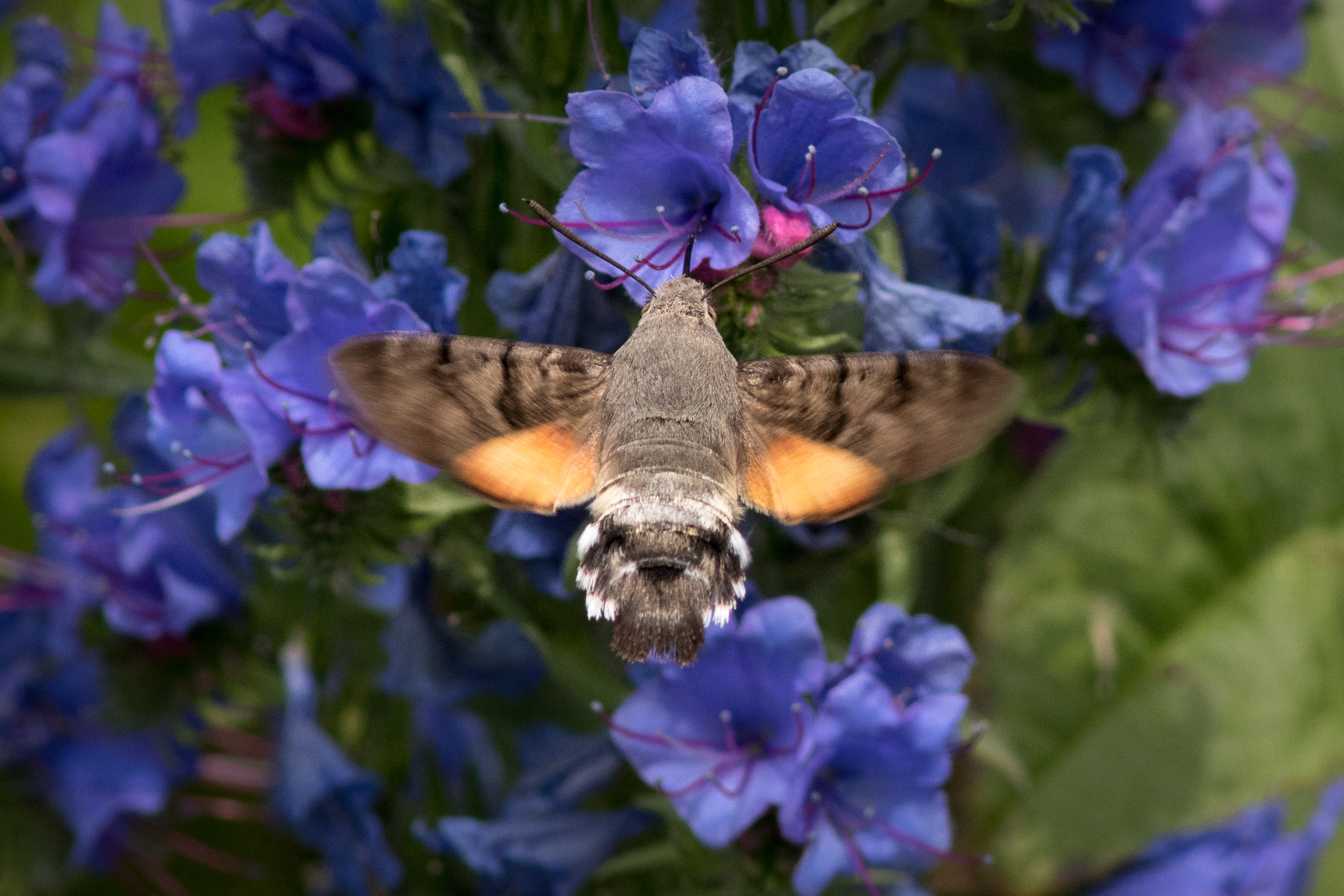
There is a lot happening at this time of year so I get a bit behind posting things on the blog.  A hummingbird hawk-moth was a regular visitor to my kitchen garden eat the end of last month month, attracted by the mass of viper's bugloss.  It is a very challenging subject to photograph, especially in late evening light.  I read that its wings beat 85 times a second, even faster than a hummingbird.  That's one complete wing beat in 0.012s - no wonder the wings are blurred.  Here are the best of a few hundred(!) photos.


I have seen several hummingbird hawk-moths this year in different gardens.  The UK moths are usually immigrants from southern Europe or North Africa so there may have been more incomers on the recent southerly winds.  The BTO Garden Birdwatch may not be the most accurate measure of abundance but it has recorded a notably higher number than usual this year already.

Graph showing differences in Hummingbird Hawkmoth reporting rates between 2022 (blue) and 2017 (black), the previous record holding year.

Tuesday, 19 July 2022

Fox News


Three years ago
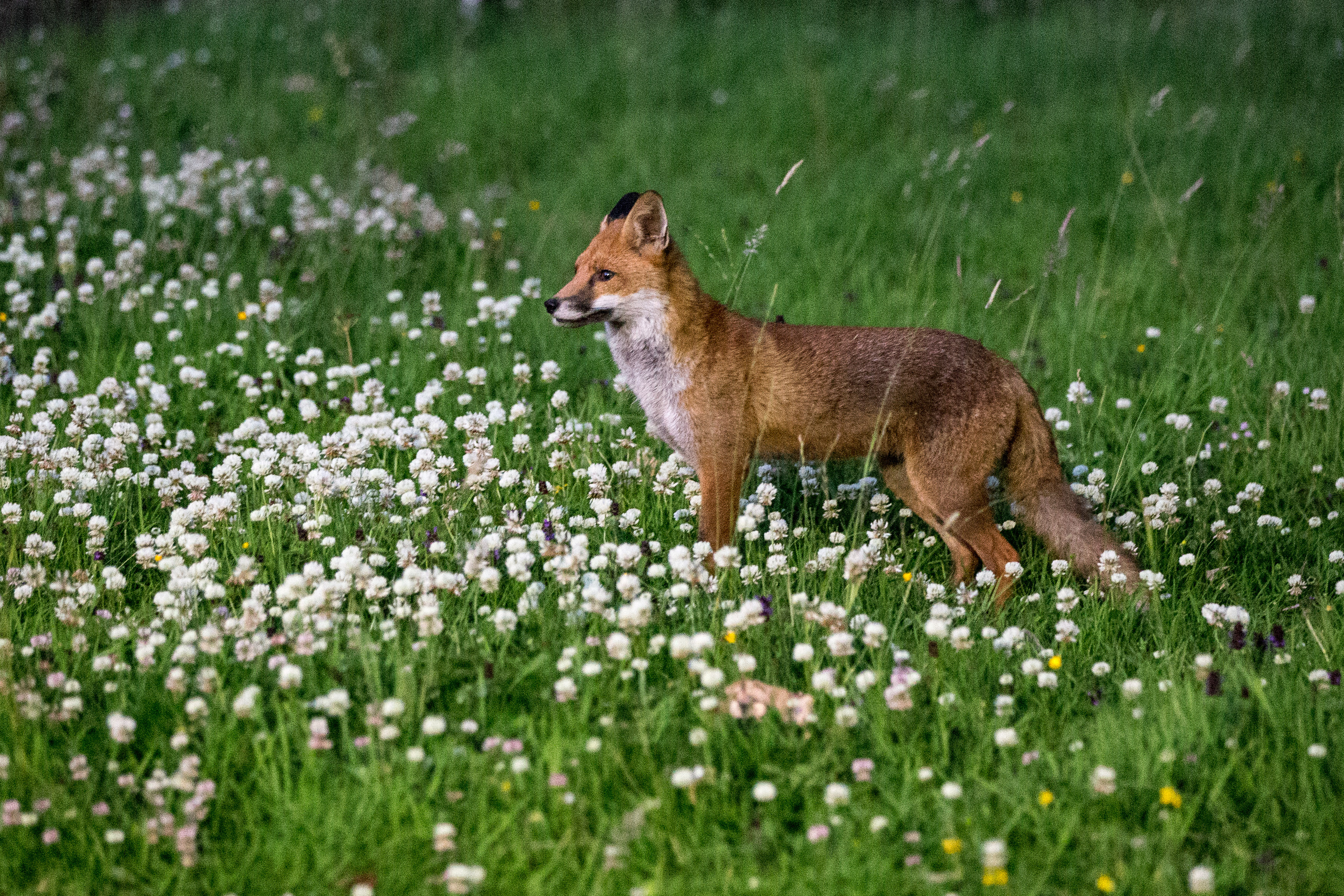
there were five cubs in the garden every evening, two years ago there were two, and  last year there were between 7 and 10 from two litters within the same family, although I couldn't get them all in one photo.  This year I have only seen one cub once, and that was over two weeks ago.  It ran in when the alpha male was here and was immediately body-blocking its father, although he didn't seem to mind.

After he left the cub fed on its own for about 10 minutes but it ran off when a yearling appeared and I haven't seen it since.


The dog fox is here every evening, often at about 10.15 (he's usually very punctual).


The only other foxes I see are three yearlings, presumably all vixens.  They adopt a submissive posture if the dog is already here and he often lies down as well in greeting.

The yearlings occasionally feed together but usually alone.


They often give each other space and sometimes lie down in the meadow to wait their turn at the food.

I haven't seen the alpha vixen for several weeks.  She has now had three litters here so that may be the end of her time.  If she doesn't return I shall miss her as she was very distinctive and quite a character.