Birds in flight are not my strong point. It is rare for me to get one in focus.
I was up the coast mainly to look for a hen harrier but it seemed rude not to call in on the shore larks again. They have been around all winter and are fun to watch. They seem to be cheerful as they scurry around looking for food on the beach and certainly cheer up those who are watching.
Most of my recent posts about the foxes in the garden have been using the colour still trail camera with flash (as above) but I had another go with the infrared video camera. The fox(es) come for food every night - usually peanuts. I am pretty sure there is more than one because on the camera last week one was noticeably smaller and slimmer than the other.
The video camera records 30s clips and there were 56 in one night meaning that, with short gaps inbetween, the fox(es) were in the garden for at least half an hour. I was surprised to see the first recording was only 20 minutes after I put the food out after dark so maybe the fox was already in the wood watching me and waiting. There were 9 clips recorded before 19:00 and then a break until 23:16 when another 33 clips were recorded. Then a wood mouse at 00:07 followed by another 14 fox clips starting at 01:49. So I suppose it could be three foxes, or two, or one coming back three times. I'm also a bit surprised that the first fox didn't finish all the peanuts.
There follow three clips, one from each session. Do you think it is all the same fox? It isn't easy because the second time the fox was sitting down nearly all the time, making it more difficult to judge its size. I also wonder if the first fox, and perhaps the third, is limping. (I think the videos probably won't play on an iPad or iPhone unless it has a different browser installed. I think they also might not run on an iMac without something like Google Chrome but I can't test it out for sure until after I post this.) - since posting I found that the iMac won't run the videos in Safari but they work fine in Google Chrome. I think the problem is that Safari can't handle Adobe Flash. They also work on my old Windows computer.
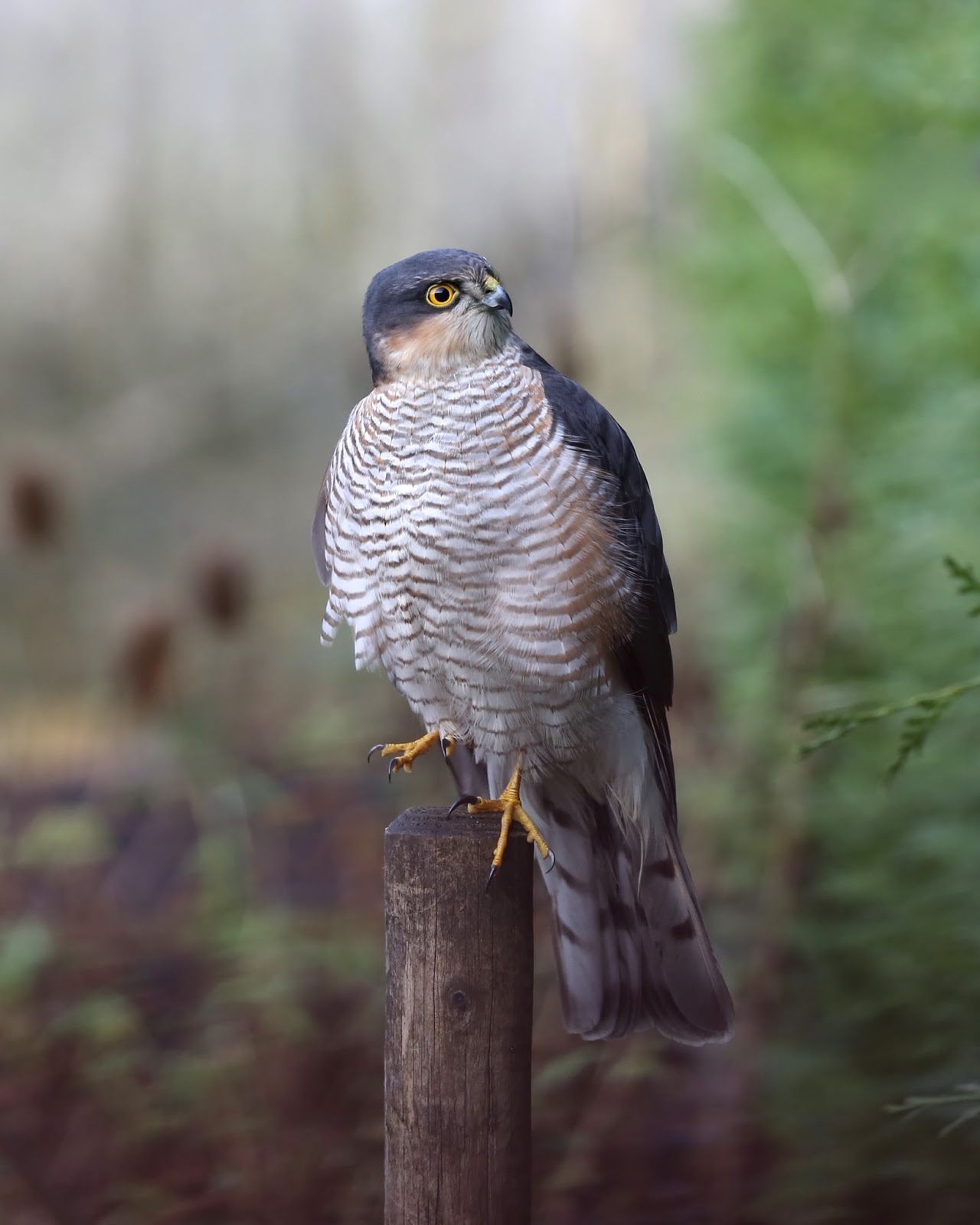
I was pleased with these photos, especially because of the planning that went into them. I had noticed this sparrowhawk hanging around in the kitchen garden but he kept sitting in the wrong place out of view or facing the wrong way for a photo. So I put in a post for him to sit on in a position where he was likely to face the window. It worked and several times he was sitting on the post as I passed the window. I then set up the window as a hide with the camera ready. Earlier this week he sat in wait near the bird feeder for 30 minutes or so, constantly alert and watching for incoming small birds. Unfortunately I hadn't opened the window in time so the photos are taken through the double glazing.
Occasionally his concentration lapsed and he spent time stretching and preening.
Here he is also showing off his tail feathers.
Eventually a blue tit turned up despite the constant alarm calls from nearby bushes. The sparrowhawk attacked but the blue tit dived into the safety of a thorny gooseberry bush right in front of me. It was only 50cm above the sparrowhawk, which was now on the ground, and was very agitated but too scared to fly away. At one point there were three blue tits in the bush all jumping about and calling alarms but eventually they all made a dash to the safety of a holly bush.
Then a great tit arrived and wasn't so lucky. The sparrowhawk briefly took it back to the post but found there wasn't room enough so flew a short distance away to pluck and eat its prey.
This bird is an adult male, with beautiful RAF blue feathers on his head and back and a rufous tinge to the chest feathers which is less marked than in some other birds. His eyes are yellow-orange (and will become darker with age). He can turn his head nearly all the way round, like an owl, and has white marks on the back of his head.
The male sparrowhawk is much smaller than his mate, a feature called reversed sexual size dimorphism. It's a very efficient arrangement as the two birds hunt different prey, the male catching tits, finches, etc while the female goes after blackbirds and pigeons. They only need small birds when the chicks are being brooded by the female but larger food items once she can leave them in the nest to hunt.
The Eurasian sparrowhawk is Accipiter nisus. Accipiter is Latin for hawk. Nisus was the King of Megara and was killed by his daughter Scylla after she cut off a lock of purple hair which kept him from harm. Nisus was transformed into a sparrowhawk (or an osprey or a sea eagle, depending on which story you read).
Thomas Bewick engraved a sparrowhawk for his A History of British Birds (1797).
Sparrowhawks are now fairly common birds but were severely affected by DDT, aldrin and other pesticides used in agriculture after the Second World War and the population crashed. It recovered slowly after the chemicals were banned and is now stable.
Sparrowhawks are birds of woodland and gardens are are more common in eastern parts of the country. They have made a good recovery in East Anglia where they were almost extinct.
Sparrowhawks are fairly common visitors to gardens, hunting small birds attracted to feeders. These BTO Garden BirdWatch data show that fewer visit in late spring when the woods and hedgerows are full of fledgelings.
Read more about sparrowhawks here. You can watch a wonderful short video from the BBC Natural History Unit about a hunting sparrowhawk here. Watch a BTO video on identification of sparrowhawk and goshawk here. And listen to the BBC Radio 4 Tweet of the Day on sparrowhawk here.
There was a little bit of snow here last night, not much but enough to persuade the redwings to come off the golf course and into the garden. Photos in low light with high ISO and through the double glazing, so not as sharp as I would like.
These bitterns really know how to put on a show but they don't get on with each other. I had been sitting watching as the occasional bird flew briefly from one reed bed to another, testing my reflexes. Suddenly a bittern jumped out so close that I didn't have time to adjust the zoom and lost what might have been a good photo.
It landed in the reedbed just in front of me but landed right on top of another bittern - who wasn't best pleased. There was a brief fight, out of view, and the newcomer was unceremoniously dumped back in the water.
It swam around with its crest erect for a minute or so, trying to show it wasn't intimidated, but eventually took off and flew back to the bed it had come from.
I wrote before about the bittern's landing technique, which is to close its eyes, crash into the reeds and hope for the best. Here's another example. The colours on its wings are wonderful.
The original occupant of the reedbed briefly made itself visible to establish ownership, and then disappeared from view.