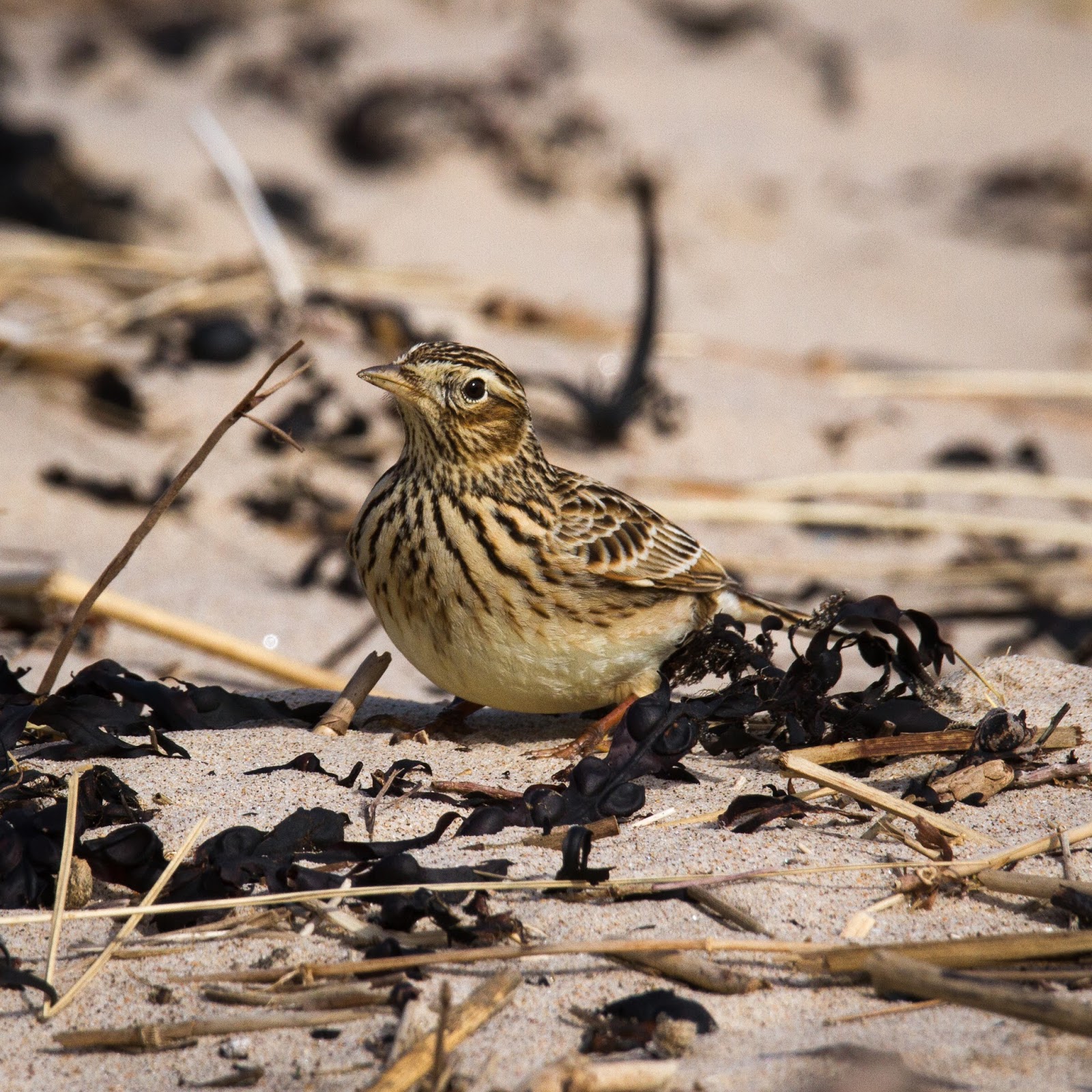
I expect you knew what they all are but if not here's a list: brambling (♂), common frog, ashy mining bee (♂), common lizard, chocolate mining bee (♀), adder (♂), grey seal, ring-necked parakeet, common hawker (♂), willow tit, yellowhammer (♂), hawfinch (♂), swallow, twite (♂), shore lark, snow bunting (♂), roe deer (♀).
My Blog List
Showing posts with label Shore lark. Show all posts
Friday, 29 December 2017
End of year favourites - Northumberland
As I live on the northern edge of Newcastle it is very easy to escape into proper countryside. Away from my garden and my two local haunts of Gosforth Park and Banks' Pond I most often head north up the Northumberland coast or west up the Tyne Valley. Here are a few photos from my travels in Newcastle and Northumberland this year.
Saturday, 16 December 2017
Bird of the week - Shore Lark
When I went to see the twites recently there were also a couple of shore larks on the beach. Last winter there were seven in the same spot but so far this year I don't think anyone has seen more than two.
The shore larks are more wary than the twites and didn't come very close so I only managed these few photos.
Shore larks are occasional winter visitors to the east coast from their breeding range in northern Scandinavia. Most Scandinavian shore larks overwinter on the shores of the Baltic Sea.
The shore lark must have been a rare British bird 200 years ago as it was not included in Thomas Bewick's A History of British Birds (1797). It did feature in a supplement published by Thomas Campbell Eyton A History of the Rarer Species of British Birds (1836). Archibald Thorburn painted a shore lark along with a short-toed lark (L) and a crested lark (R), both of which are rare vagrants in the UK.
Saturday, 1 April 2017
Beach birds
When I went to see the snow bunting I posted a few days ago there were lots of other birds on the beach. Among them were shore larks and twites (both yet to depart for breeding grounds), skylarks, and reed buntings. Here are a few photos.
Wednesday, 18 January 2017
More larks
I was up the coast mainly to look for a hen harrier but it seemed rude not to call in on the shore larks again. They have been around all winter and are fun to watch. They seem to be cheerful as they scurry around looking for food on the beach and certainly cheer up those who are watching.
Saturday, 3 December 2016
Bird of the week - Shore lark
Here is a bird I had never seen before this week, a shore lark. Shore larks are rare winter visitors, occasionally seen on the Northumberland coast as single birds, but there have been seven this week at East Chevington which is quite exceptional. I didn't manage to get all seven in one shot but here are five of them.
Male shore larks have darker face markings and bigger "horns" (feathers) but the sex differences are less noticeable in the winter. In the first picture below I suspect it is a male in front and a female behind. The second photo is probably a female and the third probably a male. The birds are small and were mostly 20-30m away so the photos lack some resolution.
It was a very cold day so when they had finished feeding the birds fluffed up their feathers to keep warm.
The shore lark is Eremophilia alpestris, meaning desert-lover of the high mountains, so you might guess it doesn't live on the shoreline at home. These birds come from northern Scandinavia and most move down to the shores of the Baltic Sea in winter. A few make it across to England, mostly to East Anglia and eastern Kent.
This seems to have been a good autumn to see shore larks here. This is the latest chart from BTO BirdTrack.
I can't find any reference to the shore lark in Thomas Bewick's writings - maybe it wasn't known here in the late 18th century.
You can listen to Chris Watson's BBC Radio 4 Tweet of the Day on shore lark here, broadcast only a couple of weeks ago.
Subscribe to:
Posts (Atom)