My Blog List

Showing posts with label Twite. Show all posts

Friday, 29 December 2017

End of year favourites - Northumberland

As I live on the northern edge of Newcastle it is very easy to escape into proper countryside.  Away from my garden and my two local haunts of Gosforth Park and Banks' Pond I most often head north up the Northumberland coast or west up the Tyne Valley.  Here are a few photos from my travels in Newcastle and Northumberland this year.


I expect you knew what they all are but if not here's a list: brambling (♂), common frog, ashy mining bee (♂), common lizard, chocolate mining bee (♀), adder (♂), grey seal, ring-necked parakeet, common hawker (♂), willow tit, yellowhammer (♂), hawfinch (♂), swallow, twite (♂), shore lark, snow bunting (♂), roe deer (♀).

Saturday, 25 November 2017

Bird of the week - Twite


The flock of twites has returned to Druridge Bay this winter and numbers about 100 birds.  They are enchanting to watch as they gradually hop closer and closer to feed before suddenly twinkling off across the beach or over the dunes. At times they were closer to me than the minimum focus on my lens (2.5m), allowing some intimate portraits.  The details of their colouring are quite variable.


The BTO and Wikipedia give the twite's binomial name as Linaria flavirostris whereas the RSPB and Collins guide give it as Carduelis flavirostris.  It has a greyish bill in summer and a yellow bill in winter (hence flavirostris).

Twites are rare and endangered birds and are on the red list.  Most of the UK population is in north-west Scotland but in England a few breed in the south Pennines.  The rest of the European breeding population is almost all in Norway.


The BirdTrack reporting rate has been low this year with a recent increase as birds have moved to the coast for the winter.

In Thomas Bewick's A History of British Birds (1797) the twite was the mountain linnet.  He also had a mountain finch (our brambling) and a mountain sparrow (tree sparrow).

This is Archibald Thorburn's painting of twites.

In an attempt to reverse the population decline the RSPB is putting a lot of time, money and effort into the England Twite Recovery Project.  You can read more about it and watch a video on twite ID here.  You can listen to the BBC Radio 4 Tweet of the Day on the twite here.

Saturday, 1 April 2017

Beach birds

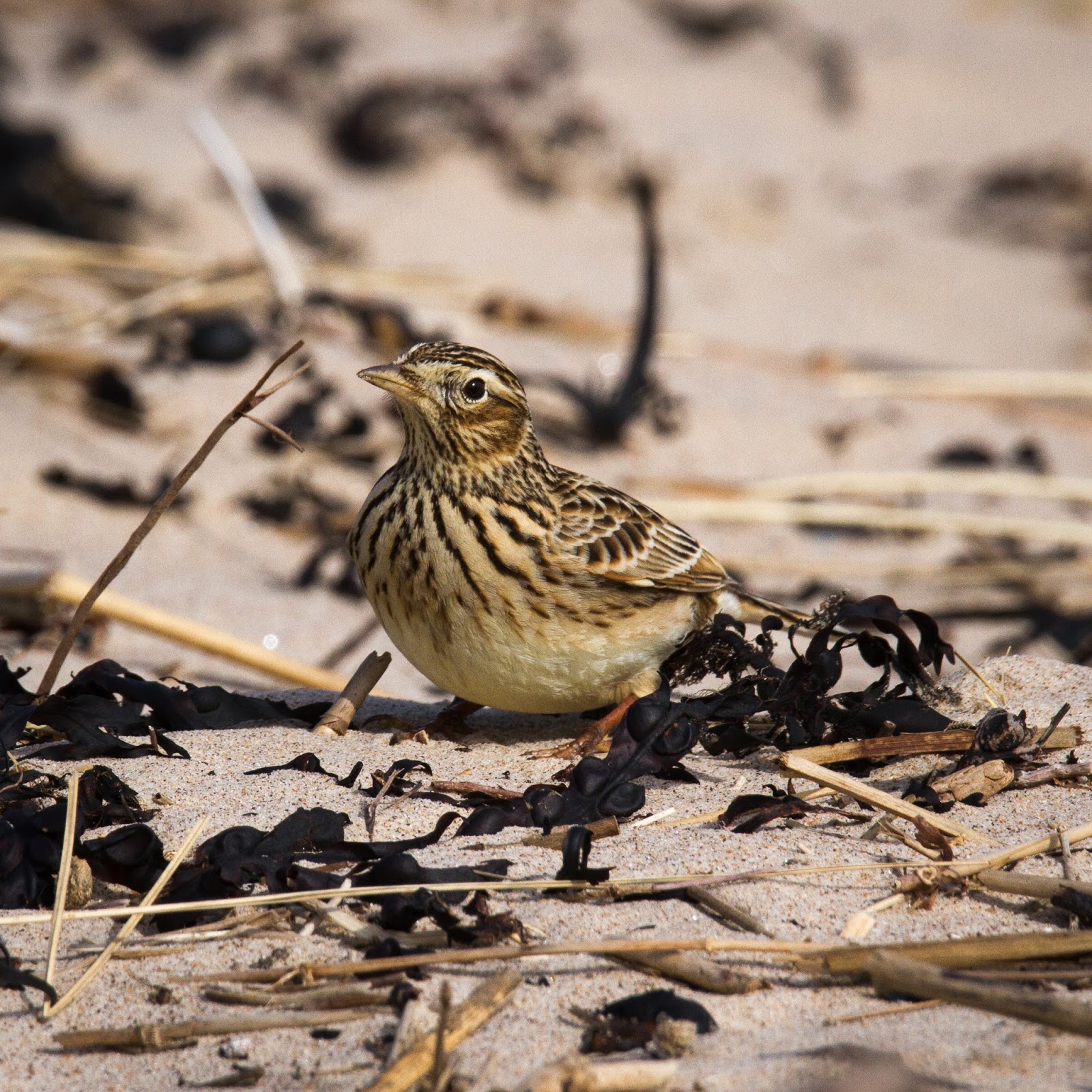
When I went to see the snow bunting I posted a few days ago there were lots of other birds on the beach.  Among them were shore larks and twites (both yet to depart for breeding grounds), skylarks, and reed buntings.  Here are a few photos.


Saturday, 18 February 2017

Bird of the week - Twite


Here's a little bird I hadn't seen before this winter.  The twite is a small brown finch similar to a linnet.  This flock of 80 or so birds has been at Druridge Bay all winter, sometimes mingling with the shore larks.  This was earlier in the week, the closest I have seen them, but the light was poor.  They make tinkling metallic calls as they fly around in a flock. Although it is a classic LBJ (little brown job), close up the twite has a gingery face and the male has a mauve/pink rump.  The amount of white underneath varies considerably.


These are males showing the pink rump.


Then I went back yesterday in sunshine, so here are a few more photos.


The twite is Linaria flavirostris, meaning the yellow-billed linen weaver.  In French it is Linotte à bec jaune, the yellow-billed linnet.  It has a yellow beak in winter and a grey beak in summer.

Thomas Bewick knew the twite as the mountain linnet.  In his day twites nested locally - the bird he drew for A History of British Birds (1797) was shot(!) at Callerton Fell, about 10km due west of here.  No digital photography in those days.

Archibald Thorburn painted a twite (R) and a snow bunting (L) in a setting almost exactly as I saw them.

In the UK the twite is red listed.  There is a fairly small breeding population in Scotland and a tiny breeding population in the southern Pennines.  The Scottish birds mostly winter on the coast of Scotland and here while the English birds winter on the coast in eastern England.  The birds I saw might be Scottish or from Scandinavia.


The main reason for the drastic decline in twite numbers is the change in agriculture which has led to destruction of hay meadows and removal of hedges.  Twites are exclusively seed feeders - even the chicks are fed on seeds - so the birds can't survive if the right seed plants aren't available.  The RSPB have a successful support programme for the tiny English population in the south Pennines.

This is where twites breed in Europe (from the EBCC Atlas).  They also live in central Asia.

You can watch a short BTO video on identification of linnet and twite here.  You can also watch an i.d. video from the RSPB Twite Recovery Project here.  Listen to recordings of twites here.  Listen to the BBC Radio 4 Tweet of the Day here.