My Blog List

Showing posts with label Hawfinch. Show all posts

Tuesday, 3 May 2022

A rare garden visitor

While I was on the phone yesterday afternoon I glanced out of the window and saw a bird I didn't immediately recognise.  I peered at it for a few seconds but then all the birds were spooked by something and flew off.  It was larger than a bullfinch with a pale beige front and a neat black bib but it was looking straight towards me so that is as much as I could see.  I wondered about a hawfinch or possibly a waxwing, although a waxwing wouldn't come near a feeder. During the rest of the phone call and the rest of the afternoon it didn't return so I thought I would never know what it was.

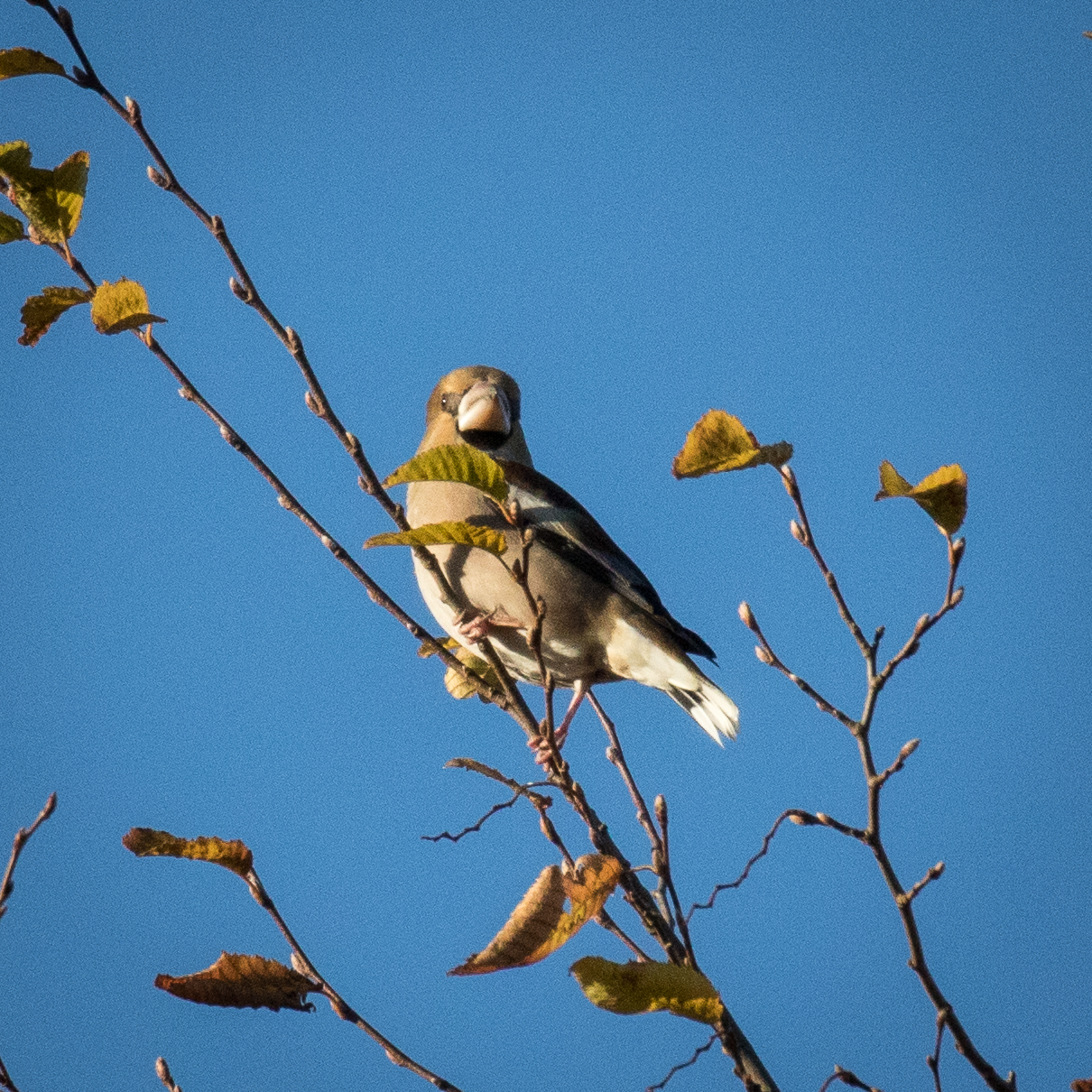
Then first thing this morning it was back.  And it was a hawfinch.  As always, there was camera close at hand so this time I was able to take a photo.


I even had time to change to a camera with a longer lens to get some slightly less grainy photos.


Hawfinches are scarce birds and rare garden visitors.  A few years ago I spent two days wandering around fields near Morpeth, a few miles north of here, to get some rather distant views and then this one turns up almost on my doorstep. What a treat.

I don't keep a formal garden list but it would now include yellowhammer, waxwing, red-backed shrike, oystercatcher, buzzard, woodcock, ring-necked parakeet - and hawfinch.  I wonder what will turn up next.

Friday, 29 December 2017

End of year favourites - Northumberland

As I live on the northern edge of Newcastle it is very easy to escape into proper countryside.  Away from my garden and my two local haunts of Gosforth Park and Banks' Pond I most often head north up the Northumberland coast or west up the Tyne Valley.  Here are a few photos from my travels in Newcastle and Northumberland this year.


I expect you knew what they all are but if not here's a list: brambling (♂), common frog, ashy mining bee (♂), common lizard, chocolate mining bee (♀), adder (♂), grey seal, ring-necked parakeet, common hawker (♂), willow tit, yellowhammer (♂), hawfinch (♂), swallow, twite (♂), shore lark, snow bunting (♂), roe deer (♀).

Saturday, 18 November 2017

Bird of the week - Hawfinch


Hawfinches are shy and elusive birds so I was very pleased to see these near Morpeth.  In the winter they eat tree seeds and are very fond of hornbeam seeds.  These birds were in a row of mature hornbeams on the site of an old tree nursery.  Hornbeams are not native to the north of England but there are mature trees which have been planted in parks and gardens.  The birds I was watching mostly appeared in the tops of the trees for a few moments before disappearing so all the photos are at long range and heavily cropped.


The most striking feature of the hawfinch is its enormous bill, used for cracking open seeds and fruit stones.


The male's colouring is beautiful but catching a well coloured male in good light was difficult.  This one wouldn't sit in full view but you can see the colours on his head and the blue in his wings.  You can see how well he is camouflaged against the hornbeam leaves.

A lot of the birds were less brightly coloured - probably females or this year's young.


Even in silhouette they are pretty easy to identify.

The hawfinch is Coccothraustes coccothraustes, meaning kernel breaker.  Few of the birds I saw stayed for long but this one was feeding on the hornbeam seeds for a few minutes.


The hawfinch is a scarce breeder in the UK with fewer than 1000 pairs.  Numbers have declined markedly over the last thirty years and it is now red listed.  This map from the BTO Bird Atlas shows it is mainly confined to a few areas of the country.

The winter population is a little higher and more widespread, boosted by migrants from Europe.

This autumn has seen a record influx of hawfinches.  This graph from BirdTrack shows a reporting rate 12 times higher than the historical average.  Lets hope a few of them like it here and decide to stay and breed next year.

There are plenty of hawfinches in continental Europe so it is a bit of a mystery that they are so rare in the UK.  Causes for their decline here include habitat loss and predation of nests by American grey squirrels.  This EBCC map shows the European distribution.


And a graph from EBCC shows a stable European population.

Thomas Bewick made this engraving of a hawfinch for A History of British Birds (1797).

Archibald Thorburn painted this male hawfinch along with male and female linnets.


You can listen to the BBC Radio 4 Tweet of the Day on hawfinches here.  To learn more about hawfinches and their rise and fall you can read a great article by Ben MacDonald in Birdwatching here.