My Blog List

Showing posts with label Bittern. Show all posts

Friday, 15 May 2026

Birds on trail cameras


Birds account for most of the "non-target" triggers on the trail cameras, mainly pigeons, ducks, geese etc.  The advantage the cameras have is that they are watching all the time, so they see things that would otherwise be missed.  The videos can also show us natural behaviour in an undisturbed environment, something else rarely seen.


Bitterns have been causing great excitement in Gosforth Nature Reserve this spring with at least one booming male and at least one female.  Hopes are high that they may breed in the reserve for the first time.  Most of the time they are hidden in the reeds but this one, probably a female, went for a wander in front of the cameras last week.


And then it happened again a couple of days ago.  The bittern walked past three cameras and was a bit too close by the end.  It appeared to pause when it heard a sudden burst of song from a Cetti's warbler close by in the reeds.  I was interested to see that it stood tall and still when out in the open, just as it does for concealment when it is in the reeds.


Another recent recording showed an adult male Redstart, a summer visitor to the UK and a rare record for the reserve.  This one was presumably en route to a breeding territory farther north in upland woodlands.


And this is what I am seeing most of the time.  There are several Mallard, Canada Goose and Greylag 
Goose families in the reserve and they spend a lot of time using up camera memory and battery power.  This is a brief excerpt from a prolonged visit from the greylags.

Friday, 27 March 2026

Birds on OtterCam


I rarely set my trail cameras for pictures of birds but birds trigger more recordings than mammals.  Most of the mammals are rats and mice and most of the birds are wood pigeons and moorhens but sometimes it is something more interesting.  Several Eurasian bitterns have been in Gosforth Nature Reserve all winter and at least one is still there - it is rarely seen but constantly heard as its booming call echoes through the reeds.  This one did me the honour of walking past my camera.


Another surprise was a cormorant, a common sight on the lake but not previously within range of a trail camera.


Next two little brown jobs.  
Reed buntings are common enough and the singing males are very visible in spring.  Females are less showy but still very attractive and, like the bittern, beautifully camouflaged for life in the reeds.  Cetti's warblers are easily heard but rarely seen, which is a pity as they are also very attractive little birds.


Common birds tend to get overlooked but the trail cameras can give us an intimate view.  Here are a few recent ones that caught my eye.


Finally another surprise - a tawny owl trying to catch a rat.  Perhaps a bit optimistic but it may have misjudged the size of its prey in the dark.  The rat lived to tell the tale.

Saturday, 12 January 2019

Bird of the week - Bittern


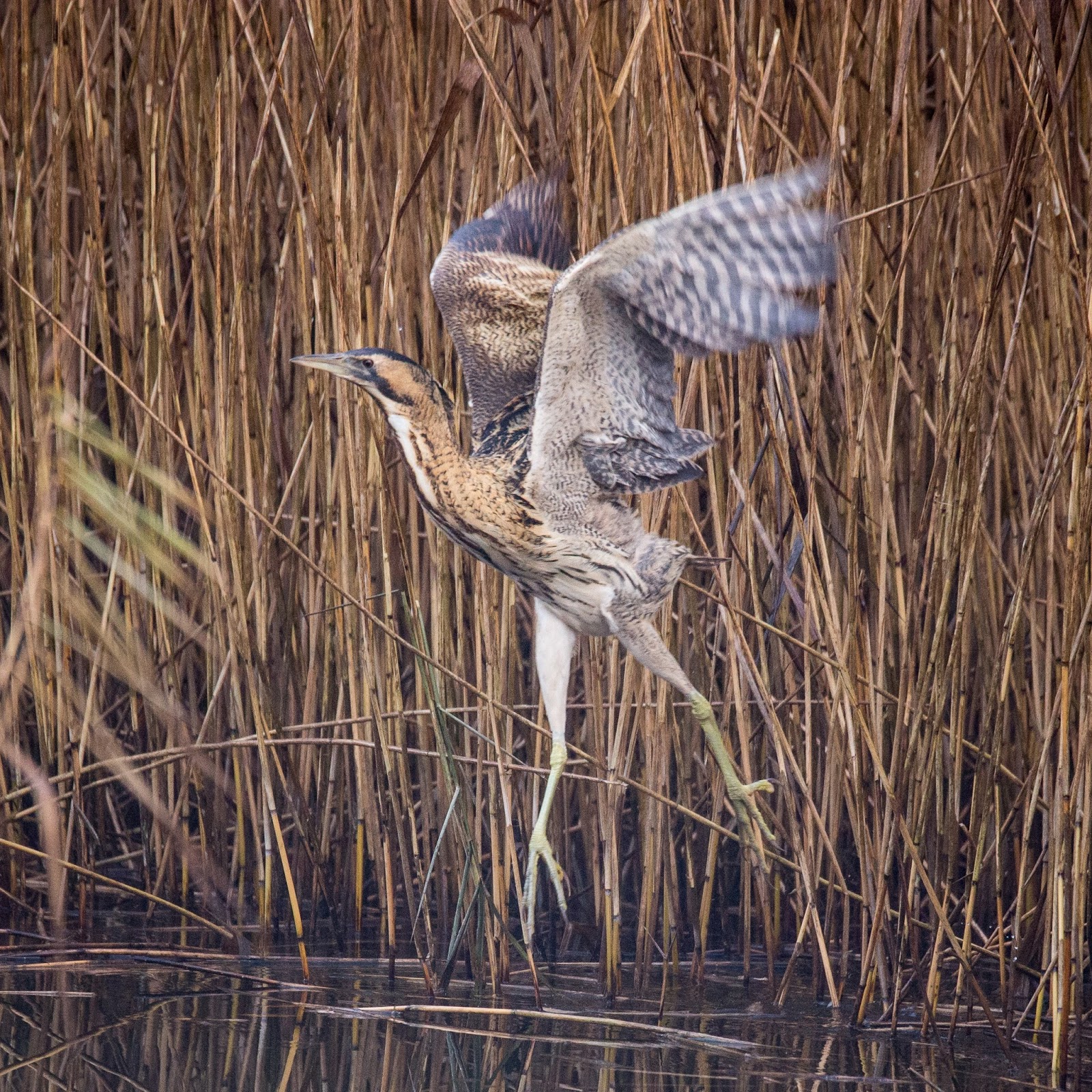
The bittern is a rare bird in this country and is on the amber list in the UK (having been red-listed until 2014).  We have more than 100 breeding pairs with perhaps 600 or so birds in the winter.  In 2017 there were 166 "booming" bitterns (males in breeding condition) in the country, an increase from a low of 11 in 1997.  In my local nature reserve in Gosforth Park a few bitterns arrive every summer and stay until the following spring.  A lot of effort has been put into improving the habitat in the reed beds in the hope that one day bitterns might breed here although so far they haven't. Ours are elusive when they first come back but seem to get easier to see as the winter goes on.  At this time of year we will expect to see them every day, either flying from place to place across the reed beds or suddenly breaking cover and flapping across the pool before crashing into the reeds on the other side.  They are elegant in flight but not on take-off or landing.


The bittern is also known as the great bittern or Eurasian bittern and is found across Europe and Asia in the breeding season.
Yellow: breeding, green: year round, blue: non-breeding.
By Cephas - Own work, CC BY-SA 3.0, https://commons.wikimedia.org/w/index.php?curid=8677345

The bittern is Botaurus stellaris, Botaurus because its booming call sounds like a bull and stellaris from its starry plumage.  Unlike its relatives grey herons and egrets it is an elusive bird and, as you can see from the photos, it is beautifully camouflaged in the reeds.

Thomas Bewick wrote about the bittern in A History of British Birds, vol ii, in 1832.
The Bittern is a shy, solitary bird; it is never seen on the wing in the day time; but sits, commonly with the head erect, hid among the reeds and rushes in the marshes, where it takes up its abode, and from whence it will not stir, unless disturbed by the sportsman.
Perhaps bitterns are a little easier to see now that they are not hunted and feel a little safer. This is Bewick's engraving.
 Archibald Thorburn made several paintings and sketches of bitterns.


You can listen to a bittern booming in Kate Humble's BBC Radio 4 Tweet of the Day here.

Wednesday, 27 December 2017

End of year favourites - Gosforth Nature Reserve

I have been spending more and more time in Gosforth Nature Reserve, which is run by the Natural History Society of Northumberland.  Much of the time is spent in working parties and helping with teaching, etc, but I do also get time to go in and watch the wildlife.  It is amazing to think that all these creatures are so close to my home, only a mile away as the sparrowhawk flies.  Here are a few photos from 2017.


Wednesday, 11 January 2017

The Battle of Bittern


These bitterns really know how to put on a show but they don't get on with each other.  I had been sitting watching as the occasional bird flew briefly from one reed bed to another, testing my reflexes.  Suddenly a bittern jumped out so close that I didn't have time to adjust the zoom and lost what might have been a good photo.


It landed in the reedbed just in front of me but landed right on top of another bittern - who wasn't best pleased.  There was a brief fight, out of view, and the newcomer was unceremoniously dumped back in the water.


It swam around with its crest erect for a minute or so, trying to show it wasn't intimidated, but eventually took off and flew back to the bed it had come from.


I wrote before about the bittern's landing technique, which is to close its eyes, crash into the reeds and hope for the best.  Here's another example.  The colours on its wings are wonderful.


The original occupant of the reedbed briefly made itself visible to establish ownership, and then disappeared from view.

Monday, 19 December 2016

Not such a rare bird

Given that this is a rarity, there seem to be a lot of them about.  I have at least five bitterns living less than 2km from here and reckon to see three or four every time I go to the reserve.  Here are a few recent photos.