My Blog List

Saturday, 9 March 2019

A walk round the pond - Week 10

We'll see how this works out.  Last year I published a weekly post from the pond(s) each week from week 13 (late March) until week 44 (early November).  There was a lot to see and to report and it was fascinating to watch the season unfold.  I am starting a bit earlier this year and if there is enough to see I'll try to post a report each week.

The most striking thing about the pond at this time of year is how brown everything looks.  I am used to everything being green in the summer but most of the new growth has yet to emerge.  There is some colour as the alder trees are in flower.

Here are the (male) catkins and the small purple female flowers which will produce this year's cones.

Hazel trees are in full flower as well.

Here are the catkins plus the small red female flowers.


The flowers have already been fertilised as they are starting to swell to form new hazel nuts.

Although it has been a dry winter there has been a fair amount of rain in the past week and the water level is noticeably higher than last year.  The island in the larger pond is once again an island.

On my last couple of visits at the end of last year a pair of swans was in residence.  Almost the first thing I noticed on this visit was a lot of swan feathers plus a breast bone.  Obviously a swan had died or been killed.

Right across the other side of the larger pond, about 100m away, was a very large number of swan feathers.  Whether they came from the same bird or a different one is impossible to say.

When I got to the smaller pond the first thing I saw was a swan, a cygnet.

Then there were four, plus an adult.  If this was one of the pair I saw last year it must have fetched its young to join it. Of course, these may be different birds altogether.  And the good news is that there is no signs of Canada geese.


Two species I saw were new sightings (for me) at the pond.  A pair of widgeons - this is the female but the male flew off before having his photo taken.

And a pair of gadwalls - this is a very distant view of the male.

Other birds were heron, buzzard and coot.


I'll be back next week to see what has changed.  Soon there will be frog spawn and toad spawn.  The pussy willow will be in flower soon and I have to complete the first bumblebee walk before the end of the month.  Watch this space.

Thursday, 7 March 2019

Sparrowhawk news


The sparrowhawk is now having a noticeable impact on the birds in the garden.  There are many fewer around, and not just because he has eaten them all.  The small birds have more or less abandoned the kitchen garden where he is most likely to be.  As a measure of that the feeder there is usually emptied in less than two days but is now going down by less than 1cm per day.  Even when he is not around they somehow recognise it as a place of danger and avoid it.

His favourite place to sit is now on top of the compost bins where he is sheltered and partly hidden.  He can sit there for half a day, with an occasional foray to the feeders on the other side of the house if he gets bored or needs to stretch his wings.  This is a nuisance for me as well, partly because he is difficult to photograph there but mainly because he can see the garage and the greenhouse so I have to be careful not to disturb him.

There are almost no tree sparrows around and many fewer starlings than I would expect at this time of year - both species are normally jostling for the best nest sites in the boxes or in tree holes.

Here he is under the gooseberries, having just eaten his lunch and looking round for some more.

He still sometimes sits on top of the feeder but there are now rarely any birds in the gooseberry bushes so that doesn't work well for him.

He has also found a new vantage point on top of a log where I can at least reach him with a camera, and I can get to the garage without being seen.


I am pleased to say that he is still sometimes using the perch I put up for him and is looking after himself - spending more time preening than when he first arrived in the garden.  Here you can see he has recently fed because he still has blood on his feet.


In the past two years the sparrowhawks hanging around the garden have disappeared in March so this one may not be here much longer.  If he does move on the tree sparrows will be pleased.

Tuesday, 5 March 2019

More from OtterCam

A couple of weeks ago I had two or three cameras in for seven consecutive nights and recorded otters on every camera on every night.  The cameras are set to record video but do allow frame grabs, although these were less impressive than they have been with the foxes.


The best of the videos were recorded earlier in the week and were posted previously.  Most of the later recordings showed one otter at a time searching for food or eating.  Here is an example.


Although the videos were generally good quality the still camera didn't manage much.  It is really tricky to get the otter in the right place, facing the right way.  These two were the best of the bunch.  From its shape I think this is the mother.

This one is probably a pup.

All the cameras recorded lots of rat pictures as well.  I'll spare you the videos but here are a couple of stills.


Although we are sometimes lucky enough to see an otter during the day, all the recent recordings were during night time.  I am encouraged by this recent experience and plan to use the cameras a couple of nights every month to see what the otters are up to.  If I see anything interesting I'll post it here.

Saturday, 2 March 2019

Waking up early

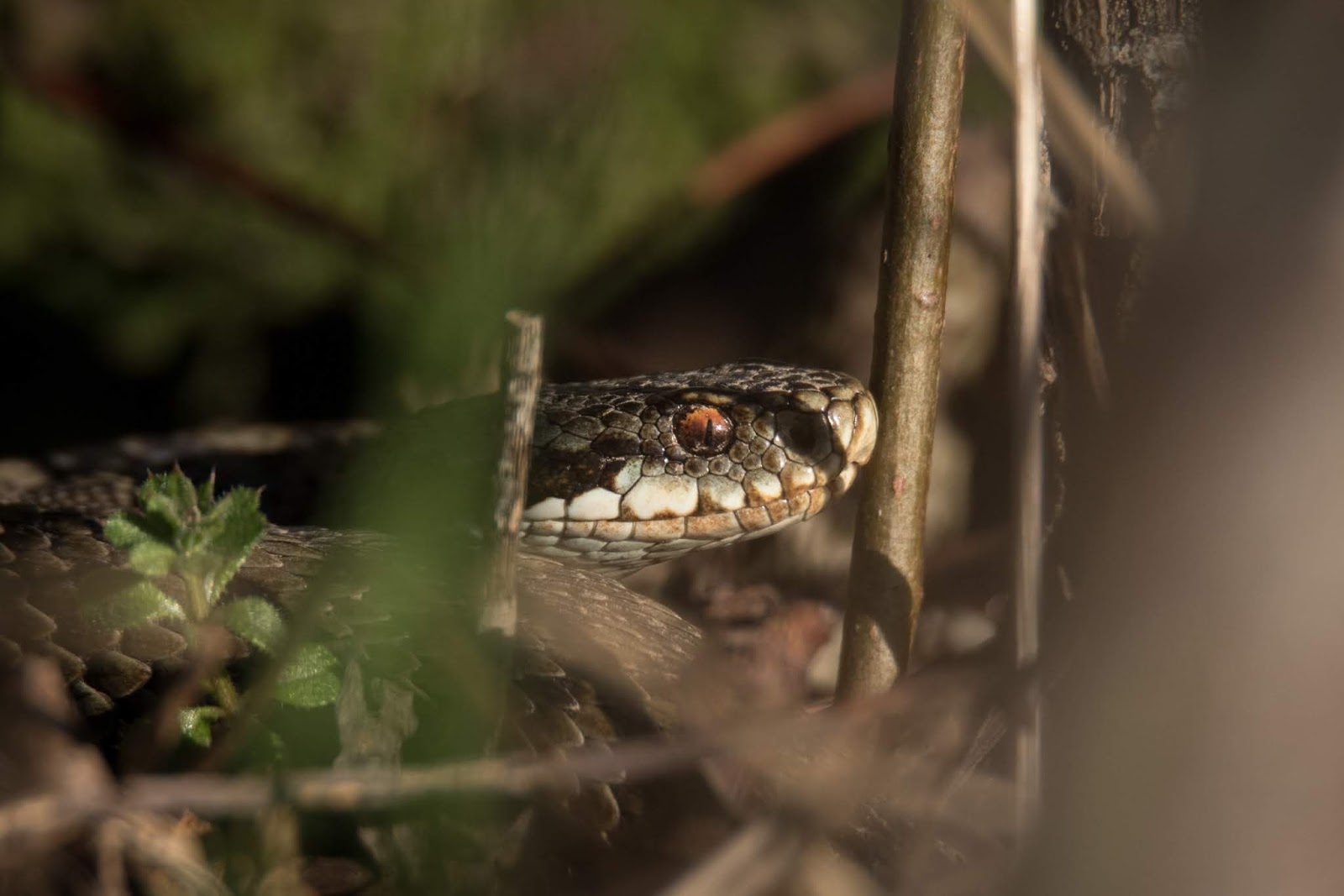
The recent warm weather has had an effect on a lot of wildlife, including adders which emerged from hibernation a couple of weeks ago.  When I arrived to see them, about 30 minutes after sunrise, there was none about but a few minutes later I saw this one.

It was only when it moved that I realised the coils it was resting its head on belonged to another snake.  I had seen one front end and one tail end and assumed it was all the same (very long!) snake.


As I walked along I saw more and more, at least 12 in all but it gets difficult to keep count after a while.  Here are a few more photos.


And a few more portraits.  Adders have markings that are individually identifiable (to an expert).


This one, for instance, has a W behind its eye.

Once you look closely you can see they are all different.


It isn't always easy to tell males from females at this time of year, before they have sloughed off their old skins.  Males generally emerge up to a month before the females but I think this one might be a female, but then it might just be dusty.  Females are larger, browner and have shorter tails.


This one is smaller and is bright and shiny and is definitely a male.


Some were stretched out to take the sun.


Others stayed tightly coiled.


Some were very shy and all I could see was this.


By mid morning they had all warmed up nicely and slithered off to do whatever it is that adders do at this time of year, which isn't much.  I'll be back to see them in a month or so when they have changed into their new skins.