My Blog List

Sunday, 9 April 2023

Early season moths

I haven't previously put out my moth trap this early in the year but there are moths around so I decided to try last weekend.  I caught six moths, much easier to process than the dozens that appear at the height of the summer.  There were three Hebrew Characters,

 two Common Quakers,

and an unidentified micro moth.

The biggest surprise was a black sexton beetle (Nicrophorus humator).  It is the first beetle that has appeared in the moth trap.  It is very large and very smelly!  It uses its magnificent antennae to detect dead animals on which to lay its eggs.

Sunday, 2 April 2023

On the Trail of the Lonesome Pine

Jesmond Old Cemetery is the best place in Newcastle to see overwintering ladybirds.  There is a single Scots pine within the cemetery and the gravestones around it are usually the best place to look.  Ladybirds have probably been discouraged from coming out of hibernation by the recent weather but should soon be getting on with the business of mating and egg-laying before dying and leaving the next generation to replace them.  After a cold, wet, gloomy March, today felt like the first day of spring so I decided to take one last look this morning.

There were still plenty of ladybirds on gravestones but I was looking for two species  in particular. I made straight for the pine tree and after checking the gravestones I decided to look in the tips of the lowest branches which were just within reach.  And there I found what I had hoped to find, a Cream-streaked Ladybird.  Its scientific name is Harmonia quadripunctata but in fact it has 16 spots and it is a real beauty.


And then I found another, well camouflaged in the pine buds.

And another.

And a fourth.  This one has larger and darker markings and is also well camouflaged.

When I first checked the back of the gravestone under the tree I was delighted to find my other target, an 18-spot Ladybird, Myrrha octodecimguttata.

Then I found one in the tree as well.

Other ladybirds I found in the tree were, appropriately enough, a Pine Ladybird, Exoxchomus quadripustulatus,

and two Harlequin Ladybirds, Harmonia axyridis.


After all this excitement I looked back to the gravestone and the first 18-spot Ladybird was on the move, no doubt realising it was time to get on with life.

Nearby a similar-looking species, a Cream-spot Ladybird (Calvia quattuordecimguttata), was moving around as well.

And a week ago, after a tip-off from James Common, our local expert, I found another ladybird new to me, a Kidney-spot Ladybird (Chilocorus renipustulatus), this one on an ash tree only a couple of miles from here.

Since getting interested in ladybirds in January I have seen 19 species.  With practice I am gradually learning to identify them but there are plenty more to see and learn.

* For those of you too young to remember, The Trail of the Lonesome Pine Is a song first recorded in 1913 and which became a hit single for Stan Laurel & Oliver Hardy in 1975.  You can watch them singing it here.

Tuesday, 28 March 2023

Holt! Who goes there?

These are not recent pictures but they have not been published before.  A couple of winters ago I had very privileged access to an artificial holt.  It was difficult to get to and I was wary of visiting too often for fear of spooking any otters that might be using it.  In the end I left the camera for a few weeks at a time but found it was mostly filled with recordings of ducks and geese.  It also recorded plenty of passing deer, foxes and badgers but fortunately there were a few otter sightings as well.  The holt wasn't used regularly by otters, but was just an occasional stop-over place.  There were very few daytime recordings but this was one.


Here is a brief montage of four night-time sightings.  In the last one an otter ran into the holt but then heard a rat running overhead and came out immediately to give chase.  I don't know if the pursuit was successful as it didn't return.


I may see if I can put a camera there again one day.  My greater ambition would be to find a natural natal holt with mother and cubs.

Wednesday, 22 March 2023

My new bee house

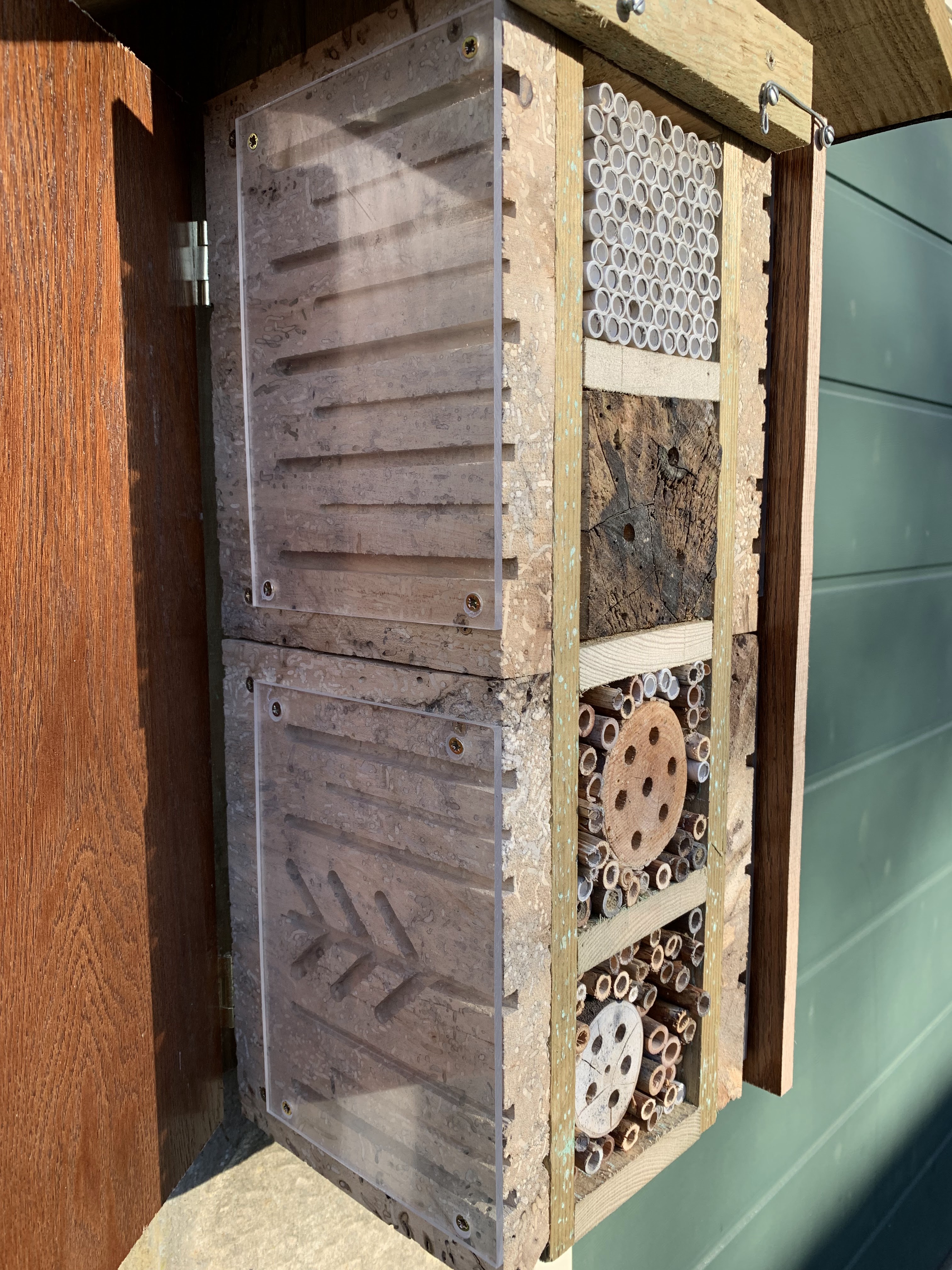
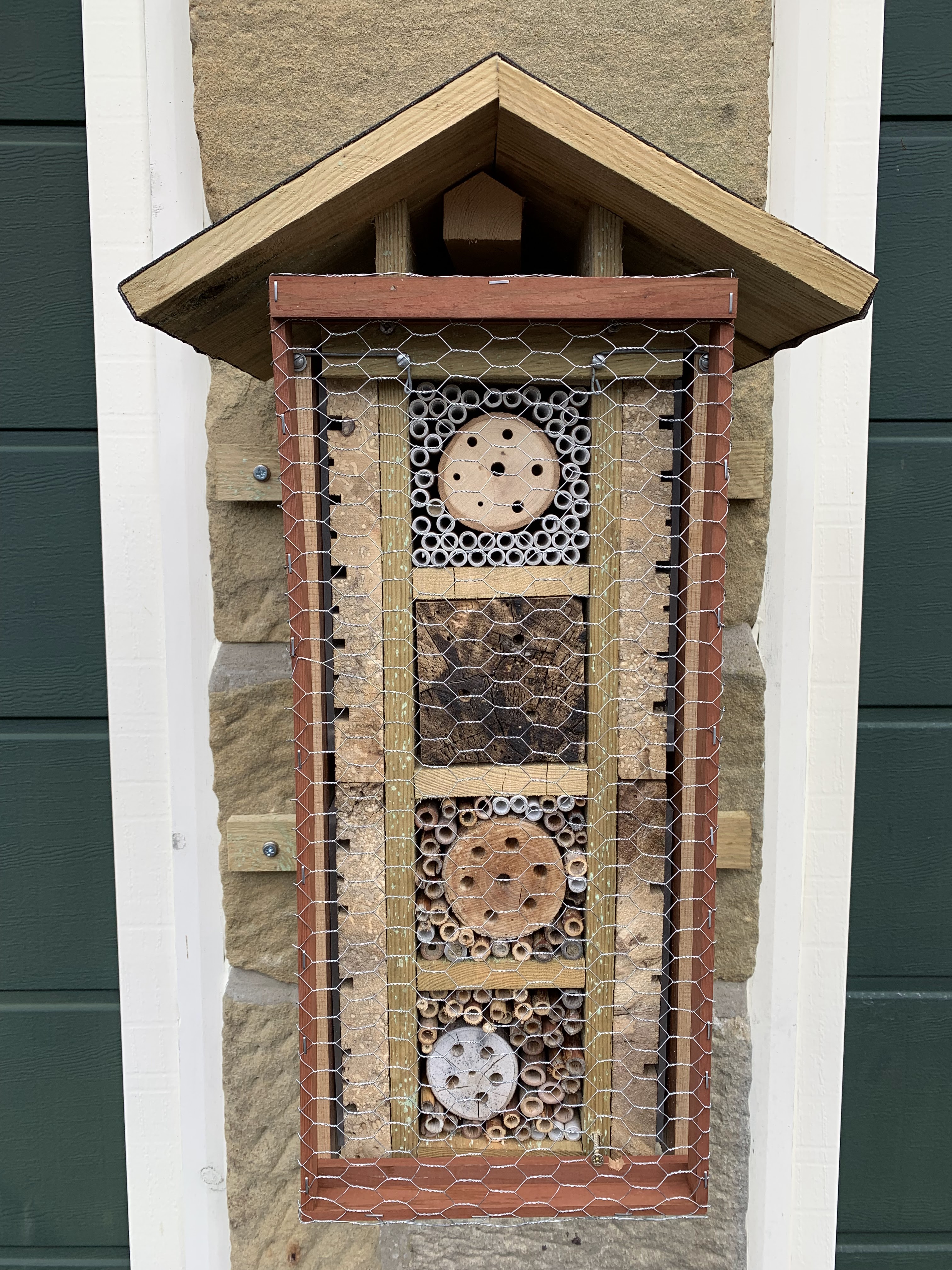
I have just finished making the new, improved, deluxe, mark IV bee house (2023 model).  The central section is fairly conventional but also contains a solid piece of rotten wood, in the hope of attracting fork-tailed flower bees.  The side doors are recycled from my old kitchen units.  They extend in front of the rest of the house so I can put on a wire mesh to protect against woodpeckers and blue tits.


The side panels are covered by perspex so I shall be able to see the occupants.  Three are made out of dead sycamore and the fourth out of rotten dead sycamore.  It was interesting machining the wood but I hope it will have been worth it.  I have put in a mixture of 3, 4, 6 and 8mm holes to attract a variety of species.


The panel with rotten dead wood has just three short starter holes because fork-tailed flower bees apparently like to excavate their own holes.  If one does come in I hope it will stay next to the perspex so I can see what it is up to.

I have transferred canes and tubes etc, some of which contain bees, from the mark I bee house which is now retired.  (The mark II and the mark III are still in use.)

Since taking the above photos I have modified the top section with another log to make it easier for bees using that to get their bearings and I have fitted a clip-on wire cover to protect against blue tits and woodpeckers.  The bees can easily fly through the mesh and I can remove it for photos.

So it's all set to go.  I'll report back later in the spring or summer on which bees have moved into this luxury accommodation.

Thursday, 16 March 2023

Otters in early morning

The cubs are now nearly as big as their mother.  These pictures are from last weekend when there was a short freeze and a thin layer of ice.  Mother otter and her two cubs appeared in the early morning and played at the water's edge for a couple of minutes.  As luck would have it I had moved two cameras to another nearby site (more news soon) and the light was difficult for this camera, looking straight into the reflection off the ice.


The second camera was looking the other way and because it had less light it was still in night mode (infrared and therefore black & white) so I can't edit the two videos together.  Also, as you'll see, the otters were a bit too close and too low.  Still, it's worth a look.


A couple of hours earlier they had visited the same spot.  As ever, one cub was lagging behind and the other two had to wait for it.  There is a good view of the smaller cub swimming under the ice.


I have my fingers crossed that the other cameras will turn up trumps.  I hope to have more news soon.

Monday, 13 March 2023

My latest wildlife yearbook

My 2022 photobook has just been published.  As usual, there was a print run of only two but it is available to view online for free here.

Wednesday, 8 March 2023

A cob brick bee house

March is the time to look out for hairy-footed flower bees (Anthophora plumipes), one of my favourites.  They fly in spring, being among the first solitary bees to emerge from hibernation. They nest in cob walls and old mortar, often in large aggregations.  Their whole season is over by early summer and the next generation of bees waits in the safety of the wall before emerging the following spring to start the cycle over again.

I read an article in the BWARS magazine by John Walters, an entomologist from Buckfastleigh in Devon, on making a cob brick bee house for hairy-footed flower bees and was inspired to have a go.  A year ago I followed his recipe using cricket pitch loam mixed with a little sharp sand, some chopped straw and enough water to make it all stick together.  You can see John Walters' videos on how to make cob bricks for hairy-footed flower bees, part 1, part 2 and part 3.  I also took advice from my friend Chris Henderson, a retired doctor and renowned mud-brick house builder in Tasmania. Chris said the secret is to let the cob dry slowly, out of the sun, so it doesn't crack and fall apart. The bricks then have to be kept dry and put where the bees can find them.  I built a shelter from a few old planks and put it close to some pulmonaria plants, the bees' favourite flower.

I didn't see bees flying into the bricks while I was watching but within a few weeks there were signs of activity with what looked like spoil from excavation below a couple of the holes and at their entrances.


When I peered in at the end of the season with a macro lens and ring flash I could see something at the end of four of the holes.


My hope is that these are sealed bee nests.  I found a PhD thesis written by Radha Devkota Adhikari on the use of the hairy-footed flower bee for strawberry pollination in greenhouses in Japan.  It includes this photo of the inner structure of a nest and says "the inner walls of both provisioned cell and pre-chamber were coated white" so this could be what I am seeing in mine.


I have set up the bee house again, ready for the bees to emerge (I hope) later this month.  Ever the optimist I have also built a small cob-filled observation panel with a perspex window in the hope that I may be able to see what happens inside.  There are four small starter holes and if a bee does move in I'll keep my fingers crossed that it excavates next to the window so I can see what is going on.

I have also built a much more stylish Mark II version for the new season.  It contains Victorian land drain pipes filled with the same cob.  It is now in position in the hope that the bees will take to it.  If they do I'll post an update here.