My Blog List

Saturday, 22 July 2023

News from the bee house

Fortunately the solitary bee season coincided with warm sunny weather in late spring and early summer.  Now it is wet and gloomy the season is almost over but it has been fascinating to watch and mostly very successful for the bees.  The most numerous residents of the bee houses are always red mason bees.  This is a female in the observation wing having a brief rest before setting off to forage again.

In most previous years I have had between half a dozen and a dozen completed red mason bee nests.  This year, with my new bee house, I have about 80!  Here are 34 of them.

In the next photo the rear cell is complete with a food store of pollen and nectar and an egg. Work has started on the front one contains a bit of pollen and a pool of regurgitated nectar.


A few days later it looks like this.

Here is another bee coming back with a load of pollen.

The bees always reverse in to unload pollen.

Here are a couple of bees plugging the entrances to their nests.

There was one blue mason bee nest from last year with nine cells.  The front six were males. This is one of them.

Once they had chewed their way out of their cocoons five of them sat in the nest for another 24 hours before deciding to brave the outside world.

The females emerged a few days later and one of them moved into my new bee house.

She uses chewed leaves rather than mud to the build the cells.

Here she is in the precess of laying an egg.

Another bee in the new house was a common yellow face bee (Hylaeus communis) but she completed only three cells.  She made several more cellophane walls along the hole before sealing it so three was all she planned.  The nectar pollen mix she brought in was almost black.

The observation part of my original bee house is still in use and this year, for the first time, it was host to a leafcutter bee.  I was very pleased until I realised that she was lining the cells first before working on them so I couldn't see what was going on!  The nest was in an old red mason nest, hence the mud lining.


The bee house has a wire mesh covering as protection against woodpeckers.  Rather than risk dropping the leaf if she flew through the mesh, this bee flew in the bottom each time and then flew vertically upwards to reach the nest.

I was struck by the precision in the final work to seal the nest.

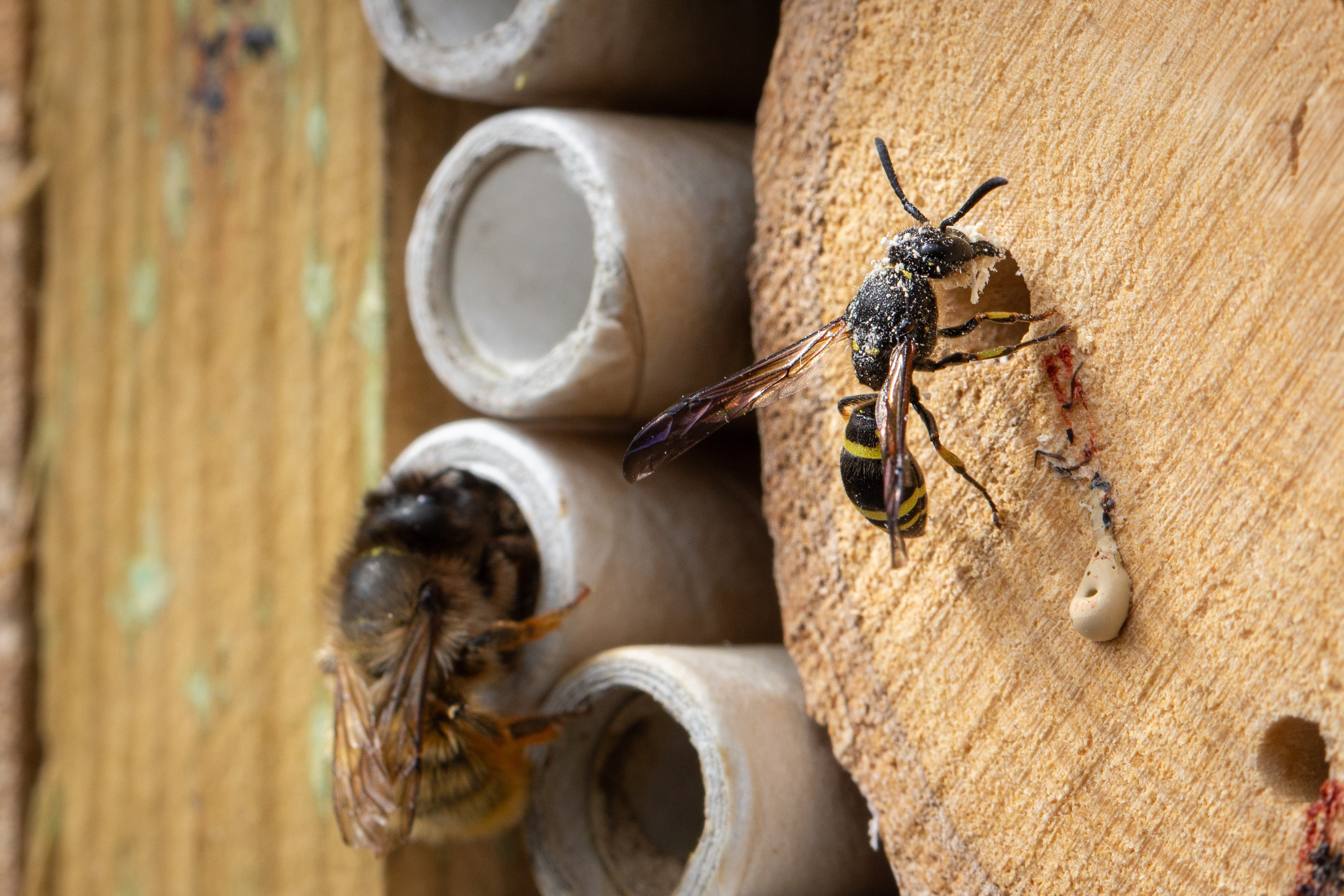
Another resident of the "bee" house was a mason wasp, a solitary wasp that uses mud in the same way as the red mason bee does.  It used a smaller hole and filled the cells with caterpillars rather than pollen.  Here it is clearing out sawdust before starting to build cells, with a red mason bee in the background.
There were other solitary wasps which were tiny.  They made their own holes in the wood, about 1mm in diameter, and stocked them with aphids.  Louise Hislop, our local bee & wasp expert, says they are Passaloecus sp. females.


Perhaps the most exciting bees I saw in the bee house were fork-tailed flower bees.  They nest in rotten wood so I made one panel out of dried rotten wood, specifically in the hope that they would move in.  I made three small starter holes and was surprised and delighted to see that for several days two of them were excavated by female fork-tailed flower bees.  But although I often saw the bees pushing their way out through clouds of sawdust I never saw them going in with pollen.  I wonder if they didn't fancy the holes after all after all that digging.  With luck they did continue when I wasn't looking.  I'll be able to remove the panel later in the year to take a look.


I am already making plans for next year, to make sure there will be room for perhaps an even larger population of bees.


Tuesday, 18 July 2023

Summer ladybirds


I enjoyed looking for ladybirds in the winter but they turn out to be even more interesting in summer.  At this time of year the last winter adults have died off and we can see larvae, pupae and newly emerged adults.  I can't show them all but here are a few that have caught my eye recently.

Striped Ladybird.  A larva, a pupa, and a newly emerged adult from Havannah Nature Reserve and a mature adult I found a few weeks ago on the roundabout at the end of my road.


Pine Ladybird.  A larva and a pupa from Havannah and an adult from the Spetchells.


Eyed Ladybird.  A larva from Hepple and a pupa and newly emerged adult from Havannah.


Cream-streaked Ladybird.  A larva and a pupa from Jesmond Old Cemetery.  This was a hot spot for hibernating ladybirds in the winter but obviously some are there all year round.


Larch Ladybird.  A larva from the Spetchells and a new adult from Jesmond.


Heather Ladybird.  A larva and an adult, both tiny and both from Hepple.


While looking through the branches of Scots pines I saw quite a few empty mummies of Scots pine aphid nymphs (Cinara pini) like this.  They have been attacked by a parasitoid wasp.

And here's an interesting finding.  A 14-spot Ladybird larva lunching on a smaller 14-spot larva.

10-spot Ladybird.  A larva and two new adults from an oak tree in my garden and a newly emerged decempustulata form from Hepple.


22-spot Ladybird.  A larva from my garden and an adult I found on the bathroom wall.


The best finding of all was my first 11-spot Ladybird (Coccinella undecimpunctata) at Newbiggin-by-the-Sea.

And a new species for the garden, a tiny Rhyzobius litura in my meadow, one of the so-called inconspicuous ladybirds, this one 2.5mm long.


It is amazing how many ladybirds there are around now that I am learning how to find them and how to identify them.  I'll keep an eye out over the summer for any more I can find.

Friday, 14 July 2023

The new generation of ladybirds

At this time of year there is so much to see and so many things to photograph that it is hard to keep up.  Over the past few weeks, and especially the past few days I have seen many more ladybirds.  Mid summer is the time to see larvae, pupae and newly emerged adults, all at the same time.  I found two pupae in the garden and was able to bring them in to watch what happened.  The first was a 14-spot ladybird.  To tell the whole story, here is a 14-spot larva, not from the same individual.

This is the pupa.

The emergence happened while I was out but this was shortly afterwards.  The ladybird is still standing on the exuvia and hasn't developed its spots.

Here are the changes over the next 24 hours.  Then it went back into the meadow to join all the others.


The second pupa was a harlequin ladybird.  Again first a larva.

This is the pupa.


This time emergence happened overnight.  This is the ladybird first thing in the morning and over the next five hours.


Then it too went into the meadow.  Its colour would have continued to develop over a few days to bright red.  I have seen lots of other ladybirds recently and will post a few photos soon.

Monday, 10 July 2023

One-eyed bandit

My local sparrowhawk still visits the garden every day but doesn't often eat in view.  He has lost an eye but is still an efficient hunter.  I expect this type of injury is not rare because male sparrowhawks chase their prey through thorny bushes and the prey may put up a fight.


Tuesday, 4 July 2023

Wool carder bee

I have only once seen this bee before, six years ago in London.  It is the wool carder bee (Anthidium manicatum), widespread in the south of the UK but rare this far north.  These bees were in Kiftsgate Court Gardens in north Gloucestershire last week.  The first I noticed was a male, patrolling his territory around some lambs' ears plants (Stachys).  Every few minutes he paused to refuel.


At one stage he took a short rest on my boot.

Wool carder bees are unusual in many respects.  The male is larger than the female and defends a territory against other males and against most other insects, allowing in only females of his species.  Most solitary bee females mate only once but these bees have to put up with frequent mating as the price of access to the flowers and the leaves on the Stachys.

The female bees bite off the hairs from the leaves and roll them into balls to carry back to the nest where they are used to line the cells, behaviour I have yet to see.  These females were mainly collecting nectar.


Although Anthidium manicatum is rare this far north there have been a few records along the Tyne valley in the last couple of years, including in my friend Liz's garden.  Liz spotted a male bee last Saturday and when I called in on Sunday he was resting in a hole in her bee house.  I managed to get this picture of his tail, showing the three spikes he uses as weapons to defend his territory.

I hope there will be more sightings of our northern wool carder bees to report soon.