My Blog List

Showing posts with label Wool carder bee. Show all posts

Tuesday, 4 July 2023

Wool carder bee

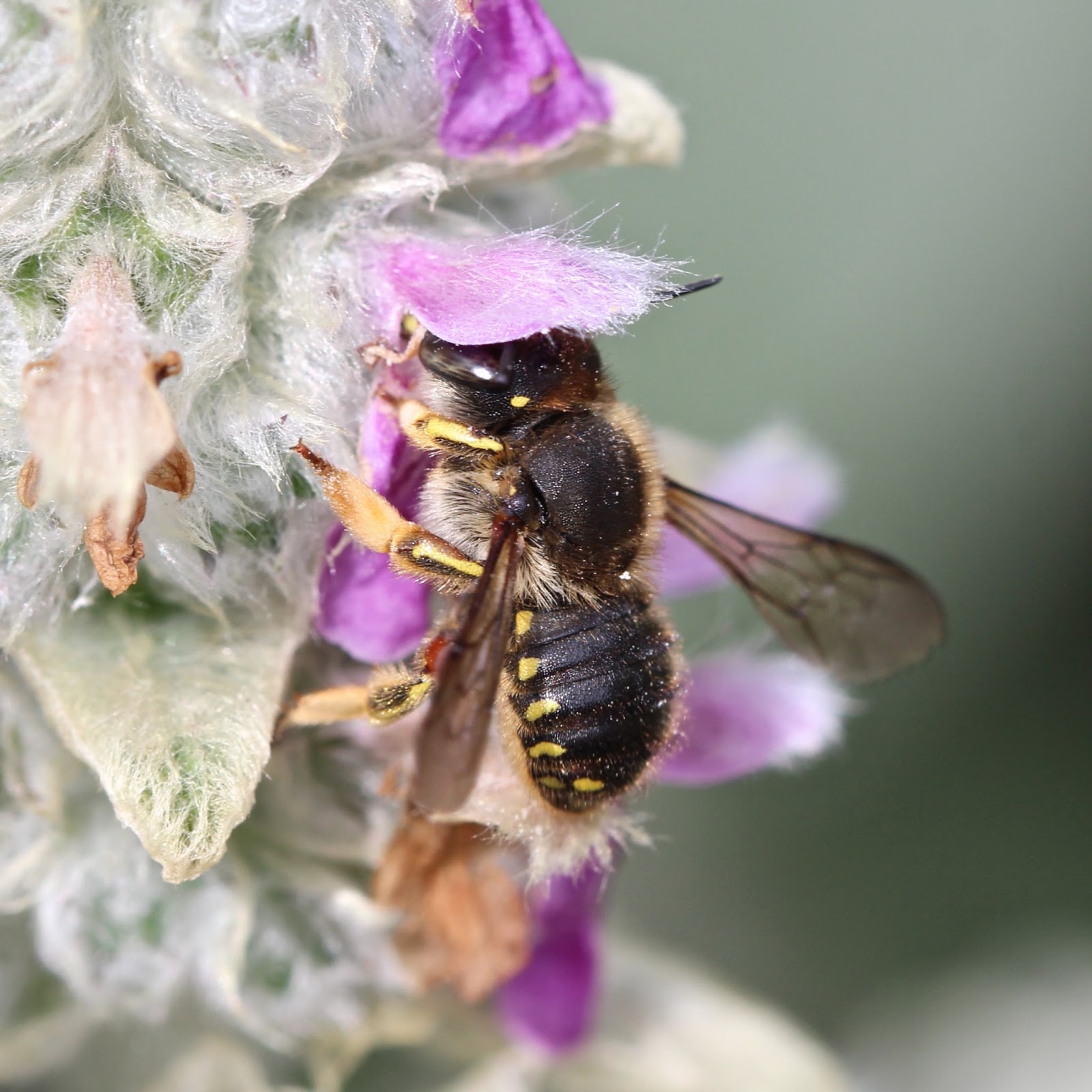
I have only once seen this bee before, six years ago in London.  It is the wool carder bee (Anthidium manicatum), widespread in the south of the UK but rare this far north.  These bees were in Kiftsgate Court Gardens in north Gloucestershire last week.  The first I noticed was a male, patrolling his territory around some lambs' ears plants (Stachys).  Every few minutes he paused to refuel.


At one stage he took a short rest on my boot.

Wool carder bees are unusual in many respects.  The male is larger than the female and defends a territory against other males and against most other insects, allowing in only females of his species.  Most solitary bee females mate only once but these bees have to put up with frequent mating as the price of access to the flowers and the leaves on the Stachys.

The female bees bite off the hairs from the leaves and roll them into balls to carry back to the nest where they are used to line the cells, behaviour I have yet to see.  These females were mainly collecting nectar.


Although Anthidium manicatum is rare this far north there have been a few records along the Tyne valley in the last couple of years, including in my friend Liz's garden.  Liz spotted a male bee last Saturday and when I called in on Sunday he was resting in a hole in her bee house.  I managed to get this picture of his tail, showing the three spikes he uses as weapons to defend his territory.

I hope there will be more sightings of our northern wool carder bees to report soon.

Tuesday, 4 July 2017

Bee of the week - Wool carder bee


This is a bee I have wanted to see for a long time - the wool carder bee (Anthidium manicatum).  It is common in the south of England but gets progressively rarer farther north.  I saw these in Regent's Park in London last week.

Anthidium manicatum is a solitary bee related to leaf-cutter bees but has a very different life style.  The male bee (above) holds a territory and defends it against other males and against any other bee that strays in.  Only female wool carder bees are allowed.  The male patrols his patch - usually Stachys byzantina as here - often hovering and sometimes resting or taking nectar.


Other males are chased off or fought, resulting in injury or death.  Males are larger than females and the largest males are the most dominant.  The male has no sting but crushes his victims using spines on his tail.


This was a smaller and presumably less dominant male.  I wasn't sure whether he had been beaten up or was just keeping a low profile.  He seemed happy to sit on my finger for a few minutes, perhaps feeling safe there.  When he flew off he seemed uninjured.


Here you can see his spines.


Female wool-carder bees usually have similar colours to the males but there is also a variant with longer yellow stripes on the abdomen.  I was lucky enough to see both.


The females have notably hairy legs and, like leaf-cutter bees, carry pollen on a scopa (pollen brush) under the abdomen.


Like many other solitary bees, the female builds her nest in a hole in wood, plant stems, etc.  One behaviour I didn't see is that she shaves the hairs from the Stachys leaves and carries a ball of them back to line the nest.

The mating behaviour of these bees is also different from other solitary bees.  Generally males emerge before females and fight to be the first to mate with emerging females.  Wool carder bees do it differently.  Females allow repeated mating with territory holding males - presumably as the price for protection and exclusive access to forage.


I have Stachys byzantina in my garden and I am hoping that one day Anthidium manicatum will venture this far north. You can read a BWARS information sheet on Anthidium manicatum here.