My Blog List

Wednesday, 6 May 2020

RoeDeerCam


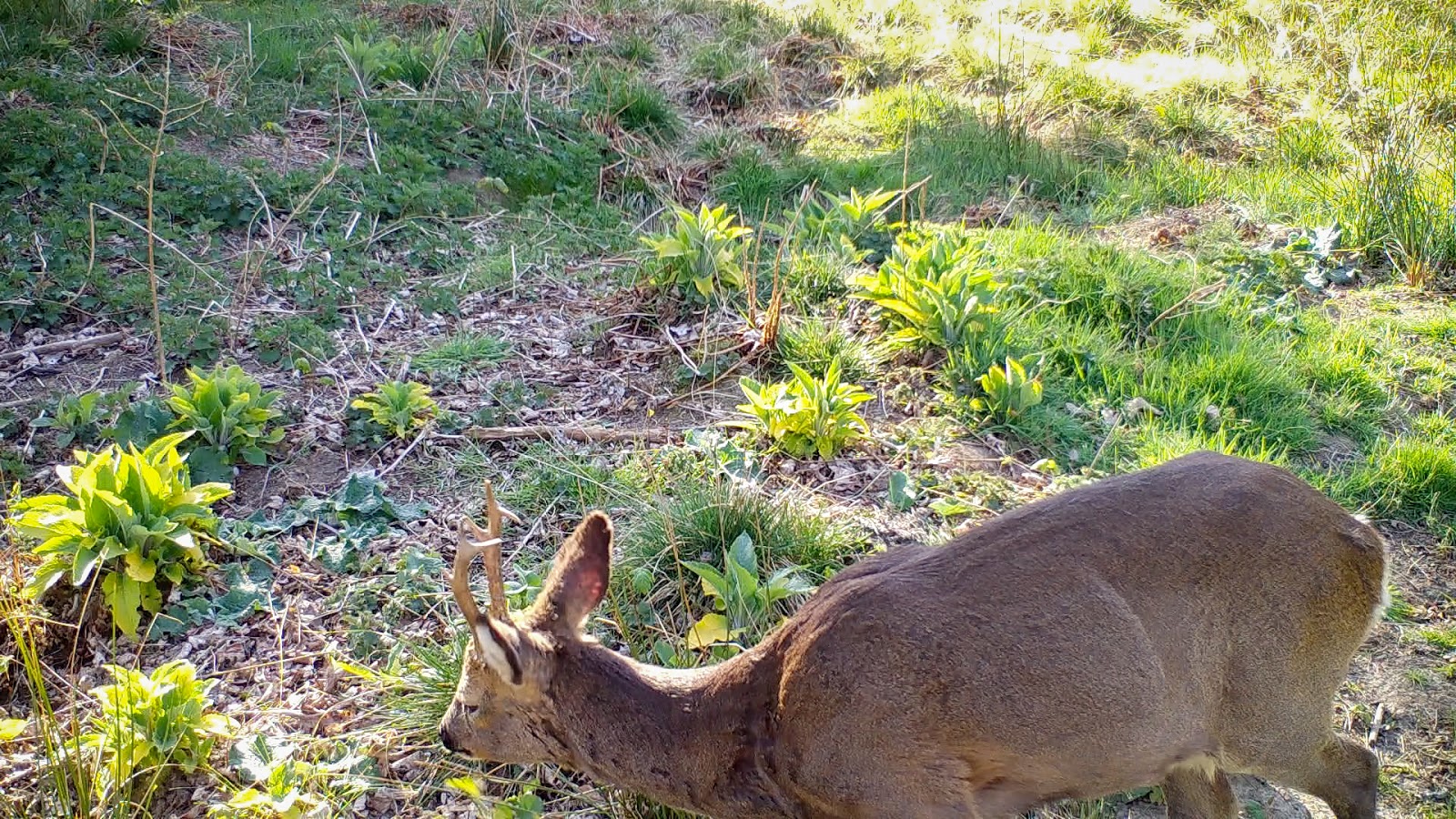
It isn't easy to get good images of roe deer on a trail camera.  They don't have a home like badgers or foxes and won't take food put out for them, unlike most other mammals.  One way is to position a camera near a trail in the hope they will walk past facing the right direction.  This time I was just lucky.  Roe deer browse trees, shrubs and herbs and are surprisingly fond of brambles, as in this short video.  This one is still in her dark winter coat but will soon moult into her thinner foxy-red summer coat.


On another day the roe buck was less accommodating but did at least show off a fine pair of antlers.  He looks a bit shaggy as he is already moulting.


This doe walked in front of two cameras that were positioned close together.  She is starting to moult and already has the summer red colour around her face.  You can see she is heavily pregnant.   The fawn(s) will be born in a couple of weeks' time.  Wouldn't it be a treat if one of them walked past the camera?


Monday, 4 May 2020

Badger cubs in daylight

I expect you won't mind another badger cub video.  This is the only time so far they have come out in front of the camera in daylight, although they often don't use this entrance to the sett.  Mother and the cubs settled down for a scratching and grooming session before setting off to explore.  They weren't quite as well disciplined as before in staying in shot and in focus but it wasn't too bad.


This is a bit like those slow TV programmes of Norwegians lighting fires or people knitting.  I like the way halfway through the video the troublemaker gets a clip round the ear and then goes and sulks in the sett entrance.  It soon got over it.  I hope you enjoy it.


These images were recorded with the trail camera fitted with a +1.25 dioptre lens to improve close focus.  However, the badgers this time were a bit farther back from the camera and are just starting to go out of focus (interestingly the depth of field seems better with infrared pictures at night).  So I have splashed out on a pair of +0.5 dioptre lenses (£2.99 including postage!) and cut one down and fitted it today in the hope of moving the focus range slightly farther back.  We'll see if it works.

Saturday, 2 May 2020

Garden birds in April

This blog has been rather overrun by mammals recently but I haven't given up on bird photography.  April was a good month for birds in the garden, including the arrival of chiffchaffs and blackcaps from Africa.

I saw the male kestrel again very early one morning.  Twice he dived down to the lawn to catch something which I think was probably a worm.  Although their main prey is small mammals, kestrels eat other things including small birds, insects and worms.


A pair of jays are in the garden every day.  They are the prettiest crows and are great opportunists.  This one was standing under the peanut feeder while a woodpecker was feeding, waiting to catch the bits as they fell.


Jackdaws also come down to the feeders and stand underneath.


Jackdaws are more agile than jays and can get onto the feeders themselves.

I also have a woodpecker feeder which has holes filled with suet.

It also attracts other birds.


And you-know-who is still around, keeping them all on their toes.

There were lots of other birds I didn't take photos of - all the usual suspects plus reed bunting and green woodpecker. The only disappointment is that my camera nest box is unoccupied for the first time since it was put up in 2009.  I have modified it slightly to move the camera so that it can see the whole floor and the entrance hole so it would have given good pictures.  Maybe next year.

Thursday, 30 April 2020

WoodMouseCam

A few more pictures from the trail camera in a log pile in the garden.  In the daytime it records only bank voles but at night the wood mice join in.


Then something I haven't seen before, a baby wood mouse.  At the beginning there is an adult in the video as well so we can see how small the baby is.


Female wood mice produce four litters a year, each of 4-7 young, and females can breed in their first year.  At this time of year there are about 40,000,000 wood mice in this country but the population will grow to about 120,000,000 by the end of the summer.  Few of them will survive to next summer.  I expect many are eaten by weasels, stoats, foxes, owls and domestic cats.  About half are eaten by tawny owls.  A pair of tawny owls raising young are likely to get through the equivalent of 4-5000 mice a year, although they obviously eat other things than mice.  There are about 20,000 pairs of tawny owls in this country so they need a lot of mice.

So far I have had only one fleeting glimpse of a common shrew on the camera so I may try a different location in the hope of getting a good picture.

Tuesday, 28 April 2020

Growing up fast

It is two weeks since the cubs first appeared above ground.  In the following week there were no sightings on the trail camera but in the past week there have been three, a few days apart.  The sett is large and has many entrances, making it difficult to predict which one the mother will use.  I don't have enough cameras to cover them all and some are not suitable for placing a camera.

On the first of the latest sightings the cubs were making a lot of noise off stage left and another badger that heard them coming retreated into the sett.  They look much bigger than two weeks ago and are probably now about 10 weeks old.


The second sighting was three days later in the early morning as they were off to bed.  I expect they had been out all night with mother but they hadn't emerged from this entrance.


Later that day they came out at twilight (around 8.30pm) when the remaining natural light complements the infrared light from the camera to give a good picture with a good depth of field.  They sat around for a minute or so while mother had a good scratch before they went off.  The cubs are now steadier on their feet and are more inquisitive but they always stay within reach.  They were silent on this occasion although the mother was still talking to them.


Sunday, 26 April 2020

First sightings

Expeditions for damselflies and dragonflies will be limited this season, at least for the next few weeks, but I got off to a good start yesterday.  Only 1 km north of here, as the dragon flies, is Northumberland Wildlife Trust's Weetslade Country Park where I have arranged to survey dragonflies for a second year.  The weather has been so good this week that I thought it was worth an early look yesterday to see what was about.  And as I had hoped, large red damselflies were on the wing.  The photo below shows the typical place to find them after emergence, in shrubs a few metres from the water, in sunshine and sheltered from the breeze.

This was the first one I saw, a teneral (freshly emerged) male.

All the others I photographed were female.  This is another teneral.

These are slightly older, with better developed colour but they still have pale eyes which will turn red as they mature.


My plan is to repeat this survey every couple of weeks for the Wildlife Trust.  It may be the only place I can look for dragonflies in the near future.  Next month should see the emergence of other damselflies, chasers and perhaps one or two other dragonflies.

Friday, 24 April 2020

BankVoleCam


I eat a lot of apples.  Working on the premise that an apple a day keeps the doctor away I reckon that three apples a day should be three times as good.  And now that I know the bank vole likes apple cores I leave them all out to be eaten, rather than putting them in the compost.  This is what happens.


A vole's life is short and busy and lived at high speed.  This one is wondering why I haven't eaten another apple.


I don't know how many voles live in, or visit, this log pile but it is obviously every vole for himself.