My Blog List

Saturday, 7 July 2018

A walk round the pond - week 27

Another week of hot sunny weather has been good for all the insects around the pond.  After last week's brief sighting I saw several immature common darters this week and managed to get a few photos.  Note the black and yellow legs.


A new dragonfly was the ruddy darter and these were more numerous than the common darters.  Note the all black legs.


The three above are immature males, I think, and this one is an immature female.


By yesterday some males were already in mature colouring.

I also saw one mating pair yesterday.  This was the male, not yet in full colour.

This was the female.

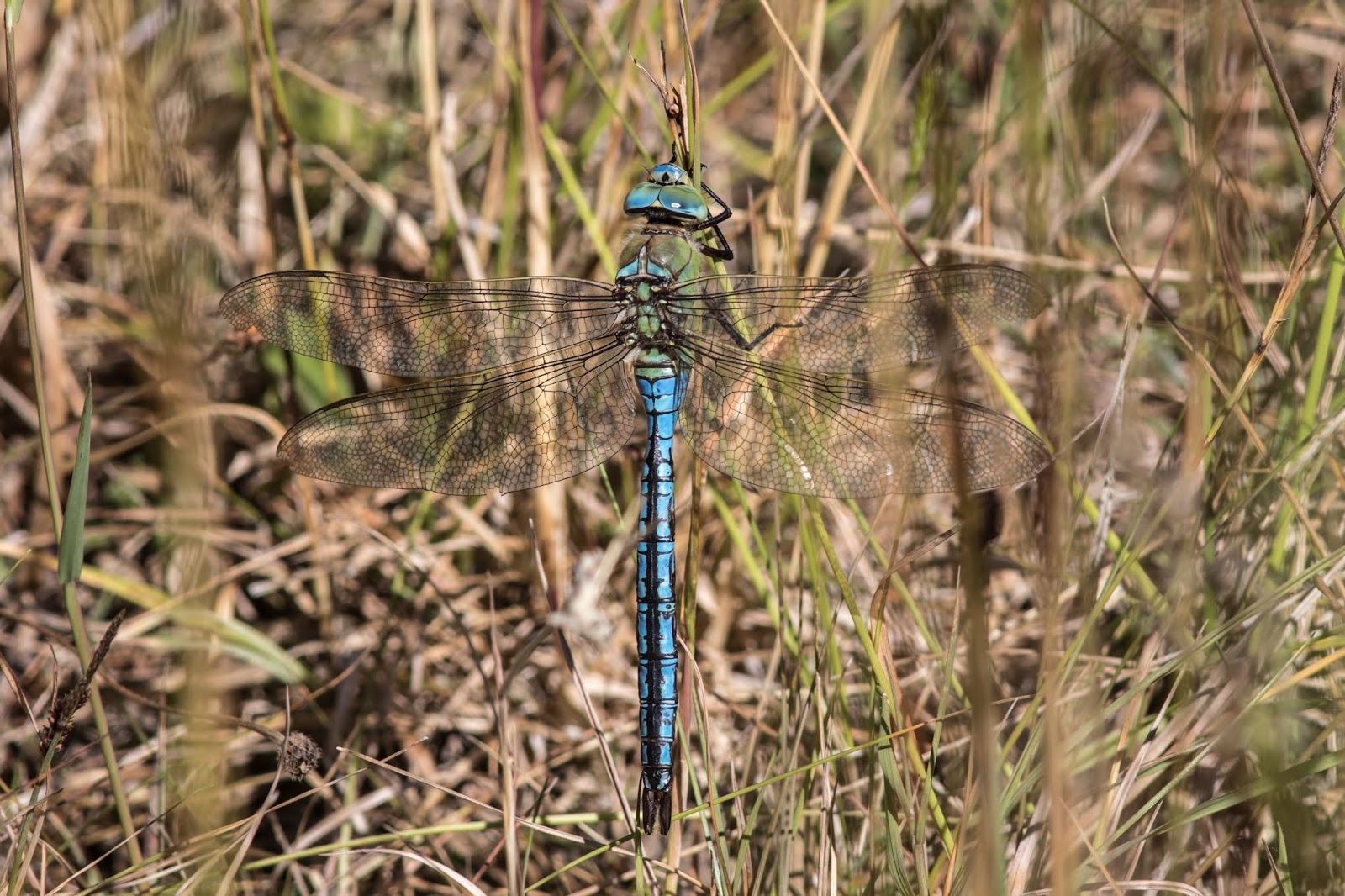
There have been more emperor dragonflies this year than I have seen before - possibly because numbers are increasing or perhaps because the weather suits them.  I tried some flight shots but they were a bit distant and so are heavily cropped.


I also saw several males at rest but haven't seen a female this week.


Four-spotted chasers are still chasing although some are now looking a bit faded and battered.


This week's damselflies were large red, common blue, blue-tailed, azure and emerald.  I also saw a male banded demoiselle but, despite running along the bank to follow it, I didn't get a photo because it stayed on the pond side of the reeds.  The male emeralds now have their mature blue colouring.


This mating pair of emeralds were interrupted by another male hoping to steal the female.


A new butterfly this week was a small skipper.  I expect there will be many more if the weather stays fine.


I saw a willow warbler hunting for spiders.  I have heard the young but not seen them.


Until next week...

Wednesday, 4 July 2018

White-legged damselfly

This is the white-legged damselfly (Platycnemis pennipes).  Superficially similar to other blue damselflies, it is distinguished by the white edges to its legs, brown wing spots, paired black marks on the abdomen, and a different pattern of stripes on the thorax.   It isn't found north of the Midlands so I saw these mature males on a recent trip south.    


This is an immature male with the same patterns as above but pale brown colouring.


Immature females have a similar pattern but mature from pale brown to pale green.


Because the white-legged damselfly is uncommon and rather localised, there are few reliable data on its distribution. The British Dragonfly Society is undertaking a special survey this year.

Monday, 2 July 2018

Spring-cleaning hornets


This was an unexpected find while I was looking for damselflies in Northamptonshire and led to me seeing more hornets in an hour than I have before in my life.  I had first noticed a tree bumblebee nest in a hole in an old wall and while I was watching a hornet came out of another hole 20cm lower down, carrying a mouthful of rubbish.  It was a worker and was presumably clearing out the nest hole in the wall to allow the colony to expand.  The hornet dumped the rubbish and turned and went back inside.


More rubbish followed.


Other hornets were coming and going.


I couldn't see whether returnees were carrying anything because they went inside too quickly.  I expect they were probably bringing back chewed wood pulp for nest building or prey for feeding larvae.


Hornets are very handsome insects and have amazing wrap-around C-shaped dark brown eyes.  (A common wasp's eyes are the same shape but are somehow less noticeable.)

Hornet numbers build up over the summer and peak in early autumn so I'll watch this nest with interest and expect to see more hornets each time I visit.

Until last week I thought hornets were confined to the southern half of the UK but, having seen one only 2km from here, I am hoping eventually to see them in my garden.