Melecta albifrons is a cuckoo bee, a cleptoparasite of last week's Bee of the Week, Anthophora plumipes. It is found in and around aggregations of nests of its host. The female flies or walks around the nest holes, looking for an unprotected nest in which to lay her eggs.
The male and female Melecta albifrons are almost indistinguishable in the field. This one is a male as it has 13 segments in its antennae (as opposed to 12 in a female). I think it was also newly emerged as its wings weren't quite fully expanded.
Being a cuckoo, the female doesn't collect pollen and therefore has no scopa (pollen brush) on her hind legs. All she does is drink nectar and lay eggs.
Most Melecta albifrons are black and white, as in the photos above, but a few are almost entirely black, as this one below. Melecta albifrons is also known as the common mourning bee.
Melecta albifrons is found in the southern half of the UK. These photos were all taken in Northamptonshire.
I got home the other day to find that a sparrowhawk had killed and eaten a woodpecker right outside the back door. The remains were pretty mangled (I've spared you the gory bits) so I couldn't even tell whether the victim was male or female. I also don't know whether it was one of the pair trying to set up home in the garden. There are several woodpeckers that visit the feeders every day and I can't tell which is which.
The other thing I've seen is that the second hole excavated by "my" woodpecker is now occupied by a starling. It is pretty hard to tell which bird is in which hole at the moment as things have mostly gone quiet, with the ownership battles having been settled, but it seems as though here isn't now a resident woodpecker here.
The first woodpecker hole was taken over by a pair of starlings but they also seem to have moved on. It is now the property of a tree sparrow but I think he has left it too late. I feel really sorry for him as he sits outside the hole calling for a mate all day. He has ended up in possession of prime real estate but all the females are already spoken for.
At one stage he did entice a female in for a quick look around.
For whatever reason things didn't work out for them and he was back to calling all day. He's still at it.
It is not all doom and gloom. A blackcap and a chiffchaff have started singing in the garden in the past week and I have had several interesting visitors to the feeders.
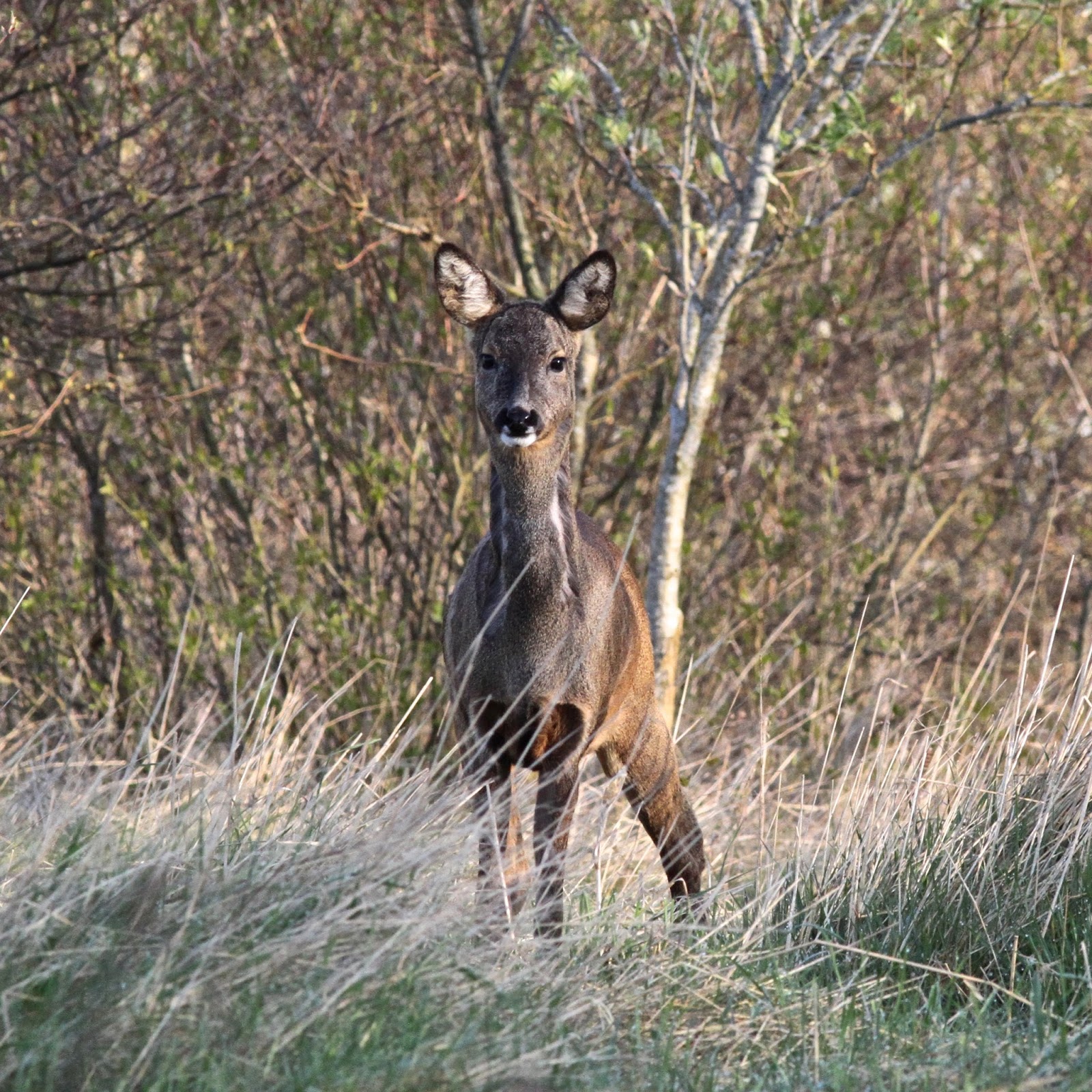
When I met this roe doe she didn't seem to know what to make of me. I was standing still and she was perhaps puzzled by the clicking of the camera. She kept turning round, as if to walk away, then turning back and taking a few steps forward.
At one stage a companion popped her head out as well but didn't stay long.
Eventually the doe decided I wasn't worth bothering with and sauntered off but even then she kept her eye on me. Looking at the times on the photos the whole thing lasted only three minutes. Usually when I see roe deer they are a long way off or running away. This encounter was enchanting.
I have found a spot where the badgers turn up every night. The deal is that they get the peanuts and I get the photos and they seem quite happy with that. Despite this I have never seen badger in these woods.
This bee is one of my favourites, the hairy-footed flower bee (Anthophora plumipes). It is named after the hairy middle feet of the male, shown well on these two collecting nectar from their favourite flowers, pulmonaria.
The male has a pale yellow face which is easy to see as he flies.
These guys were sheltering in a wall at Coton Manor in Northants on a cool cloudy day.
This one is showing his hairy middle legs.
The female hairy-footed flower bee is all black apart from an orange scopa (pollen-collecting brush) on each back leg. She doesn't have hairy feet.
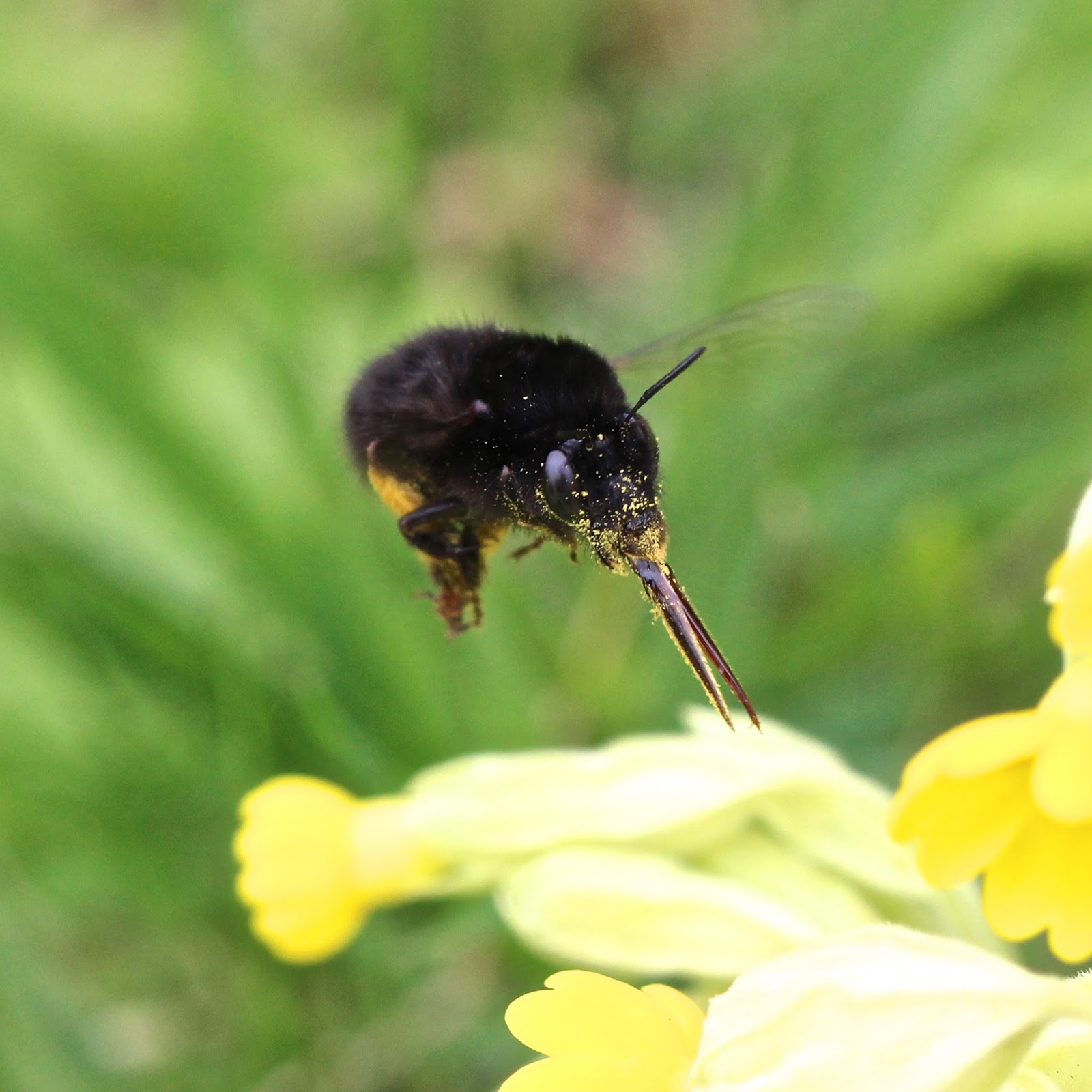
Bees of both sexes often fly with their proboscis extended when foraging for nectar.
This one shows well that the proboscis is made of two halves, like a split straw, and the true tongue is in the middle.
I have seen these bees mainly on pulmonaria or cowslips but this one was on peach blossom.
This one was foraging on pulmonaria and shows well the pollen marks of contact with the flower's anthers.
I also managed a photo of a mating pair.
Hairy-footed flower bees mainly nest in cob walls and old soft mortar in brick or stone walls. Although they are solitary bees, each female with her own nest hole, there can be several thousand in an aggregation, such as in this old cob wall in Nether Heyford, Northamptonshire.
Here are a couple of female bees emerging from their nests.
Anthophora plumipes is mainly found in the southern half of the UK, as shown on this BWARS map.
However, for the past few years there has been a population the The Alnwick Garden in Northumberland (just above the d of United on the map), where I took these photos this week. The female bee in the first photo has a big pollen load so her scopa is yellow.
You can find a BWARS (Bee, Wasp & Ant Recording Society) information leaflet on Anthophora plumipes here.