My Blog List

Saturday, 20 June 2020

The emperor and the empress


Here is something I haven't seen before.  I have seen lots of male emperor dragonflies and several females but until this morning I had never seen a mating pair.  They stayed in a mating wheel for 12 minutes, giving me plenty of time to take a few photos and a short video.  I also had time to experiment with different compositions and depths of field.  I think I prefer the shallow depth of field, the last of of these four which are at f/11, f/8, f/7.1 and f/4.


I tried a video with my Canon camera but with a 300mm lens it is too heavy for hand-held video.  This was shot on my little Panasonic TZ90.


Eventually they separated and the female flew off to powder her nose before getting down to the serious business of egg laying.  The male rested for a few minutes to get his breath back and then went back on patrol in the hope of striking up another liaison.

Thursday, 18 June 2020

TawnyOwlCam


This all began last week when I found an interesting feather on the lawn (you can see there isn't much grass in the lawn!).

It is a primary flight feather from a tawny owl.  A couple of days later I found another one.  The next night the trail camera was set to look at the foxes and there were two short recordings of what looked like a tawny owl catching worms.


On one of the clips of the dog fox you can also hear an owl in the background.


The following night I set four cameras on the lawn with no result (apart from foxes all over the place) but on the second night one of the cameras recorded this video.  The action is brief so I have added a slow motion replay.


It is interesting that the owl sits so still, presumably because it is listening.  Interesting as well that it looks hard at the camera.  Owls are said not to be able to see infrared light but the camera also clicks occasionally - whether this is something audible from outside, or just a fault on the audio track I don't know.  There was a following clip but the owl was too quick for the reaction time of the camera and all that was recorded was a couple of leaves stirring in the downdraught from the wings after it took off.

Tuesday, 16 June 2020

WoodpeckerCam


This past week the garden has been full of woodpeckers and there is nearly always one on the feeder.  To save me having to spend too much time trying to catch the right moment I set up a trail camera to watch them.  Eventually it picked up good examples of an adult feeding a youngster.


On the next video a jay has jumped up to have a look around (it is usually on the ground collecting fallen peanut chips). The woodpecker is wary and stops feeding to keep an eye on the jay.  You can hear a young woodpecker calling for food in the background.


The videos above were recorded on a Browning trail camera with a +1.25 dioptre lens, giving good focus on the fence post (0.9m away) and the feeder (2m away).  I also tried the Wingscapes BirdCam Pro.  Although this has an adjustable focus and was developed and marketed for taking video of "wildlife in your backyard" it doesn't do as well.  It can't cope as well with the bright/dark contrast and is generally less clear at this range.  The sound is also quite muted on this camera.  It did, however, pick up a few interesting clips.  Here is another example of an adult feeding a fledgling. You can see the problem with getting the young bird in the right place.


And here a youngster is fed by its father on the feeder.  It returns to the feeder a moment before a female lands on the other side.  This is not the mother and she gives it a swipe to knock it off.  The young bird returns to the fence post to see what went wrong and to think about what to do next.


A lot of that goes on.  There is competition between adults for access to the food, and between fledglings which often take a swipe at each other.  I have only occasionally seen an adult obviously accompanied by two youngsters at the same time and in that case they seem to get on well with each other.  Otherwise it is every woodpecker for himself.  To cope with the extra demand I have put up another peanut feeder.

Within the next week all the fledglings will be able to feed themselves so there will be less interest in the video and photography and I'll be able to concentrate on other things.  Fox cubs perhaps?

Sunday, 14 June 2020

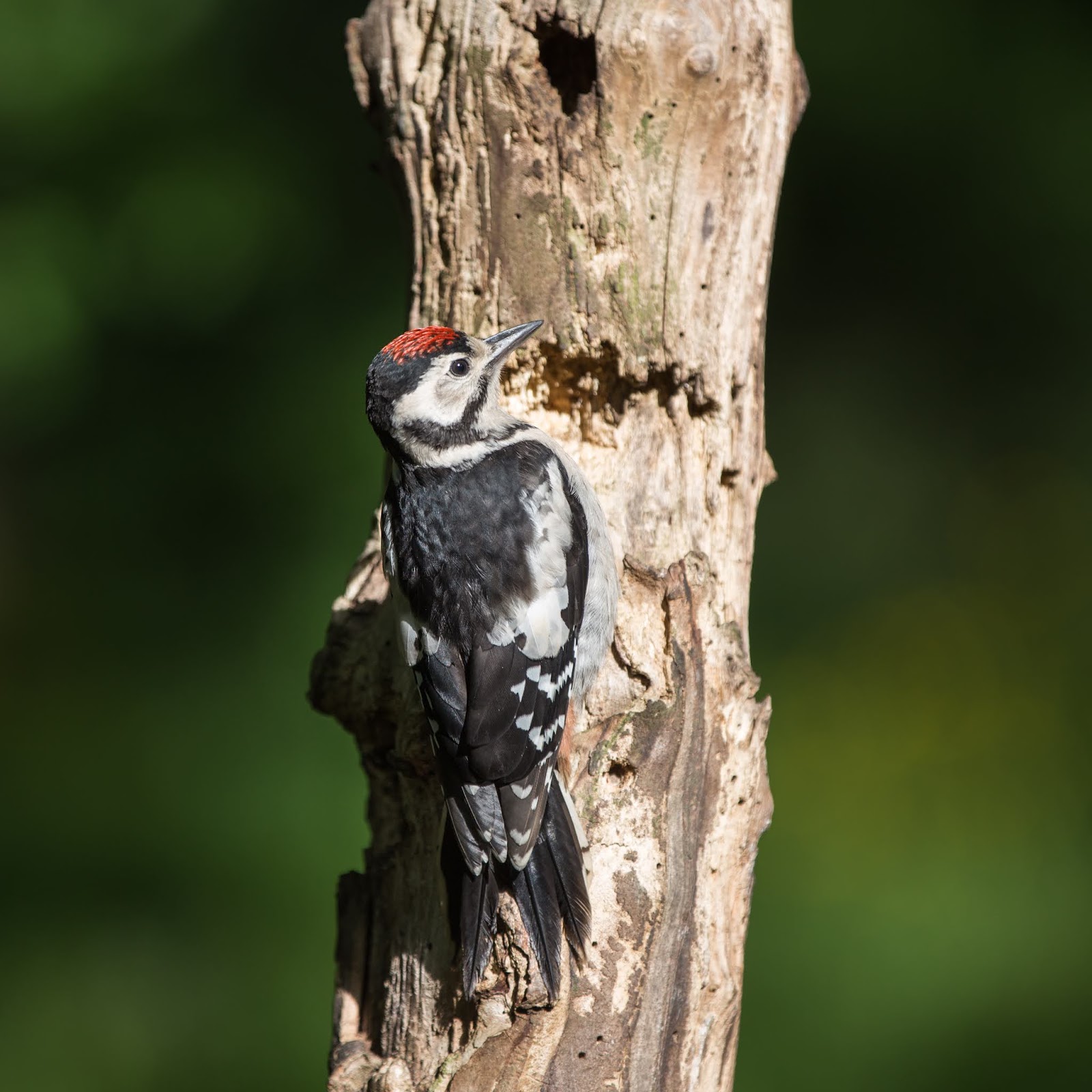
Juvenile woodpeckers


I look forward to the first week of June every year because it sees the arrival of newly-fledged woodpeckers in the garden.  This year I saw the first on 31st May but it has been difficult to get good photos, mainly because of the change in the weather making it dark under the trees.  I usually hear them first as they sit high in the trees calling for food while their parents collect it from the feeders.  Soon they are confident enough to come a bit nearer but they don't sit still, flitting off to a different spot just when I have the camera nicely lined up.  Within a couple of days they can feed themselves and the parents leave them to it.

I set up the (open) sitting room window as a hide with a photogenic old fence post outside and spent some time trying to get a few photos and videos.  The parents and the youngsters on their own are easy but getting them together and feeding is more of a challenge.  Here is a young bird being typically unto-operative, both with me and with its mother.

After several failed attempts the first success was a photo taken through the hinge of the window, not where I had hoped they would be at all.

Many times a fledgling would sit on the fence post but jump up into the tree before the parent brought the food.

Then eventually I got what I wanted.  A parent and a fledgling on the fence post together.


I have also been trying a few videos, partly because I already have plenty of photos and because video gives more insight into behaviour.  Here is a first attempt with the birds on the log feeder.  It caught me by surprise before I was properly set up - the video is too closely cropped, and is wobbly because I was holding the camera, and the crunching noise is from the polystyrene balls in the bean bag, and the fledgling was round the back of the feeder - but you can see the potential.


Here is a fledgling bouncing up and down with excitement but of course it flew up into a tree before the food arrived.


This is a bit better with feeding on the fence post.  Three examples although the first is still a bit wobbly and crunchy.


In the next video an adult bird brought food from the peanut feeder but then realised there were a few peanuts in the top of the post (I wonder how they got there?).  So it decided to use them but chopped them up before handing them over, interesting behaviour as it was making sure the food wasn't too big for the youngster to swallow.  The whole episode lasted more than five minutes but I have edited it down to just over one.


The adult birds have a pecking order - somehow a new arrival can tell whether to attack or to wait its turn and sometimes the bird on the feeder will leave as soon as it sees a more dominant bird has arrived.  The adults aren't too keen on other youngsters either.  This clip is another on the log feeder - an adult male gives way to a more dominant bird, leaving its fledgling behind, and the new bird (a female) realises the youngster is there and chases it away.


Video is harder than it looks.  There is usually a steady arrival of new fledglings over the first couple of weeks of June because not all broods fledge at the same time, so if the weather is better in the next day or two I may be able to get a bit more practice.  Within the next week all the youngsters will be able to feed themselves and there will be less excitement in the video and photography.

I have just noticed it is six years to the day since my first post on this blog.  In that time there have been 1169 posts (including this one), and the first one was on newly-fledged great spotted woodpeckers.

Friday, 12 June 2020

Badger cub progress

After watching quite a lot of videos from around the sett I think the clan comprises eight or so individuals with one breeding female and a dominant boar.  The two cubs are the only new arrivals this year.  Marc Baldwin's excellent website, Wildlife Online, says that other clan members take no part in raising the cubs, which fits in with what I have seen.  In fact until recently they have seemed reluctant to interact with the cubs, perhaps fearing the mother's reaction if they got too close (or perhaps having their tails pulled by the naughty cub).  Things have changed a bit recently and the cubs are becoming more integrated with the group.  On a dry warm evening most of the badgers sit near the sett entrance for a bit of social time before going their separate ways for the night's foraging and the cubs are now joining in.


The cubs still spend most of their time trailing round after their mother.  On a couple of occasions recently I have seen the mother snap at them for no obvious reason (was it something they said?).

The first time was at midday when this happened.

Three days later, at the same spot and almost the same time of day there was a very similar episode.

There seemed to be no hard feelings but from a human point of view it looks a bit harsh.  I am sure from the badgers' viewpoint it is just how things are.  Perhaps she is instilling a bit of discipline or reminding them of their place in the world.

It has been interesting how often the mother and cubs appear on the videos compared with the other clan members.  I think the reason is that mother hasn't gone far from the sett while the cubs have been small whereas other badgers are mostly seen only when they leave and return.  I expect that will change as mother takes the cubs farther afield.  The recent rain will also have been a relief for them, making earthworms easier to find.  The sett is quite a long way from any human activity and it has been striking how much they are out in the middle of the day when undisturbed.

Wednesday, 10 June 2020

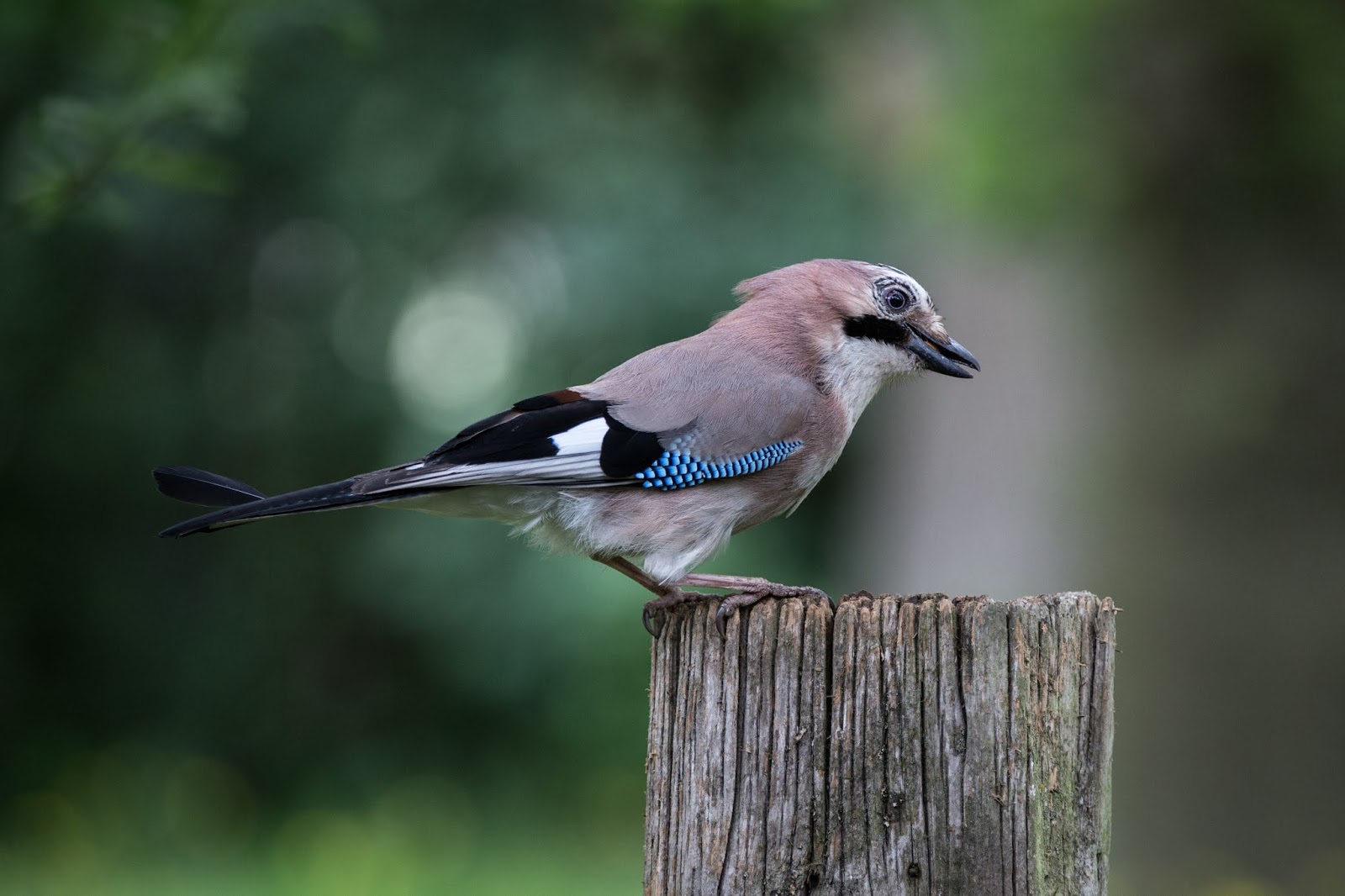
Jays in the garden


A pair of jays have been spending a lot of time in the garden.  One of them is usually to be found under the peanut feeder, waiting for a woodpecker to drop a shower of peanut fragments.  Even better is a whole peanut.


This is how a jay looks when all the peanuts have gone.

The jays had a nest in the top of a dead sycamore.  I didn't know it was there until I heard the commotion as it was attacked by a carrion crow.  I fear that the eggs or chicks didn't survive but at least the adults are still here.  The crows have been in my very bad books since I caught them chasing the sparrowhawk weeks ago and they know it.

Sunday, 7 June 2020

Mother springs a surprise on FoxCam

Trying to get video of the fox cubs on the trail cameras is very frustrating.  All four are still dashing around but they don't often appear together and don't produce many images worth posting.  This was an exception.  The camera struggles to cope with the high contrast in bright sunshine but I have adjusted it as much as I can and cropped it a bit so the image is not too bad. 


I generally prefer close-up images with the camera mounted low down for a more intimate view but that hasn't been a success with the foxes so I put the camera on a tree, without an additional lens, to get a wider view.  The parents rarely appear, probably because they know where the cameras are.  However, one day the vixen arrived at about 11am and as she turned round there was a surprise.


The day before at 1pm there were two cubs suckling.  The whole episode went on for over four minutes but I have cut it down to two.


The foxes' den is in an abandoned corner of the badger sett and although the badgers probably don't approve of their rather untidy neighbours they seem to get along OK.  I have occasionally seen the fox cubs sniffing round an entrance to the sett but only when there was no sign of a badger.  Here the vixen is exploring at 3 in the afternoon, apparently unaware of the camera and only a few minutes after mother badger had gone back inside.


I have also caught the dog fox on video once in the past couple of weeks.  He had one cub for company and brought out a dead crow for it to play with, although there was only this one clip.


The parents bring back food and leave it for the cubs to find and eat.  I have also seen a grey squirrel, a heron chick and another crow.  I expect the cubs are ranging farther afield now as they seem to be spending less and less time near my cameras.