The demoiselles are the only damselflies with coloured wings. The banded demoiselle (Calopteryx splendens) is found quite widely, including here in Northumberland, whereas the beautiful demoiselle (Calopteryx virgo) is found mostly west of a line from Kent to Cheshire. These pictures were taken on the River Nene in Northamptonshire near the ox hovel at Heyford Mill.
I first found a male banded demoiselle.
This is the female.
Then I found a few female beautiful demoiselles.
And finally a mature male beautiful demoiselle. He was very relaxed about me getting close with the macro lens. I hope he doesn't mind that his name in French means beautiful young lady!
Not many British birds have blue eyes but this young jackdaw is one. The eyes turn brown and then white as the bird gets older.
Yesterday I took a trip to the Farne Islands on Serenity II skippered by Andrew Douglas. One of many highlights was seeing the arctic terns (Sterna paradisaea).
This delicate-looking bird undertakes the world's longest migration, flying 25,000 miles a year to and from its "winter" home in the southern hemisphere although, of course, it experiences two summers each year. In the course of its lifetime it will cover well over half a million miles. Fifty per cent of birds live for more than 30 years.
Arctic terns mate for life and usually return to the same nesting ground year after year. They nest side-by-side with common terns on the Farne Islands. Some of the nests are on the footpath and are vigorously defended against visitors.
The female lays one or two eggs (sometimes three) and some have already hatched. The chicks are fed by the parents for a month but then have to learn to fish before leaving with their parents on migration.
Watch a BTO video on identification of arctic and common terns here. Listen to the BBC Radio 4 Tweet of the Day on arctic terns here.
The starling was my bird of the week a few weeks ago but I have been able to take a few more photos in the past few days.
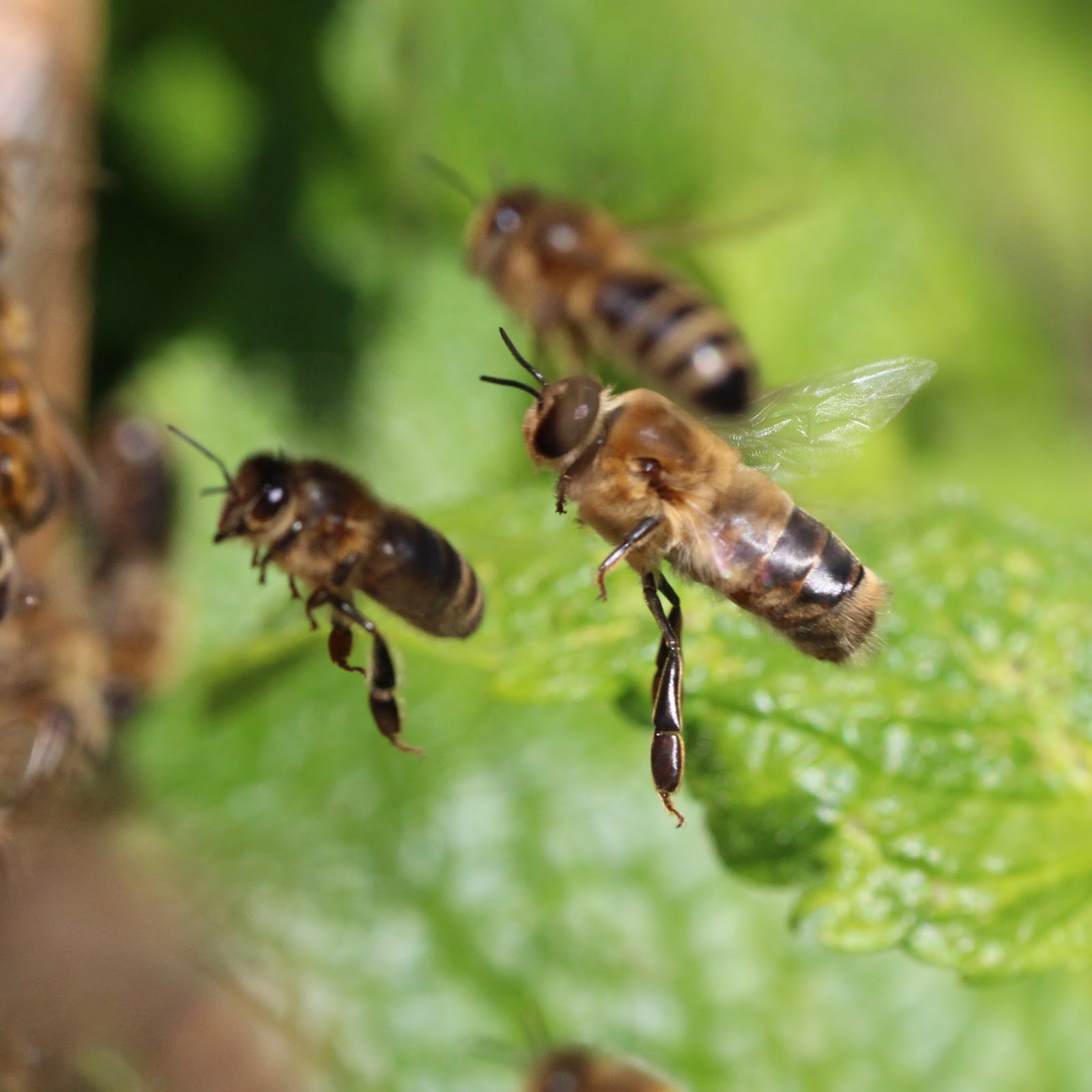
One of my hives has a lot of drones (male honey bees) and when the sun shone today they came out to fly. As there were so many I had a go at taking photos in flight. It is very hit and miss as the depth of field with the macro lens is very small. The light was good so I was using a shutter speed of 1/1000th and an ISO of 800. Nearly all the photos were rejects but one or two are not too bad.
This is a drone on the crown board (with the shadow of another one flying behind him).
Here are two drones showing their cylindrical body shape. The red mark is a propolis stain.
These photos each show a drone with a female worker for comparison - the drones are all on the left as we look. They are larger and have huge eyes.
Here are some in flight shots. The first two also show a worker for comparison. Drones make a louder and lower-pitched buzz than the workers.
Drones are strange looking things when you see them like this. Their legs look much longer in flight than they do in the hive. The last one is carrying a varroa mite on his back - the number one pest of honey bees. Drones will happily move from hive to hive so it is easy to see how the mites can be moved around.
Kittiwakes (Rissa tridactyla) normally nest on cliffs and rock faces but one famous colony has been nesting on and around the Tyne Bridge in Newcastle upon Tyne for more than 50 years. It has around 700 nesting pairs in the farthest inland kittiwake colony in the world, being around 10 miles from the sea.
The nests are made of seaweed and mud. Some of the nest have obviously been reused and added to over many years.
Some birds are still collecting nesting material, some are sitting on eggs and others already have chicks.
The kittiwake is a beautiful bird with a striking eye.
Most have black legs and feet.
But this one has brown.
Of course all the posh birds are on the Newcastle end of the bridge while the others are in Gateshead!
Watch the live feed from the kittiwake cam on the Baltic here. Listen to the BBC Radio 4 Tweet of the Day on kittiwakes here. Watch the BTO video on identification of kittiwakes and other small gulls here. Read more about kittiwakes here.