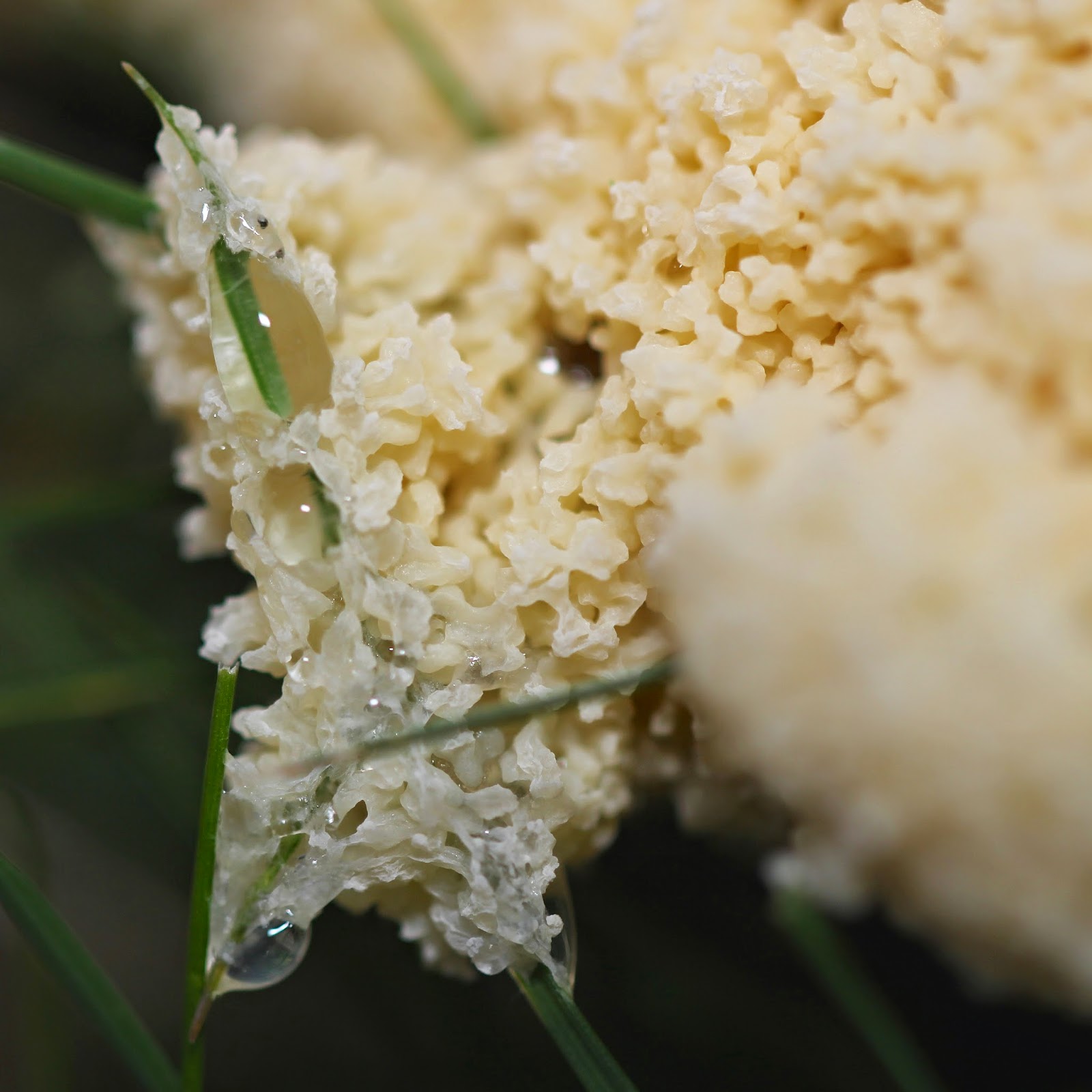
This is the many-headed slime mould, Muciturbo crustacea. It is a plasmodial slime mould and consists of a single membrane containing many millions of nuclei - essentially a giant single-celled organism. It spends most of its life as a protoplasmic mass underground engulfing bacteria, decaying plant matter and other tiny food particles. When food runs short the plasmodium will migrate to the surface and differentiate into its sporing stage. It emerges as a jelly-like plasmodial goo that develops into a more complex multi-branched form bearing spore-producing structures. The various stages of development can be seen in the pictures below - the largest example is 12-15 cm across. Many thanks to Phil & Denise for showing me this fascinating organism and allowing me to take and post the photos.
Seen on the Wannie Line Walk on the Wallington Estate. I'm not sure exactly what they are. The largest is about 15cm in diameter. Agaricus augustus and Agaricus sylvaticus seem the most likely possibilities. As far as I can see there isn't much difference between them. Both are edible but I didn't try.
One of my favourites. I haven't seen much of them during the summer but they seem to be everywhere this past week. I am not sure how many there are - it could be one manically hyperactive pair or several.
I noticed this tiny moth, as I thought, on the boot of the car. It turns out it is a moth fly, or owl midge, with the delightful latin name of Psychodidae. It has a wing span of about 5mm.
It has been a disappointing season for fungi in the garden, presumably because of the lack of rain. There have at least been some shaggy ink caps - Coprinus comatus - also known as lawyer's wig. "Comatus" comes from the latin "coma" meaning hairy, not unconscious.
Great tits and blue tits are my most frequent and numerous visitors. Coal tits seemed rare when I first moved in but have become much more common over the years, although they are more difficult to photograph than the others because they move so fast. High winds and low cloud haven't been good for photography this week but things improved enough for these photos.
I found this little monster hibernating inside a shirt in the wardrobe, fortunately before I put the shirt on. My mother will be the only one to notice that the shirt hasn't been ironed.