My Blog List

Friday, 11 August 2023

Wasps in the bee house

This year's new bee house has a space under the roof that I planned, in future years, to use as a release chamber.  In May I noticed a queen wasp had started to build a nest.  She flew in and out so quickly I wasn't able to get a photo of her or identify her.

Ten days later the nest looked like this.

After that I didn't take much notice, other than to dodge the wasps as they few in and out while I was photographing the bees and to think it was a small space for a wasp nest.  The nest grew to fill the space but then stopped.  A few days ago I saw a small male wasp walking about near the nest and was able to take some photos.


This is a male Saxon Wasp (Dolichovespula saxonica), an ID subsequently confirmed on Facebook.  The workers are usually on a mission but do occasionally stand about for a photo.
There has been a noticeable reduction in activity of the workers recently, suggesting that the colony is coming to the end of its life.


This worker is taking a drink from a raindrop at the entrance.

At the beginning of the week I saw my first queen.  She is bigger than the workers and much bigger than the male.  I watched her walking up and down the roof and I was concentrating so much on taking the photos that I didn't notice at first that she has no wings.  This poor wasp is doomed.

This photo shows the relative size of the queen and the male.

The next day this queen was sitting on a mint leaf directly below the nest, presumably having fallen out.


I haven't seen another queen but I expect there have been others flying out while I wasn't looking.  The males also liked to sit in the sun on the mint leaves.
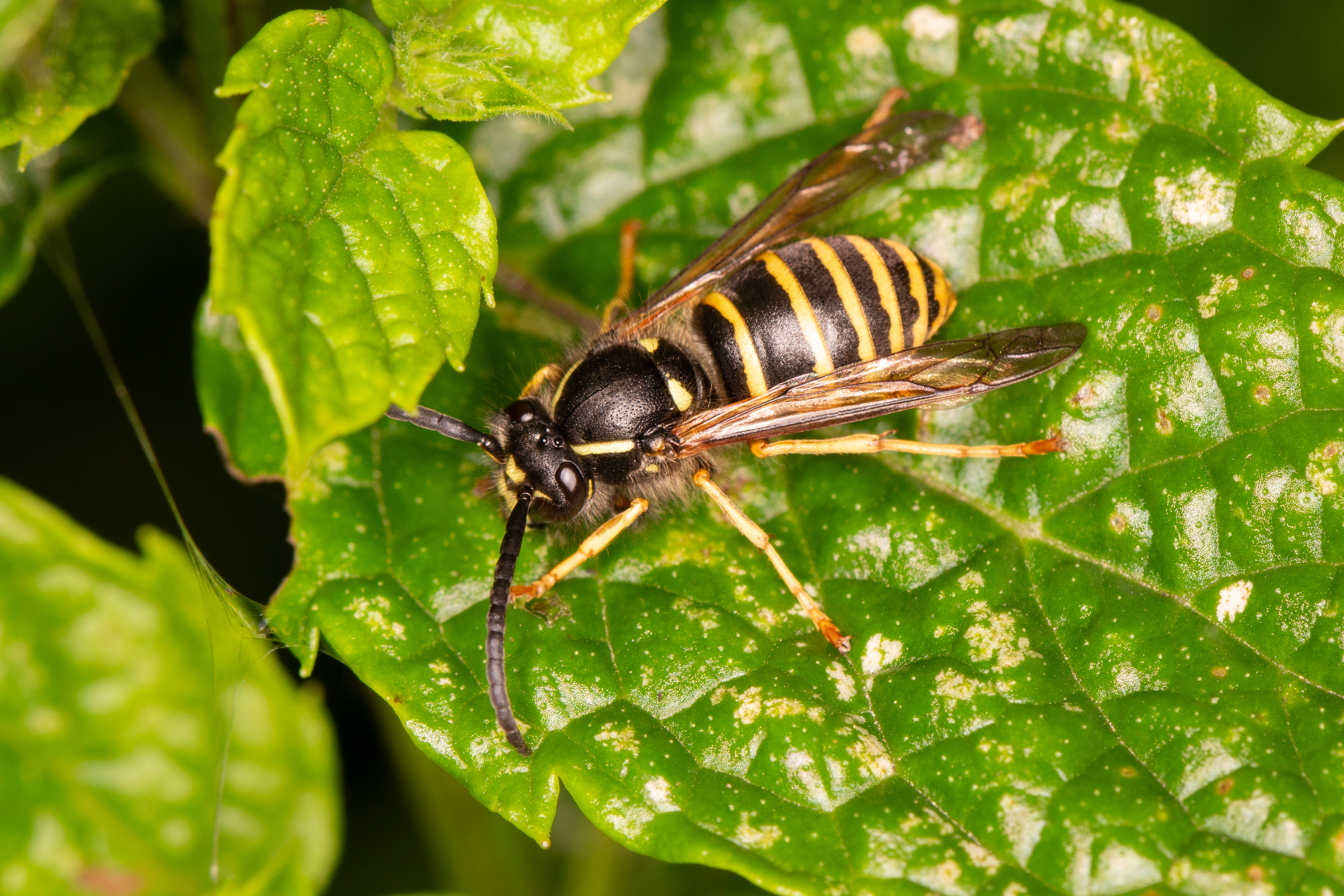
They spent a lot of time cleaning their antennae.

Saxon Wasps are recent arrivals from Europe, having been first recorded in South East England 36 years ago.  Since then they have spread and are now fairly widespread.  They build their nests in aerial locations, under roofs and in trees or sheds.  The nests are small and are usually empty by mid August.  When these are gone I plan to take off the roof of the bee house to see if I can remove the nest intact.

The severe wing deformity in the queen wasp is presumably due to deformed wing virus (DWV), which affects honey bees and gets noticed by beekeepers in beehives.  It also affects bumblebees and solitary bees (and obviously wasps) but usually doesn't get noticed because they can't fly.  DWV wasn't a problem in honey bees until the arrival of the ectoparasite Varroa destructor which is now almost universal.  DWV levels in honey bees are now many times higher and can lead to colony death.  There is concern that this will also lead to spill over into other hymenopteran species.  Social wasps could acquire the virus from contact with or predation on honey bees.

There is a much larger nest (presumably of a different social wasp) in the roof of my house, with over 100 wasps per minute going in and out.  I am keeping out of the way of that one but with luck I'll be able to remove it as well, although I'll wait until the winter when they have all gone.

Saturday, 5 August 2023

Weasily recognised


At last.  It is almost two years since I first set up my small mammal camera box, mainly in the hope of getting video of a weasel.  After a very brief early success there hasn't been another sighting, until now.  The box is sometimes here in the garden and at others is in the local nature reserve.

Earlier this week I set it up again in the garden and in the first three days weasels appeared on seven occasions.  In fact I think there were three different animals because weasels, like many mustelids, can be identified by the different patterns in their fur.

Here are the three in order of appearance.


My small mammal camera box is modelled on a Mostela, designed by Jeroen Mos and used for small mustelid research.  Previously I was using small Victorian clay land drain pipes as entrances but after reading some of Jeroen's research I changed to larger pipes and set the box on the boundary of my copse and meadow.

The first weasel appeared three days in a row.


The second one was larger and is easily identified from the pattern under its chin.  It came and went several times, crossing the box four times in the first clip and twice in the second.


The third weasel seemed a bit more timid and retreated without crossing the box as the others had done.  I have added a ¼ speed replay to the video.


Now I am wondering if there is a family of weasels in the garden so I shall set up more cameras to try to find out.

Tuesday, 1 August 2023

Mid summer dragonflies


Dragonflies like warm sunny days so they must have been disappointed with the last few weeks of cool, wet, windy weather.  The early summer was good with broad-bodied chasers staking out my new pond and plenty of damselflies to see elsewhere but things have been quieter since then.  Despite that, here are some of the things I have managed to see in July.

Large red damselfly ♂, coming to the end of its season.

Four-spotted chaser ♂, its season is also almost over.

Emperor dragonfly ♂, showing signs of wear.

Emperor dragonfly ♀, ovipositing.

Golden-ringed dragonfly ♂.

Blue-tailed damselflies ♂/♀.

Black-tailed skimmer ♂, sunbathing.

Southern hawker ♀, ovipositing in moss on the gabions.


Common hawker ♀, ovipositing in underwater foliage.


A teneral (newly emerged) common darter ♀.

The forecast doesn't look very dragonfly-friendly for the next couple of weeks but I am hoping for a better end to the summer with plenty of darters and hawkers to see.

Wednesday, 26 July 2023

Fun and games on OtterCam

Another first on OtterCam.  This is the first time I have seen two otters playing.  Five nights before I had several times seen one otter following another in and out of the water and could hear splashing off camera but this time they are play fighting. The whole episode lasted for 10 minutes but only fragments were captured on camera, partly because the otters were sometimes out of view and partly because Browning cameras (frustratingly) only record for 20s at night.


This is a dog otter and a female but I don't know the relationship between them.  In early May the mother of the previous cubs seemed to be encouraging attention from a dog otter.  If all went according to plan then I would have expected new cubs to be born about now, in which case she certainly wouldn't be playing or flirting.  It is also interesting that there is no vocalisation.  When the female was previously encouraging attention from the dog she was constantly chittering. This time we hear only splashing.  Here is the video.

Sunday, 23 July 2023

Purple rain

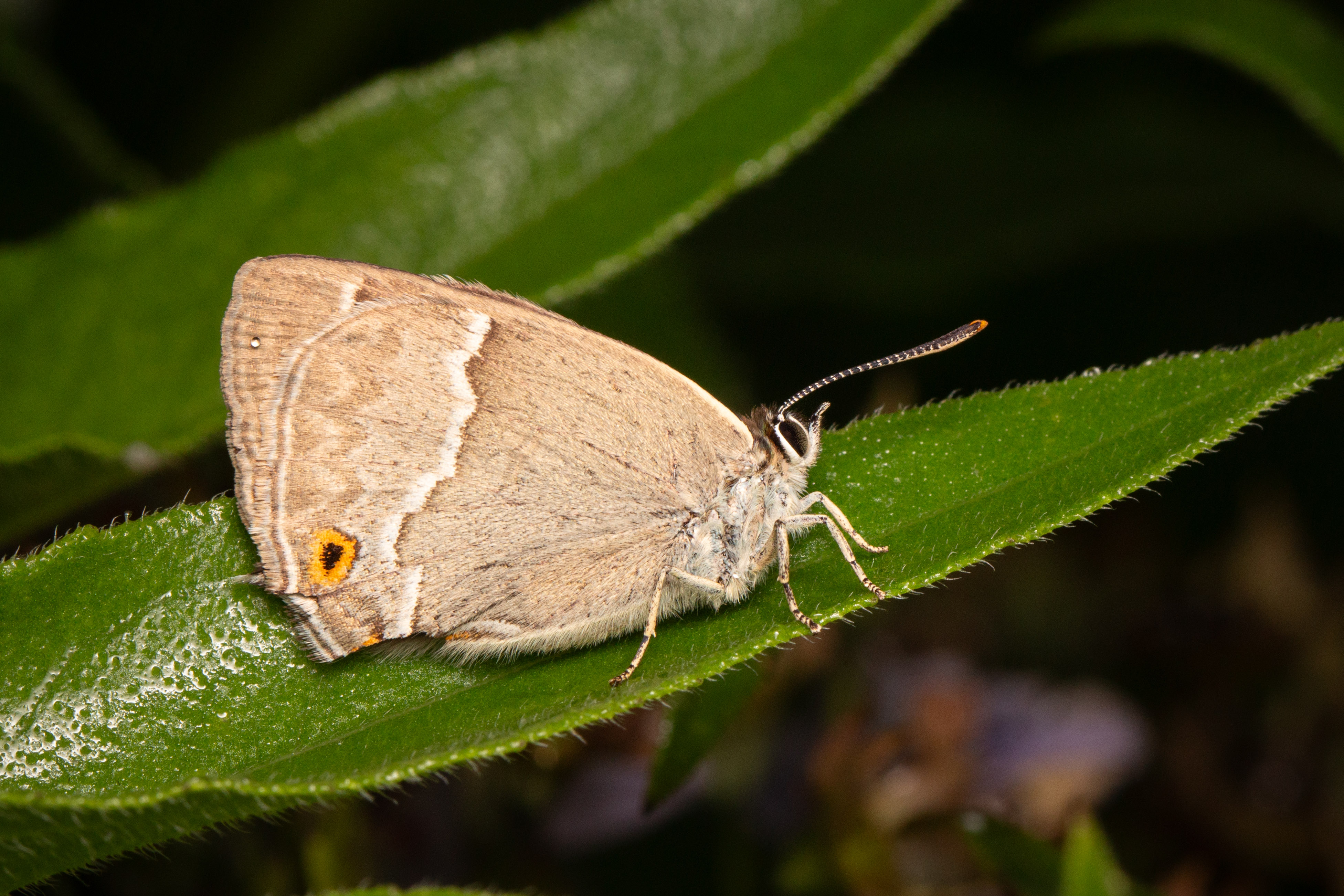
It has been a horribly wet weekend with almost non-stop rain.  When it eased slightly this afternoon I took my umbrella and went for a walk round the garden with my camera, hoping perhaps to find a few soggy bumblebees.  Instead I found a butterfly sitting on top of a sunflower leaf in the rain.  For a moment I didn't recognise it and then couldn't quite believe it was a purple hairstreak.

Having checked my photo against my field guide I brought the butterfly into the dry.  Unlike other hairstreaks, purple hairstreaks characteristically bask with their wings outspread but even indoors this one wasn't obliging.

To provide it with a bit of "sunshine" I brought out an anglepoise lamp and then it did open its wings to show it is a female, with iridescent patches on the forewings.

Perhaps attracted by the warmth it then flew into the hood of the lamp.

We agreed that wasn't a sensible place to stay so it obliged with a couple more photos before being released once the rain had eased.


Purple hairstreaks spend most of their time high in the canopy of mature oak trees (of which there are quite a few in the garden) so it isn't such a surprise to find one here.  However, because they feed on honeydew from aphids they rarely come down to ground level.  Now I know they are here I'll look for the males flying high in the trees on sunny afternoons (if we have any).