My plan to walk around the pond each week fell at the first hurdle, mainly because of the weather. However, I was only a day late and at least it wasn't raining. The ponds are very full after all the recent rain and have spread their margins. The swans look as though they have more or less finished building their nest in the reeds on the small pond but there are no eggs yet.
The Canada geese have a nest on a small island in the larger pond and the female is sitting on eggs.
There were several toads in the margins but I didn't see any toad spawn.
This one was trying not to blink in case I was a heron.
Some of the other birds I saw included yellowhammer,
woodcock, grey heron, chiffchaff, and a pair of little grebes. On the way in I also saw a brown hare but it was too quick for me to get a photo. Maybe next time.
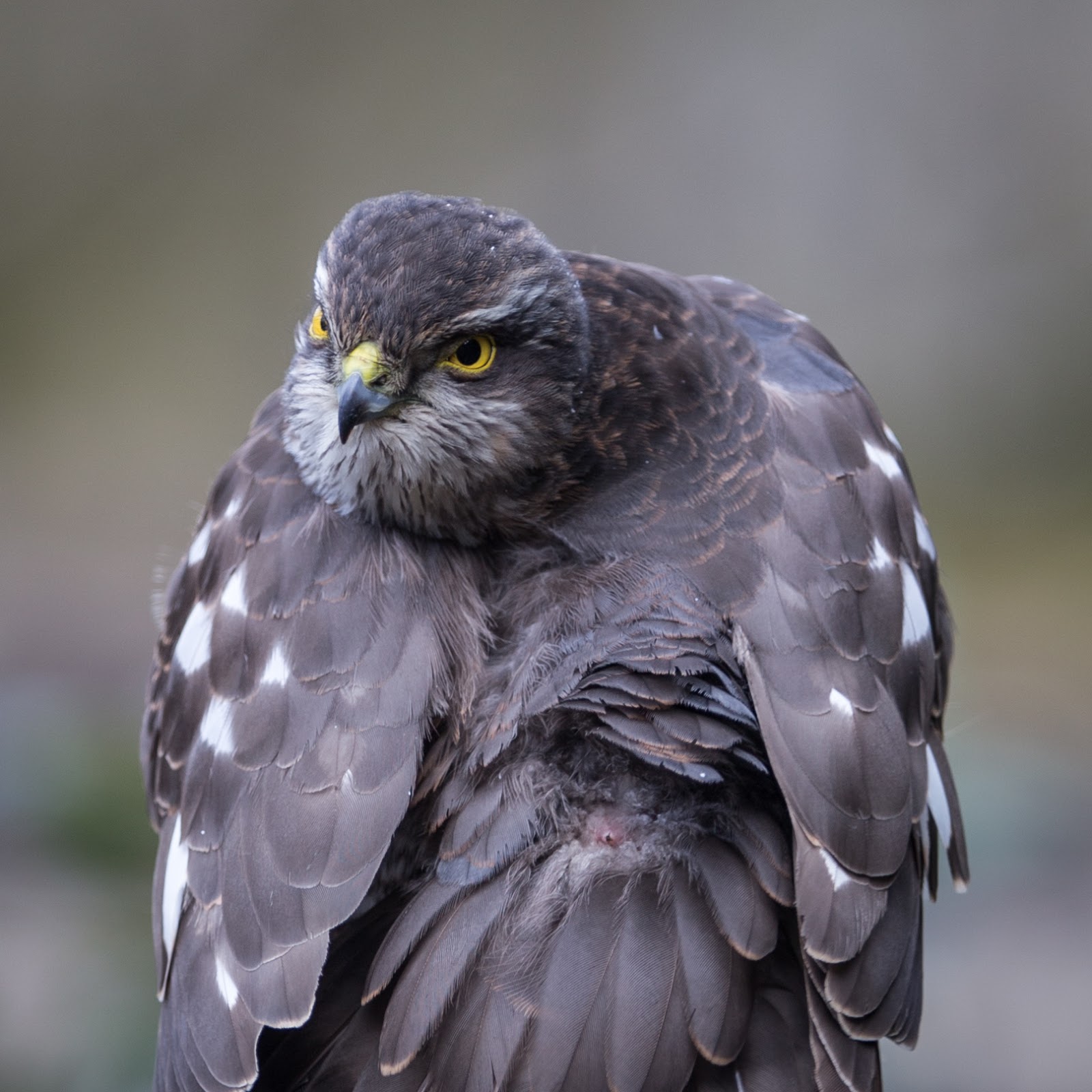
"My" sparrowhawk spends a lot of time looking after his feathers. He often visits the perch just to preen although he does also hunt from there. He particularly spends time preening after feeding, when he is not feeling hungry. He collects oil onto his billfrom the preen gland (uropygial gland) at the base of his tail and spreads it over his feathers.
Here you can see the papilla of the gland exposed.
This video shows what he gets up to. You can see him collecting the oil from the preen gland. The oil maintains feather integrity and probably also has a waterproofing and antiparasitic effect.
The function of the uropygial gland was first described by Frederick II, Holy Roman Emperor, in De Arte Venandi Cum Avibus in the 13th century. He thought the oil also contained venom which was spread on the claws to help kill the bird's prey, although that has since been shown not to be the case.
The sparrowhawk often sits like this with his tail spread if his feathers are wet after rain.
He won't have his first moult until later this year so keeping his feathers in perfect condition helps him in hunting and improves his chances of survival. Only 34% of young sparrowhawks survive their first year. This one seems to be doing OK so far.
I recently posted photos of the sparrowhawk in snow, in rain and in sunshine. This time when I spotted him he was already eating a great tit just outside the window. While he was eating it began to hail. He tried to tough it out but eventually the hail was so heavy that he grabbed his dinner and flew off to find shelter.
The weather has been pretty dreadful recently, making life difficult for bees, owls, etc and delaying spring for most things that live outside. It is forecast to improve from tomorrow. Let's hope so.
The blue tits have been coming into the camera box for the last eight weeks but work on building the nest started only this afternoon. They have been checking out the box regularly, although I obviously can't be sure it has always been the same pair. Most of the time I have seen the female but sometimes the male comes in first and calls to his mate. When she comes in he leaves so quickly that it has been very difficult to catch them both on a still frame.
Here they both are on video. The female has been spending a minute or more each time checking out the box.
I am surprised she chose today to start building as it has been so wet and I thought she would wait for a dry day. This is the equal latest start day for nest building in the camera box. This photo shows the first few strands of nest material.
Once there is more material the female will start to fashion the cup of the nest at the back of the box by doing a circular dance while fluttering her outstretched wings. It was interesting to see her doing that today, even though there is hardly anything in the nest so far.
The box went up in 2009 and had blue tits in every year from 2010-2016. In the first year it had great tits and last year I put on a 32mm entrance plate and the box had tree sparrows. Although they were great to see, videoing the sparrows was very difficult because of the construction of their nest so I reduced the entrance plate to 25mm this year and I now have blue tits again. I have records of the date of the start of nest building for 4 of the previous 5 blue tit nests and it varied between 09 March and 04 April, presumably influenced mainly by the weather. This has been a miserably cold wet spring and this is presumably why they have waited so long this year. First laying dates have varied from 23 April to 10 May with clutches of 2 to 11 eggs. The later the first egg the smaller the clutch so I expect this won't be a record year. In the 7 years of blue tit nests altogether there were 43 eggs, of which 42 hatched and all 42 fledged, so productivity has been high. Data from the BTO Nest Record Scheme show that blue tis have been laying their eggs earlier over the past 50 years but there is very wide year to year variation (depending on the weather). My local laying dates have been about three days later than the national average. (01 April is day 91 so these are around 20 April - early May.)
More BTO data show that clutch sizes have been getting smaller,
and the number of fledglings per breeding attempt has fallen slightly,
but overall the blue tit population is doing OK.
As in previous years I will document day to day progress on a separate "Nestbox camera 2018" page accessed via a tab at the top of the blog, with occasional updates on the home page here. I just hope these two blue tits will evade the sparrowhawk.
Last Thursday I made my first trip of the year to the Spetchells at Prudhoe (an artificial chalk landscape produced by the waste from a WW2 ICI fertiliser factory). It is home to a variety of locally rare plants and insects and is a marvellous place for solitary bees. I chose a sunny calm morning but the weather has been pretty cold recently so there were very few bees about. The very first I saw was a mating pair of buffish mining bees (Andrena nigroaenea).
I was a bit surprised to see a female out so early as the males are first to emerge. This is her after they separated.
And this is the male.
I saw half a dozen other males but no other females.
Andrena nigroaenea is one of the first mining bees to emerge in the spring. I expect there will be many more next time I visit.
Forgive me for posting a few more photos of the sparrowhawk. He has been coming to the garden nearly every day recently and now that the days are longer he is more often in sunshine (when we have any that is). This time he had just made an unsuccessful attack and landed on top of the hedge very close to the window. He was inside the closest focus distance on my lens (2.5m) so I had to move the camera back to be able to focus on him. He stayed there for a couple of minutes before returning to the perch to continue watching and waiting. He looks pretty fierce close up.