Widely distributed and instantly recognisable, the mute swan (Cygnus olor) is Britain's largest waterbird. Males and females are net always easy to tell apart.
The male is heavier with a thicker neck and a larger black knob at the base of his bill in the breeding season - he's standing on the left in the photo below.
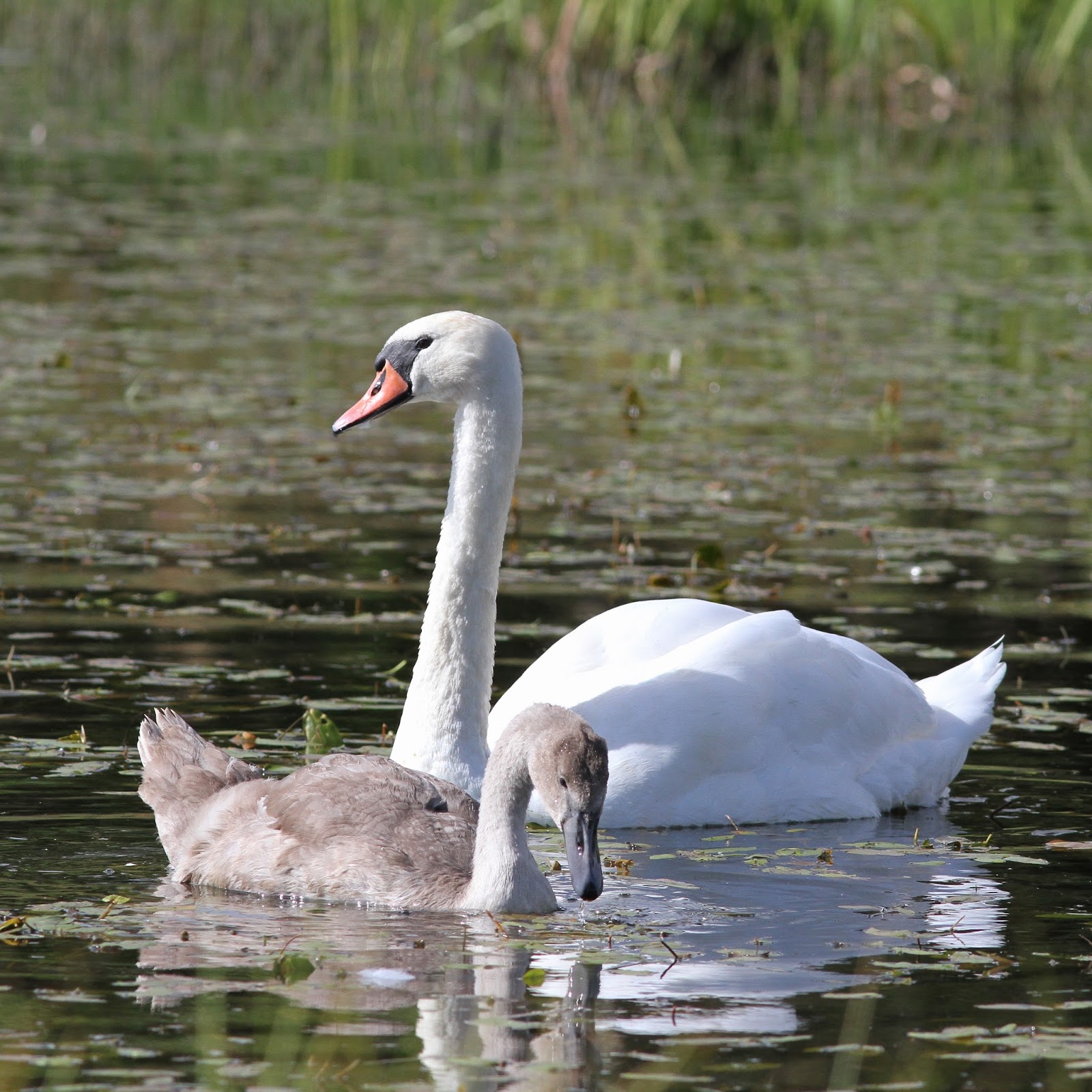
The pair on Banks' pond this year had two cygnets but in the past two weeks I have seen only one. Not surprisingly, there is always at least one parent on guard.
The pair in Gosforth Park have been resident for a few years and this year have seven cygnets. Recently another pair has moved in and the resident male hasn't been able to shift them. There is a power struggle going on with lots of displaying and chasing by the resident male. His mate tries to keep the young out of the way.
Mute swans are never far from water and occur all across lowland areas of the British Isles.
Their numbers in the UK are increasing, thanks mainly to the banning of lead in fishermen's weights.
The mute swan is native to many parts of Europe and western Asia. It was introduced to the USA in the 19th century and has become a pest in some areas there.
By Cephas (Own work) [GFDL (http://www.gnu.org/copyleft/fdl.html) or CC BY-SA 3.0 (http://creativecommons.org/licenses/by-sa/3.0)], via Wikimedia Commons
Thomas Bewick knew the mute swan also as the Tame Swan, as opposed to the Wild Swan which we know as the whooper swan (Cygnus cygnus). Bewick's swan (Cygnus bewickii) was not recognised and named until 1830, by William Yarrell. Below is Bewick's engraving for his A History of British Birds, volume II, published in 1832.
Despite their name, mute swans are not mute. They make a variety of grunting sounds (listen here) and hiss threateningly if you venture too close. The cygnets make a frequent squeaking call. The most recognisable mute swan sound is the musical throbbing of their wing beats as they pass overhead. You can listen to a mute swan taking off and flying here. You can listen to Chris Packham's BBC Radio 4 Tweet of the Day on mute swan here.