Taking advantage of the warm weather last week but they'll be hibernating soon. Part of the name Gonepteryx rhamnii comes from the fact that the caterpillars feed on buckthorn (Rhamnus). Their amazing long tongues can be used for both deep and open flowers.
Unfortunately not Norfolk Hawkers but these are a few shots of male Migrant Hawkers at Wicken Fen, Cambridgeshire and Titchwell Marsh, Norfolk last week.
Field grasshopper (Chorthippus brunneus)
This is the first hornet I have seen in a long time. It was hunting around the flowers at high speed so presenting a very difficult target for photography but I managed a couple of half decent shots. Photos taken at Coton, Northants.
Eventually it caught a honey bee. I'm not sure why it chose that one as it had flown past dozens of other without attacking.
The European hornet (Vespa crabro) is large social wasp with a life cycle similar to the common wasp (Vespa vulgaris). It eats insects such as bees, moths and wasps but is not a major predator of honey bees. The Asian hornet (Vespa velutina) was accidentally introduced to France from China in 2004 and is a very serious threat to honey bees. It has become a major concern for French beekeepers but has not yet reached the UK. Several recent hysterical newspaper reports all mistake a scary-looking but harmless giant wood wasp or horntail (Urocerus gigas) for an Asian hornet.
The highest tide of the year, last Friday.
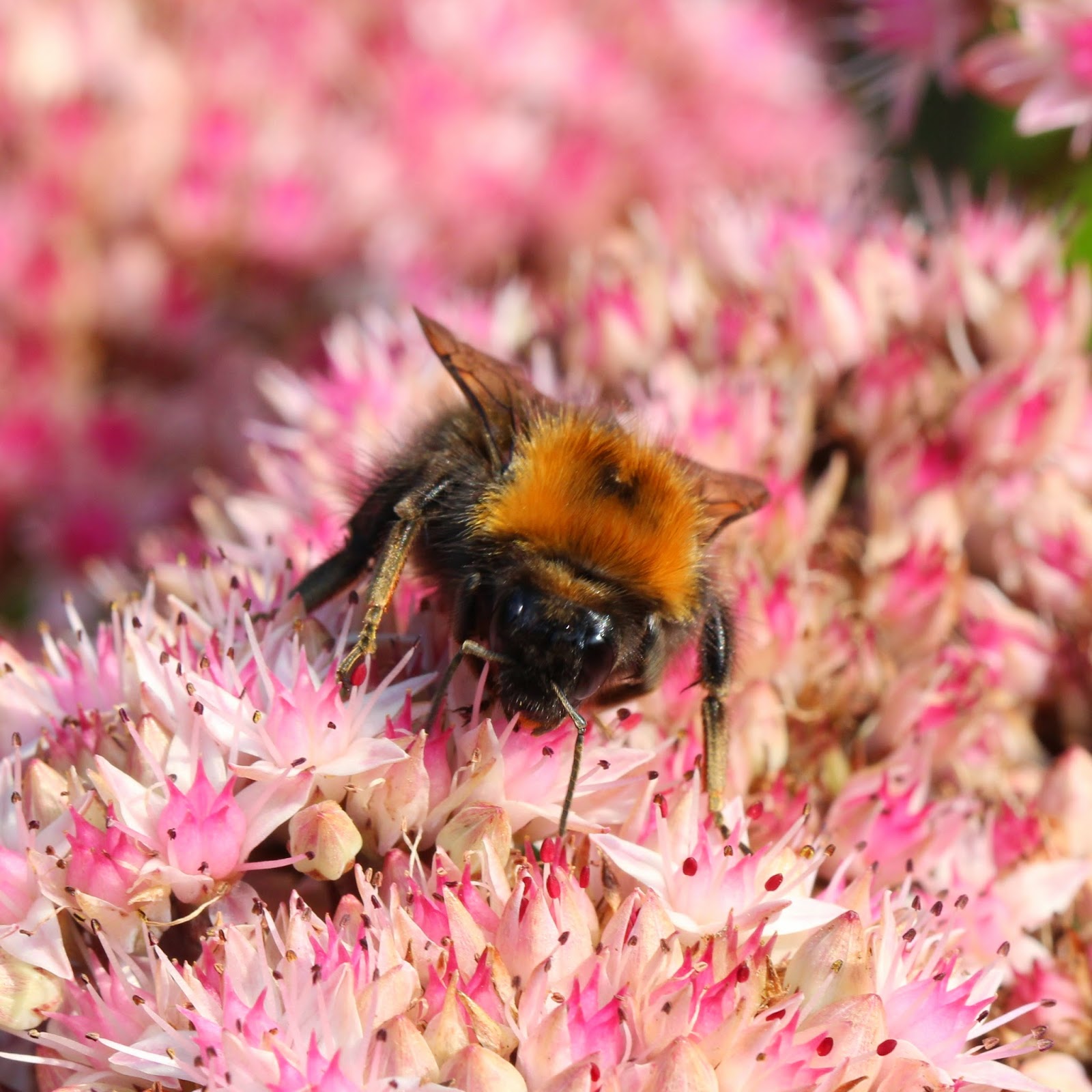
Most tree bumblebees have now disappeared but some are still around, new queens fattening up for the winter hibernation.
Bombus hypnorum was first recorded in England in 2001 and had arrived in the North East by 2009. It has also reached Iceland so is obviously a very successful coloniser.
This photo was taken earlier in the year and shows a worker pollinating my raspberries.
Tree bumblebees naturally make their nests in holes in trees but are also very happy to take over bird boxes.
Click here to read more about this fascinating bee.