My Blog List

Showing posts with label Ruby-tailed wasp. Show all posts

Thursday, 18 July 2024

A ruby-tailed burglar

Parasites seem to be dominant over hosts in the bee house this year.  I watched a mason wasp putting the finishing touches to her nest, blocking up the entrance with mud.

I wasn't the only watcher.  There were several ruby-tailed wasps waiting around.  They are cuckoo wasps and lay their eggs in the nest of other solitary wasps.


One in particular taking a close interest in what was going on.

Eventually the mason wasp was satisfied and after a last look round she flew away.

Within a few minutes the ruby-tailed wasp had returned to the nest and started to chew out the mud seal.

It took 25 minutes of chewing.

You can see her ovipositor is extended ready for action.

Then she suddenly turned around to lay her own egg in the nest.

That took only a few moments and she was off, perhaps to seek another victim.

As I understand it, the mason wasp lays a series of eggs in different cells along the length of the nest, separated by mud wall in the same was a a mason bee so I presume the ruby-tailed wasp, with a short ovipositor, can only parasitise the front cell.  I hope I'll be watching to see what emerges next year.

PS.  The photos are attracting a lot of attention on Facebook.  The experts on the BWARS page say the mason wasp is Symmorphus bifasciatus and the ruby-tailed wasp is likely to be Chrysis angustula.

Monday, 22 August 2022

More news from the bee house

A third species of bee has moved into my new bee house this summer.  After the red mason bees and a blue mason bee, two female common yellow-face bees (Hylaeus communis) built their nests in 4mm holes.  These bees are tiny, around 6mm long, and are black and shiny rather than hairy because they carry pollen in a crop, not on their bodies like most bees.  The cell walls in the nest are made of a waterproof cellophane-like material, secreted from the bee's Dufour's gland (close to the sting) and applied with its tongue.

I first noticed them on 12th July but both were already hard at work so they must have begun a few days before.  Here is one of them with one cell complete and busy marking out the next one. (For an explanation of the mud wall at the back see below.)

Here is the other one, marking out cell walls with cellophane.

The next day I found another Hylaeus communis nest in the old bee house.  All the holes there are 8mm and must seem cavernous for this tiny bee.  She had also been hard at work for several days and was stacking her cells on top of and beside each other.

Each cell contains a porridge of pollen and nectar to sustain the growing larva.  Here you can see an egg in the front cell.  The egg is quite big compared with the size of the bee.

Here the eggs have hatched and the larvae are already well grown.


Here is the bee in the old bee house, hard at work on another cell wall.
  
She eventually ran out of steam (or eggs) after building about a dozen cells but sat around for a long time afterwards, tinkering with the last cell wall.  I last saw her on 10th August, over a month after she arrived.


A few days before the Hylaeus bees arrived something else (presumably a couple of solitary wasps) had built a few nest cells in the 4mm holes and then disappeared before the nests were complete.  The cells were separated by mud walls and provisioned with tiny paralysed grubs but I never saw what had put them there.  This is on the west side, with red mason nests above and below.


And this is on the east with what I presume is a tiny egg on the window in each cell.

A third wasp nest has only three completed cells but was sealed with mud at the entrance so that wasp thought its work was complete.  Only a couple of the wasp cells look viable but it will be interesting to see what emerges next summer.  Whatever it is may have to wait until the Hylaeus bees emerge as they are blocking the exit.

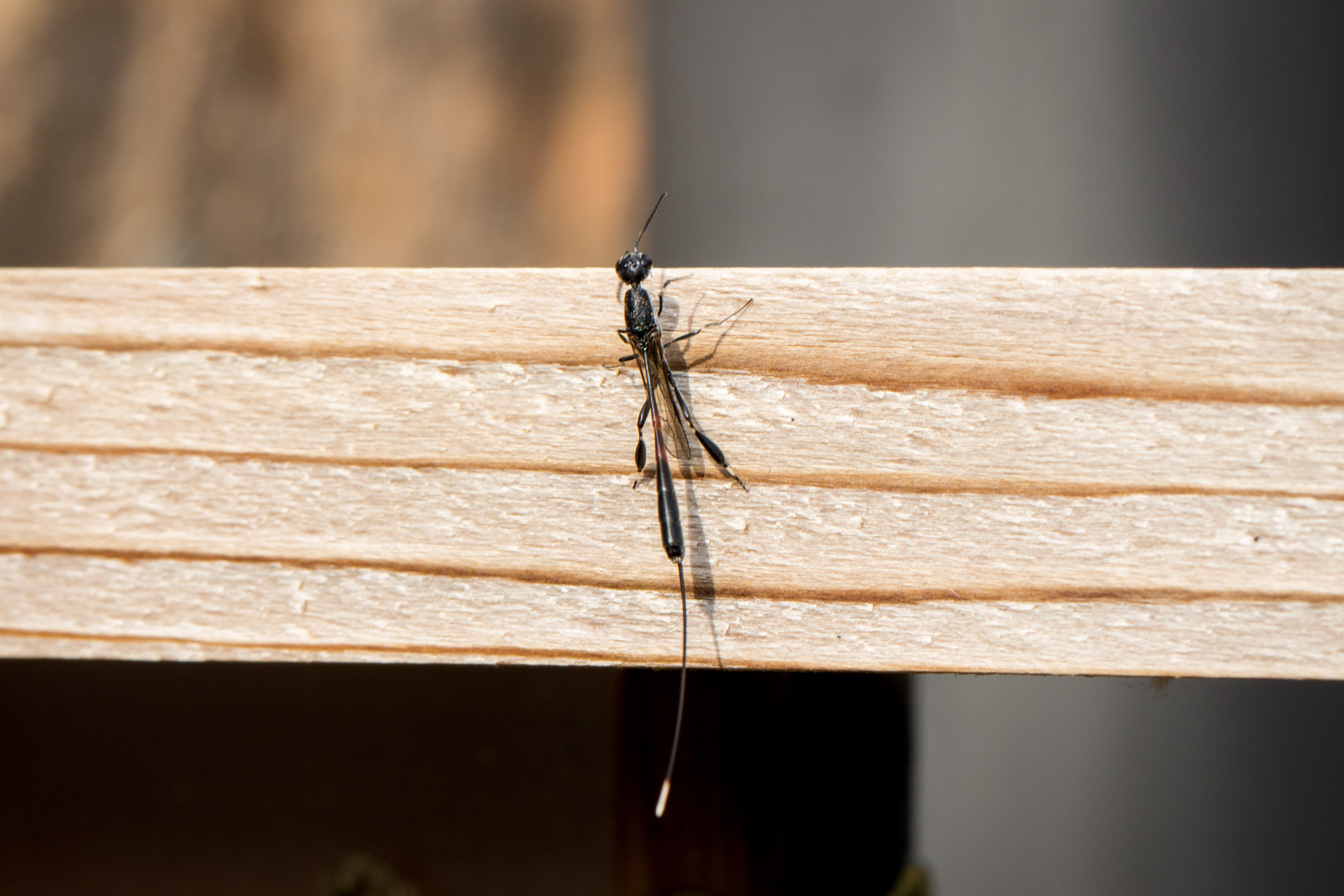
Solitary bees and wasps are targets for all sorts of parasitoids.  I noticed this female parasitoid wasp, Gasteruption jaculator, sniffing around but didn't see it enter any of the nests.


And this is a kleptoparasitic ruby-tailed wasp, Chrysis spp.

I already have plans for another bee house for next year, offering even more luxurious accommodation for all sorts of solitary bees and wasps. 

Friday, 26 June 2020

Ruby-tailed wasp


I see these little wasps quite often on sunny days at this time of year.  They are very small and move fast so they are difficult to photograph but even they stop for breath occasionally.  This is a ruby-tailed wasp, probably Chrysis ignita, the commonest of several similar species.  It has a shiny exoskeleton as armour and even the female has no sting.


The ruby-tailed wasp is a kleptoparasite, laying its eggs in the nests of solitary wasps, particularly Ancistrocerus spp. While I was watching it I saw what I think is an Ancistrocerus wasp, the host species.


Ruby-tailed wasps also parasitise solitary bees.  I saw one near the leafcutter bee nest a couple of weeks ago but it took no interest in the nest.

Friday, 5 August 2016

Ruby-tailed wasp

Two views of a ruby-tailed wasp I found in the greenhouse. It is a parasite of solitary wasps and bees, laying its eggs in their nests.  There are several similar Chrysis species, not easy to tell apart from a photo.  The generic name comes from the Greek meaning "gold-embroidered dress".  I think this one has 13 segments to the antennae and is therefore a male.

Thursday, 25 June 2015

Ruby-tailed wasp

The first time I saw this tiny jewel-like wasp was when talking to Peter a couple of weeks ago by the gate to Banks' Pond.  It was only there for a moment and didn't keep still so I didn't get any useful photos.  This time when I stopped by on the off chance it (or another one) was there again, and it sat still for long enough to have its photo taken.


Ruby-tailed wasps are cuckoo wasps, parasites or kleptoparasites of solitary wasps and solitary bees - that is their larvae eat the larvae of the hosts or their food supply.  Chrysis ignita is the most common species but there are several others that are very similar.  It has an armoured body as protection against the defences of the host.  It parasitises mason bees and leaf-cutter bees as well as some solitary wasps.  On the same gate I saw this bee, a leaf-cutter I think but I haven't yet identified it - possibly Megachile centuncularis or M. versicolor.  It may well be the host species.