My Blog List

Monday, 26 February 2024

My 2023 Yearbook

My 2023 Yearbook of wildlife photography has just been published.  You won't be surprised that there are plenty of pine marten and ladybird photos.  You can view the free online version here.


Tuesday, 20 February 2024

Southern wood ants


I have never photographed an ant before - I fear this may be the start of a new interest.  I met these in Harlestone Firs, a place I haven't been to for 50 years.  When I was very young it was somewhere I visited frequently for walks and bike rides and I remember from then the giant anthills under the fir trees.

This is the Southern Wood Ant, Formica rufa, also known as the Red Wood Ant.  Last week the anthill was covered with dead leaves and was mostly dormant but I found three worker ants wandering about the surface.  Probably because it wasn't very warm, they didn't move very quickly and paused frequently, which was a help in taking the photos.


Ants are the most highly evolved of the Hymenoptera (sawflies, wasps, bees and ants).  Formica ants are polygynous (with up to 100 queens in one colony) and with 100,000 - 400,000 workers in one hill.  They eat mostly honeydew from aphids but will also prey on caterpillars and spiders. Unlike honey bees, whose colonies remain active all winter with honey stores, I read that ants hibernate in winter and the colonies are dormant.  I presume they become active again once there is food available.  I plan to revisit these in the spring to see what they are up to and to take more photos.

Also on the anthill were a Devil's Coach-horse (Ocypus olens), which declined a photo, and a common pill millipede (Glomeris marginata) which I don't think I have ever seen before.  Despite being a millipede it has only 36 legs, although this one wasn't prepared to show any of them.

Thursday, 15 February 2024

OtterCam in February


I hadn't planned to post otters again so soon but the photo above has been attracting a lot of attention in various Facebook groups so I thought it only fair to share it here.  The picture of the dog otter is a frame grab from a trail camera video, good enough quality to look OK on phones and laptops.  I think it is helped by the fact that the otter stood very still for a fraction of a second and the light was good.  And as usual the camera had an extra +0.5 dioptre lens.  A freeze-frame gives a much clearer view of his whiskers and webbed feet than the video, especially the uploaded version on YouTube and Facebook.  Click on the photo for a closer look.  Here are three more photos from the same video.


And here is the video.  He is a very powerful-looking animal.

Sunday, 11 February 2024

News from WeaselCam


I have been running two camera boxes in the garden for the past few months to keep an eye on weasels and whatever else makes an appearance.  There were 12 weasel sightings in December, only one in January and so far there have been three in February.  On one morning last week one camera recorded an American grey squirrel, a weasel and a stoat all within two hours. The sighting of the stoat was frustratingly brief as it was too quick for the camera.  It only captured this frame of the tail.

The fascinating thing is that it shows partial ermine colouration with a white tail.  In northern regions some stoats turn white in winter, retaining just a black tail tip, although this far north (55°N) the change is more often partial.  We can't see the rest of this one but it is obviously mostly still brown.  Below is how it (or another one) looked in early December.

Here is the weasel from the same box.

And here's the squirrel!

Weasels usually explore the box rather than just running through and very often return more than once during the same recording.  I wish stoats did the same - perhaps I need a bigger box and a bigger pipe.  This weasel activity was all recorded within two minutes although I have edited out the gaps.


The day after the stoat appeared in the box I saw it
 from the kitchen window, just outside the box. I was willing it to go in again but instead it ran right across the lawn towards me with something in its mouth, presumably prey.  With luck it will stick around and I'll be able to post more pictures.

Monday, 5 February 2024

Winter ladybirds


A year ago I learnt that winter is the best time to look for ladybirds and that graveyards are one of the best places to look.  This winter I have been regularly popping into cemeteries and churchyards, armed with a torch and a camera.  Here are a few of the ladybirds I have seen.

This is a red bimaculata form of 10-spot Ladybird in a small crevice in a gravestone in Jesmond.

This is a black bimaculata form of 10-spot Ladybird on an adjacent gravestone.

When I went back a week later to get a better photo of the red one the black one had joined it.

And a month later the red one had disappeared and been replaced by a Cream-spot Ladybird.

I have seen several other interesting variations of 10-spot Ladybird but they are often tucked away making it difficult to get a good photo. 


Two Pine Ladybirds with different markings.


Pine Ladybirds are not the only black ladybirds with four red spots.  Here is a Pine Ladybird at the top with two quadrimaculata forms of 2-spot Ladybird.

And an unusual 2-spot Ladybird, f. bar annulata.

Most ladybirds at this time of year are immobile but I found a Larch Ladybird wandering round on a gravestone in the sunshine at Slaley, a first for me.  I have yet to find one in a larch tree.

An Eyed Ladybird, the largest UK species.

Here are a few more, not on gravestones.  A Harlequin 
Ladybird.

An Orange Ladybird.

A 7-spot Ladybird.

A 10-spot Ladybird, f. decempustulata.

And my favourite recent ladybird photo, two Water Ladybirds.

Having been to several churchyards and cemeteries that have no ladybirds I am gradually learning where they are more likely to be.  Even then it is a bit unpredictable.  Dinnington churchyard had none a year ago but four species when I returned this winter.  I'll keep looking.

Sunday, 28 January 2024

OtterCam in January


Otters live in a world it is difficult for us to imagine.  Apart from the cubs being with their mother, otters live mostly solitary lives.  Their sense of smell is very acute and they communicate by leaving spraint, urine or anal jelly to advertise their presence and condition.  The cubs are already doing the same.  There are popular scent-marking spots in front of my cameras, at the water's edge and up the bank.  In the first video the mother led the cubs up the bank, sniffing as they went.  When they returned the mother left a message, as did one of the cubs a little lower down.  Three hours later the dog otter turned up to sniff the messages intently before leaving his own.  (The flickering light is caused by a failing battery in another camera in the tree on the right.)  Another two hours later, in daylight, mother and one cub went by, sniffing and scent-marking again.


It is hard enough at the best of times to decide where to put the trail cameras but once the lake freezes it becomes even more hit-and-miss.  This next video is a case of what might have been, with most of the action frustratingly out of shot.  It starts at the end of the video above - the female otter came down the bank with one cub, both looking wonderfully warm and fluffy in the cold.  The mother then caught a fish in a hole in the ice, just out of view.  She gave it to the cub to eat, just after the second one came rushing down.  It's a bit fragmented but I have pieced together what I can of the action.


It is interesting that one cub is already becoming very independent, often lagging behind.  If my calculations are correct the cubs are about 29 weeks old in these videos so they still have a lot to learn and will be with their mother for some while yet.  I'll keep trying to point the cameras in the right directions.

Sunday, 21 January 2024

A wasp nest in the roof


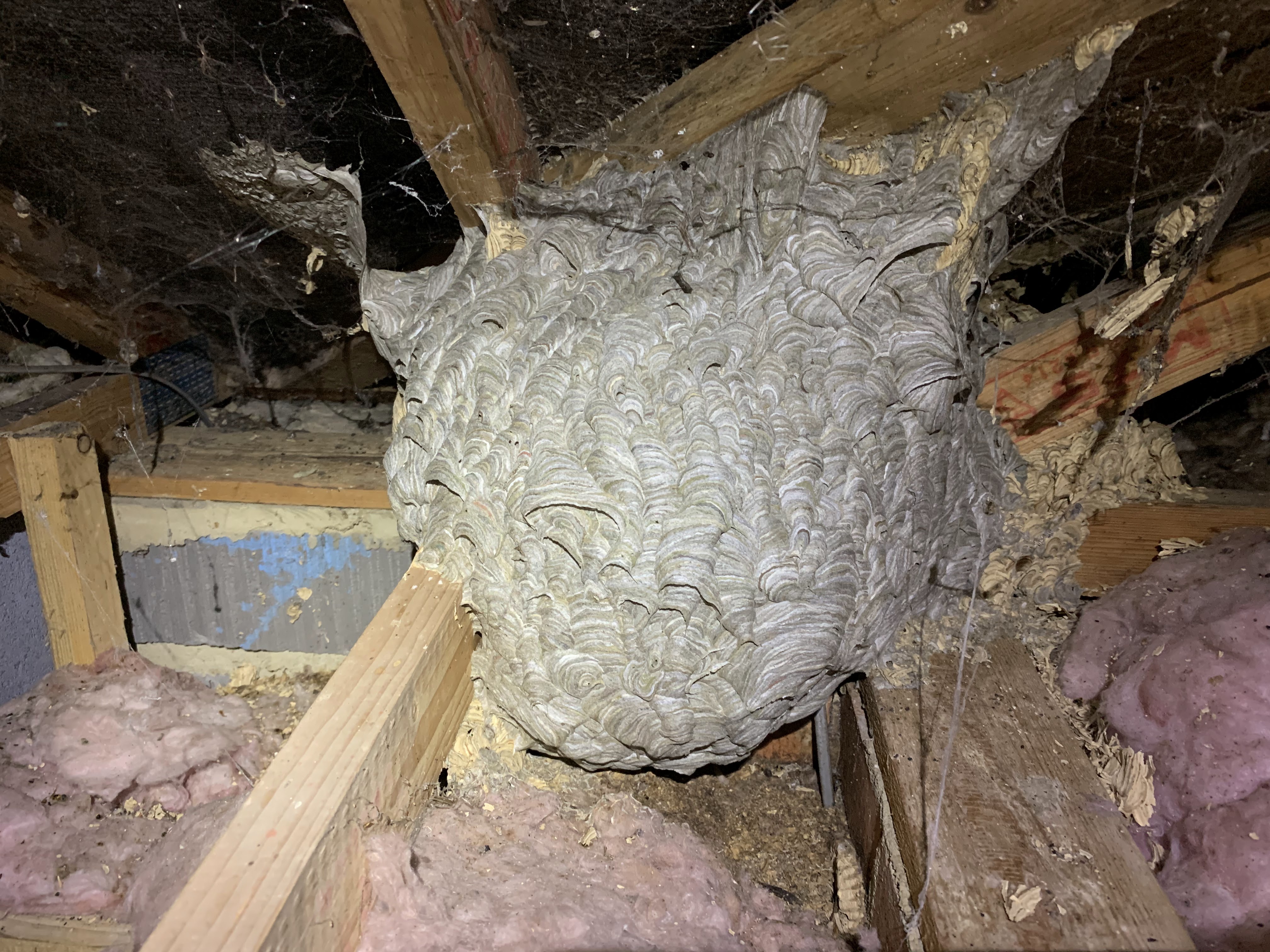
All summer and autumn there were wasps flying in under the eaves, often more than 100 per minute, so I knew the nest would be big.  Because a few wasps were still active in early December I waited until after a cold snap before going up to investigate.  My roof is low and cramped and the nest was built around the rafters so it wasn't going to come out in one piece. This is how it looked before I started.

This is the outer insulation layer.  You can see here how at one point the wasps must have changed to a different source of wood.  I think the grey comes from my shed!

This shows a bit of the comb before I removed the main body of the nest.

And this is what it looks like once it is out, all made of paper.  The combs are single-sided and horizontal with the cells opening downwards.  This was a big nest with eight storeys of comb.


The comb is surrounded by a thick layer of very fragile insulation.


There were a few dead wasps and from looking at them I think they are common wasps (Vespula vulgaris).   The nest would be a success if it produced only a couple of queens surviving the winter to found new colonies next season.  It seems an enormous enterprise to achieve that, compared with the Saxon wasps (Dolichovespula saxonica) that were in the roof of my bee house in the summer.